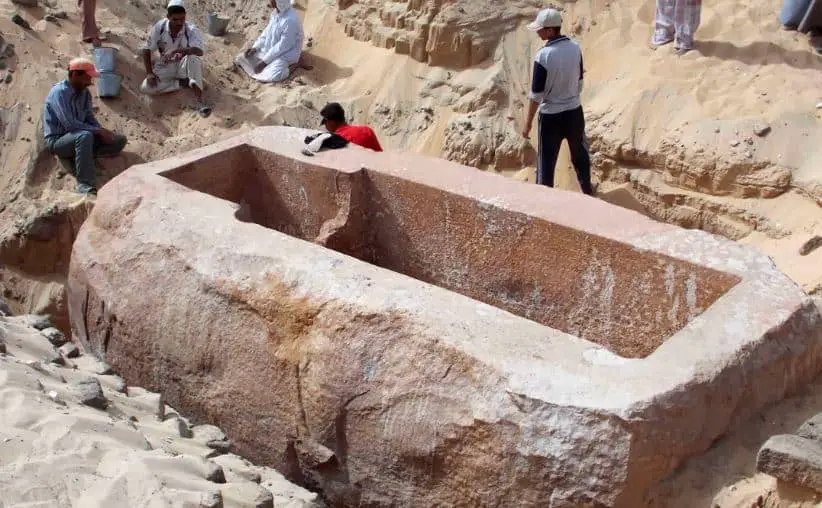
Archaeologists from the University of Pennsylvania have uncovered the tomb of Sobekhotep I, a pharaoh of Egypt’s 13th Dynasty, at the ancient site of Abydos, located around 300 miles south of Cairo. The find, made in 2025, included a massive 60-ton red quartzite sarcophagus, which was identified as belonging to Sobekhotep I after the discovery of inscribed stele fragments bearing his cartouche and depiction. The limestone tomb, originally capped by a now-lost pyramid, contained funerary items such as canopic jars intended to preserve the pharaoh’s viscera and several gold artifacts. This tomb marks one of the rare 13th Dynasty royal burials found outside the traditionally known necropolises near Cairo.
This discovery is significant due to the historically obscure nature of the 13th Dynasty, which is poorly documented and loosely dated, with the start of the dynasty estimated between 1803 and 1781 B.C. Egyptologists have long debated the exact order and length of reigns during this time. Sobekhotep I’s reign is approximated to have lasted around three to four and a half years, though this depends on different interpretations of sources like the Turin King List and scholarly assessments. Prior evidence of Sobekhotep I mostly came from reliefs in Abydos, with limited direct archaeological context. The find at Abydos, which includes the sarcophagus and associated funerary items, offers valuable physical evidence that may clarify the pharaoh’s reign and provide insight into the early second intermediate period when Egypt’s political landscape was fragmented. Similar efforts to locate and identify tombs from this era have occasionally surfaced in nearby royal cemeteries, but this intact find contributes substantially to understanding a dynasty long clouded by uncertainty.
Source: Ancient Code