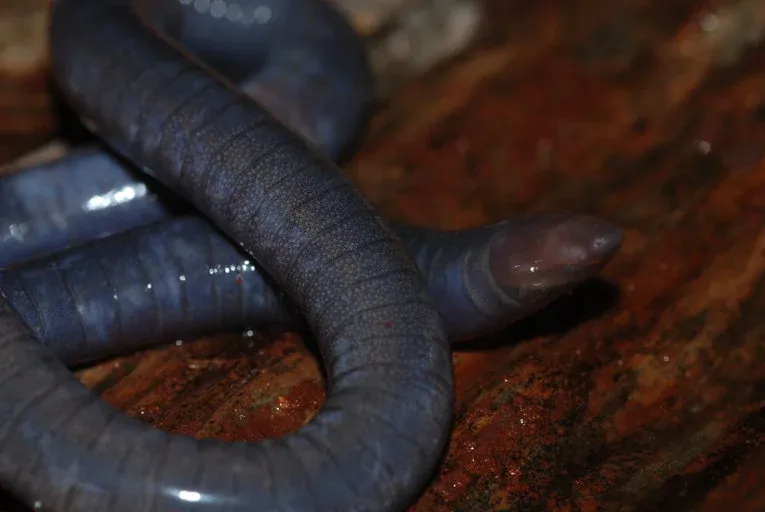
Dr. Karl Shuker has re-examined the mulilo, a cryptid reportedly found in the regions of present-day Democratic Republic of Congo and Zambia. Based on a forgotten 1940 Empire Review article and his own 1997 publication, Shuker describes the mulilo as a large, coal-black, slug-like creature around six feet long and over one foot wide. Indigenous beliefs attribute deadly poisonous breath to the beast, which is said to appear only when rainbows rest on the hillsides. Despite its folkloric nature, some natives reportedly wear pieces of blackened flesh believed to come from mulilo as fertility charms, adding a tangible dimension to the creature’s mythos.
The original description suggests that locals use a cage trap baited with a live cockerel to capture the mulilo, relying on the absence of the rooster’s crow as a sign of success. However, no scientific identification or verifiable evidence of the creature has emerged since these early reports. Shuker hypothesizes that the mulilo may be a melanistic variant of a large snake, such as an African python, whose unusual dark coloration and foul breath might have inspired local myths. He stresses the need for additional information and encourages readers with new data to contribute to the discussion.
The mulilo demonstrates how indigenous interpretations of rare or aberrant animals can evolve into cryptid legends, reflecting broader patterns in global folklore where exceptional specimens are categorized as distinct creatures. This phenomenon highlights the complex interplay between cultural beliefs and biological reality, emphasizing the challenges of identifying cryptids within scientific frameworks. The mulilo, as part of Central African mythology, also underscores the importance of preserving and investigating local knowledge when studying cryptozoological subjects, contributing to the wider discourse on how human perception shapes the understanding of natural world anomalies.
Source: ShukerNature