Contents
- Cold War Context: A Nuclear Frontline
- Night One: December 26 — Into the Forest
- Penniston's Encounter: The Structured Object
- Night Three: Colonel Halt's Recorded Encounter
- The Halt Memorandum
- Debunking the Debunkers
- Aftermath: Health, Careers and Silence
- The Unanswered Questions
- Primary Documents & Supporting Media
- Cold War UFO Case Files Series
- FAQ
In the closing days of December 1980, something entered the airspace above the Suffolk coast that the United States Air Force could not identify, could not intercept, and has never officially explained. Over three nights, trained military personnel at one of NATO's most sensitive Cold War installations encountered a phenomenon that left physical traces in the ground, generated a formal memorandum to the British Ministry of Defence, and produced a real-time audio recording that remains one of the most extraordinary primary documents in the history of UAP research. Nearly half a century later, the Rendlesham Forest incident stands not merely as Britain's most significant military UFO case, but as one of the most thoroughly documented and least satisfactorily explained encounters in the global record.
What distinguishes Rendlesham from the vast majority of UAP reports is the quality of what survived it. The Halt memo exists. The tape exists. The witness testimony — from officers whose careers, reputations, and in some cases health were affected by what they experienced — has remained substantially consistent across decades of scrutiny. The physical evidence, though limited, was documented at the time. And the strategic context of the base — its connection to NATO's nuclear posture — lends the incident a dimension that most official accounts have conspicuously declined to engage with.
Cold War Context: A Nuclear Frontline
RAF Bentwaters and RAF Woodbridge were not ordinary air bases. During the late Cold War period, the twin installations on the Suffolk coast hosted the United States Air Force's 81st Tactical Fighter Wing and formed part of the forward military infrastructure through which NATO maintained its deterrent posture against the Warsaw Pact. The bases were among the most operationally significant American installations in Europe — and, according to testimony from former personnel and material released through the UK National Archives DEFE files, they were widely understood within the military community to store tactical nuclear weapons under United States custody.
This context is not incidental to the Rendlesham incident — it is central to understanding why it matters. A security event at a conventional air base is a concern. A security event at a nuclear-capable installation, involving unidentified craft apparently capable of manoeuvring with impunity over the weapons storage area, is something categorically different. It is precisely this dimension — the proximity of the reported object to the Weapons Storage Area (WSA) on the night of December 28th — that has made the Rendlesham case so persistent and so uncomfortable for the official institutions that experienced it.
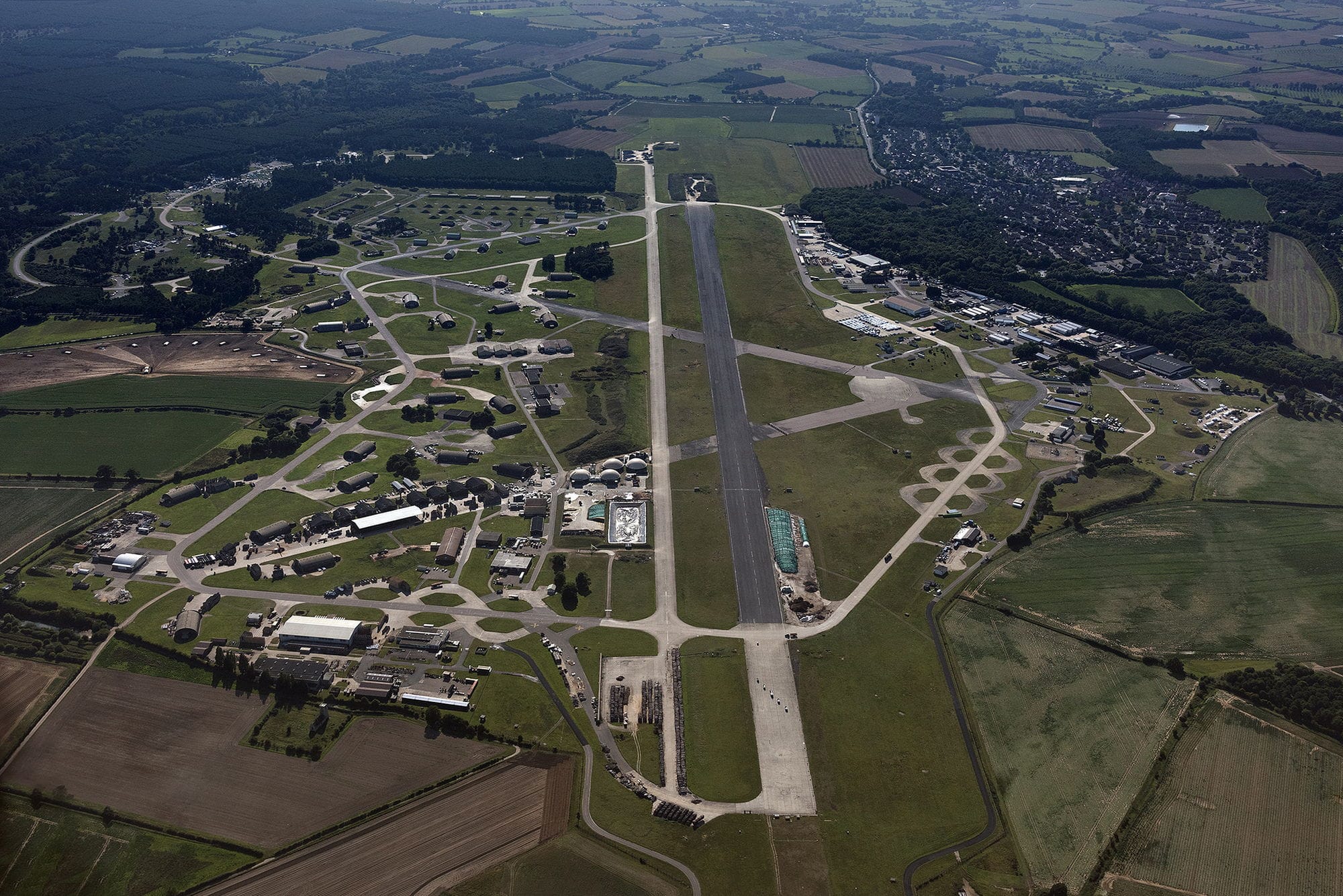
RAF Bentwaters, Suffolk (Cold War era). One of the most strategically significant U.S. Air Force installations in Europe, widely understood to host tactical nuclear weapons under NATO command arrangements.
Night One: December 26 — Into the Forest
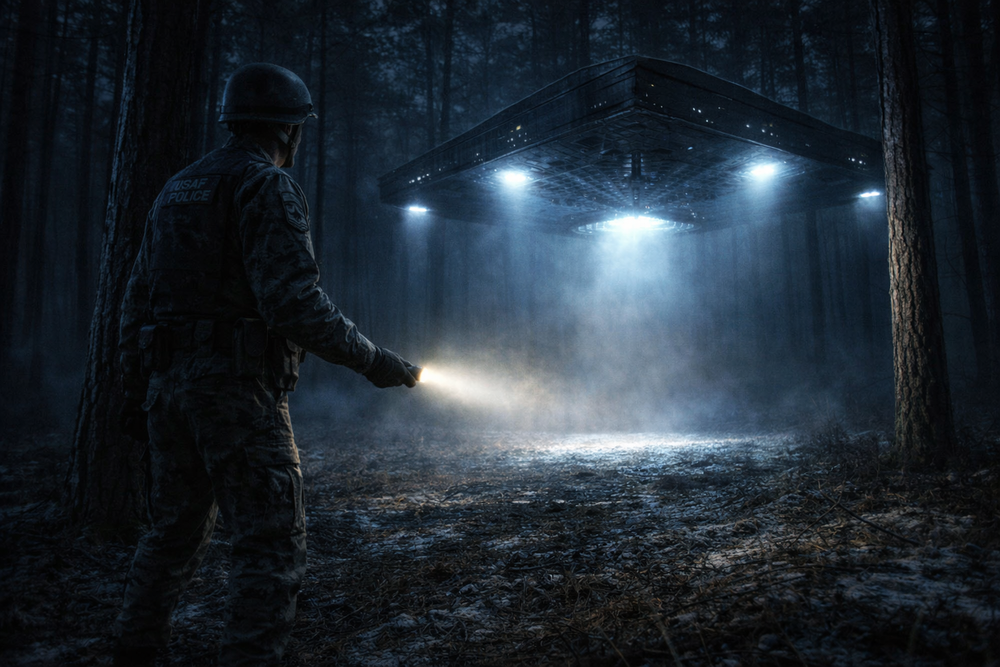
In the early hours of December 26, 1980, security personnel at RAF Woodbridge observed unusual lights apparently descending into Rendlesham Forest, which lay adjacent to the base's eastern perimeter. The initial assumption was rational and professional: a downed aircraft, a low-flying helicopter in difficulty, or a controlled intrusion of some kind. A patrol was dispatched. What they found was none of those things.
Staff Sergeant Jim Penniston and Airman First Class John Burroughs were among the first to enter the forest. Both have consistently described what they encountered as not merely lights at a distance but a physical, structured presence within the trees. Penniston has stated that he approached the object to within touching distance — close enough to observe its surface, note what he described as geometric or symbolic markings on its hull, and make sketches in his patrol notebook at the time. Burroughs, who remained slightly further back, reported intense light and a sense of atmospheric disturbance around the object. Both men described a craft approximately nine feet in length, triangular in profile, hovering silently above the ground before moving away through the trees and ascending.
Penniston's Encounter: The Structured Object
Jim Penniston's account has been the most detailed and, consequently, the most scrutinised of all the Rendlesham witness testimonies. His patrol notebook — containing sketches made at the scene — has been examined by researchers and remains one of the few contemporaneous physical records produced during the first night's encounter. The notebook entries describe a craft with a smooth, dark surface bearing raised geometric symbols, an intensely bright white light at its apex, and what Penniston later characterised as an almost static field effect in the immediate vicinity.
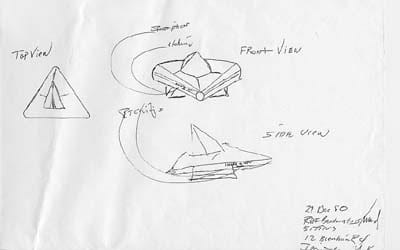
Jim Penniston's notebook sketch of the object, made at the scene on the night of December 26, 1980. One of the few contemporaneous physical records produced during the first night's encounter.
Physical traces were documented at the site the following morning. Three indentations in the ground, consistent with a triangular landing arrangement, were measured and recorded by USAF personnel. Radiation readings were taken using an AN/PDR-27 survey meter. The readings at the indentation points were reportedly elevated compared to background levels in the surrounding area — a finding that has been cited repeatedly in subsequent analyses, though the degree of elevation and its significance remain contested. What is not contested is that these readings were taken, recorded, and subsequently referenced in official documentation.
“I was close enough to touch it. The surface was like black glass. It had symbols on it — not random markings, but structured, almost like a language. I was a trained security policeman. I know what I saw.”
— Staff Sergeant Jim Penniston, USAF, 81st Security Police Squadron
Testimony given in multiple on-record interviews, 1994–2010. Consistent with patrol notebook entries made at the scene, December 26, 1980. Referenced in: Halt, Charles & Pope, Nick, Encounter in Rendlesham Forest (Thomas Dunne Books, 2014).
Night Three: Colonel Halt's Recorded Encounter
Whatever one concludes about the first night's events, the third night — December 28, 1980 — produced evidence of a different order entirely. Deputy Base Commander Lieutenant Colonel Charles Halt led a larger patrol into the forest, bringing with him a Dictaphone recorder. The resulting audio — now widely available and extensively analysed — is unlike any other piece of primary UAP evidence in existence: a real-time record of a senior military officer narrating, in controlled but unmistakably affected tones, what he and his team were witnessing as it happened.
The tape captures Halt and his team tracking lights moving through the trees, observing an object described as having a red core and dripping what appeared to be molten material, and watching it break into smaller objects before moving to the north. At one point, Halt describes a beam of light directed toward the ground — toward, as he later clarified, the direction of the Weapons Storage Area. His voice throughout is measured and professional. He is narrating, not panicking. That composure makes the tape more compelling, not less.
“I see it too… it’s back again… it’s coming this way… there’s no doubt about it… this is weird… it looks like an eye winking at you… and it’s still moving from side to side… and when we put the starscope on it, it actually looked like it had a hollow centre.”
— Lt. Col. Charles Halt, USAF — recorded in Rendlesham Forest, December 28, 1980
Direct transcription from the Halt Tape audio recording made in the field. Full transcript available at ianridpath.com. Audio archived at Wikimedia Commons.
The Halt Memorandum
On January 13, 1981, Lieutenant Colonel Halt filed a formal memorandum to the British Ministry of Defence. In fewer than 500 words, he calmly summarised the events of all three nights — the initial patrol, the physical traces, and his own team's observations on the third night, including the beams of light directed toward the base. The memo was matter-of-fact in tone and devastating in implication: a deputy base commander at a NATO nuclear installation was formally reporting that his personnel had encountered an unexplained structured object on multiple occasions, that it had left physical evidence on the ground, and that beams of light had been directed from it toward a sensitive military area.
The memorandum was declassified and released through the UK National Archives in the MOD file series DEFE 24/2094. Its existence cannot be dismissed, its authorship cannot be questioned, and its content cannot be attributed to misidentification of a lighthouse or the imagination of fatigued airmen. It is, in the simplest terms, an official document that has never been adequately addressed by the institution to which it was addressed.

The Halt Memorandum, dated 13 January 1981. Filed by Deputy Base Commander Lt. Col. Charles Halt to the UK Ministry of Defence. Now held in the National Archives, file series DEFE 24/2094. One of the most significant primary documents in the history of UAP research.
- Unidentified structured object encountered within Rendlesham Forest on the night of December 26, 1980, by multiple USAF security personnel
- Physical evidence documented at the site: three ground indentations in triangular formation, elevated radiation readings recorded with AN/PDR-27 survey meter
- Second and third night events observed by Deputy Base Commander Lt. Col. Charles Halt and a larger patrol team
- Halt Tape: real-time audio recording made in the field on the night of December 28, capturing the team's observations as they occurred
- Halt Memorandum: formal report filed to the UK Ministry of Defence, January 13, 1981 — now in National Archives, DEFE 24/2094
- Beams of light reported directed toward the Weapons Storage Area of the base on the third night
- RAF Bentwaters/Woodbridge widely understood to store U.S. tactical nuclear weapons under NATO arrangements
- UK Ministry of Defence publicly assessed the incident as having "no defence significance" — a conclusion widely regarded as inadequate given the primary evidence
Debunking the Debunkers
The Rendlesham incident has attracted more sustained sceptical analysis than almost any other UAP case in the British record — which is itself a testament to the quality of the evidence it generated. Several explanations have been proposed with varying degrees of seriousness. Each deserves examination on its merits, and each, on examination, falls significantly short of accounting for the full body of evidence.
The Orford Ness Lighthouse Theory
The most frequently cited sceptical explanation holds that witnesses mistook the rotating beam of the Orford Ness lighthouse, situated approximately five miles from Rendlesham Forest, for an unidentified craft. This theory was advanced most prominently by astronomer Ian Ridpath and was adopted as its preferred explanation by the UK Ministry of Defence. The lighthouse hypothesis can, in very limited circumstances, account for intermittent flashes of light on the horizon. It cannot account for a structured object within the forest, reported at close range by multiple witnesses on the first night. It cannot account for the ground indentations. It cannot account for the elevated radiation readings. It cannot account for Halt's real-time tape recording of objects manoeuvring above the tree line. And it cannot account for the fact that USAF personnel stationed in Suffolk were demonstrably familiar with the Orford Ness lighthouse — it was a known, routine feature of the local environment, not a novel or confusing light source.
Verdict: Accounts for at most a fraction of the reported observations. Does not address the close-range physical evidence.
The Re-entering Debris / Meteor Theory
A related sceptical argument suggests that witnesses may initially have been drawn into the forest by the re-entry of the Soviet Cosmos 749 rocket body, which re-entered the atmosphere in the early hours of December 26, 1980. A fireball event could plausibly have produced unusual lights consistent with some of the initial reports. However, a meteor or re-entering debris event is, by definition, transient — lasting seconds to perhaps a minute. It does not hover. It does not manoeuvre. It does not return on subsequent nights. And it does not leave physical indentations in the ground. The re-entry theory may explain what first drew attention toward the forest. It explains nothing that happened once personnel arrived there.
Verdict: May account for the initial trigger. Cannot explain the subsequent multi-night encounters or physical evidence.
The SAS Prank / Black Project Test Theory
A more conspiratorial sceptical argument proposes that what witnesses encountered was either a deliberate hoax staged by British special forces or a test of an experimental classified aircraft operating without the knowledge of the base's American personnel. The hoax theory has no verified documentary trail and requires us to believe that a fake security incursion was staged at a live nuclear installation during the Cold War without generating any operational record, diplomatic incident, or disciplinary consequence. The classified aircraft theory is more interesting and cannot be entirely ruled out — advanced British or American experimental platforms were certainly being developed in this period — but no aircraft of any known programme from 1980 was capable of hovering silently within a forest, leaving triangular ground impressions, and returning on subsequent nights.
Verdict: Unverified. The hoax theory is implausible at a live nuclear installation. The classified aircraft theory cannot be confirmed or ruled out.
Mass Hallucination / Psychological Stress
Perhaps the least defensible of all the proposed explanations, the suggestion that multiple trained military personnel simultaneously hallucinated, misperceived, or confabulated the same structured events across three separate nights is not an explanation — it is a dismissal dressed as one. If the personnel responsible for security at a nuclear-capable NATO installation were collectively subject to psychological episodes of this kind, that represents a national security risk considerably more alarming than any UAP. Furthermore, this explanation cannot account for the physical evidence — ground traces and radiation readings do not hallucinate — or for the existence of the Halt memorandum, which was filed through official channels by a senior officer whose competence and stability were never questioned by his superiors. Colonel Halt himself has consistently expressed frustration at this characterisation, noting that the psychological explanation was never applied to the institution that received his report — only to the people who made it.
Verdict: Does not withstand scrutiny. Cannot account for physical evidence, contemporaneous documentation, or the formal military reporting process.
Aftermath: Health, Careers and Silence
The Rendlesham incident did not end when the lights vanished from the Suffolk sky. For several of those most directly involved, its consequences persisted for years — and in some cases, for the rest of their working lives. The institutional response that followed the events of December 1980 was characterised, at various levels of the British and American military establishments, by a studied effort to minimise, discourage and, where possible, silence.
John Burroughs, one of the first airmen into the forest on the night of December 26, subsequently reported health issues that he connected to his proximity to the object during the encounter. His pursuit of medical records and veterans' benefits documentation related to the incident became, over subsequent decades, one of the most persistent threads in the Rendlesham story. In 2015, material associated with his Veterans Affairs medical review process entered the public domain — and was widely cited as representing an implicit official acknowledgement that something significant had occurred. The British government's refusal to release certain medical records connected to Burroughs, on the grounds that they were classified, added a further layer of institutional opacity to a case already characterised by it.
Colonel Halt, meanwhile, became in later years an outspoken advocate for transparency about what he had witnessed. His position — that the incident was real, that it was taken seriously at the time by those closest to it, and that the official response constituted a deliberate and dishonest minimisation — has never wavered. In a signed affidavit submitted to investigators in 2010, Halt stated that he was "100% convinced" that the craft his team had observed were not of this earth, and expressed his belief that both the American and British governments were aware of far more about the incident than they had disclosed. Whatever weight one gives to that conclusion, the consistency and credibility of Halt as a witness — a career military officer with an unblemished record — makes it impossible to dismiss.
The Unanswered Questions
The Rendlesham Forest incident has generated more primary documentation than almost any comparable UAP case in the British or American military record. It has also generated more official evasion. The gap between those two facts is itself a significant data point. Forty-four years after the event, the following questions remain without credible official answer:
- What precisely caused the elevated radiation readings recorded at the ground indentation sites, and why has no official analysis of those readings ever been published?
- Were radar returns recorded by either base or by the Eastern Radar facility at RAF Watton during the events of December 26–28? If so, where is that data?
- Why did the UK Ministry of Defence conclude that an event serious enough to generate a formal memorandum from a deputy base commander had "no defence significance"?
- What, specifically, did the beams of light directed toward the Weapons Storage Area illuminate — and was any investigation of the WSA conducted following the third night?
- What medical and operational records connected to John Burroughs remain classified, and on what legal basis?
- Did either the USAF or the RAF conduct any classified investigation beyond the material that has been released — and if so, what were its findings?
Whether the object or objects encountered over those three December nights represented advanced human technology, an as-yet-uncharacterised natural phenomenon, or something outside either of those categories is a question the available evidence does not resolve. What the evidence does establish — firmly, through primary documents that cannot be disputed — is that something happened at Rendlesham Forest. Something that a senior United States Air Force officer considered significant enough to report formally to a foreign government's defence ministry. Something that has never been explained.
Primary Documents & Supporting Media
- Halt Memorandum — MOD File Scan (PDF) The original January 13, 1981 memo from Lt. Col. Halt to the UK Ministry of Defence. National Archives ref: DEFE 24/2094.
- UK National Archives — UFO Reports Collection The full declassified Ministry of Defence UFO files, including Rendlesham-related material in the DEFE series.
- Halt Tape — Full Transcript Complete transcript of the audio recording made in Rendlesham Forest on the night of December 28, 1980.
- Halt Tape — Audio Recording (Wikimedia) The original field recording made by Lt. Col. Halt. One of the most significant primary UAP audio documents in existence.
- Halt Memorandum — High Resolution Image (Wikimedia) Full-resolution scan of the Halt Memo for research and reference use.
Cold War UFO Case Files Series
The Rendlesham Forest incident is the fourth case in the Stranger Times Cold War UFO Case Files series. The communications failures experienced by Halt’s patrol on the third night — radio disruption and equipment malfunction at key moments — mirror those documented at Malmstrom in 1967, Minot in 1968, and most strikingly at a Soviet nuclear base in Ukraine just two years later, where proximity to an unidentified object triggered an unauthorised missile launch sequence. The pattern of proximity-dependent interference with military systems is one of the most consistent threads running through the Cold War UAP record. Each article examines a distinct encounter in the same depth — primary sources, witness testimony, official response, and the sceptical arguments that have been proposed and tested against the evidence.
- Case 01 · Malmstrom AFB Missile Shutdown, USA — 1967
- Case 02 · Minot AFB Encounter, USA — 1968
- Case 03 · Tehran Phantom Intercept, Iran — 1976
- Case 04 · Rendlesham Forest Incident, UK — 1980 (This Article)
- Case 05 · Soviet Missile Base Incident, USSR — 1982
- Case 06 · Belgian UFO Wave — 1989–1990
Frequently Asked Questions
Was the Rendlesham UFO a lighthouse?
The Orford Ness lighthouse explanation is the most widely cited sceptical account and was adopted by the UK Ministry of Defence. It may account for some distant flashes of light in the initial stages of the incident. It cannot account for the structured object reported at close range within the forest on the first night, the physical ground traces, the radiation readings, or Halt's real-time tape recording of objects manoeuvring above the tree line on the third night. Personnel stationed at RAF Bentwaters and Woodbridge were familiar with the lighthouse as a routine feature of the local environment.
Were nuclear weapons stored at RAF Bentwaters?
RAF Bentwaters and RAF Woodbridge were strategically critical Cold War USAF installations forming part of NATO's forward deterrent infrastructure in Europe. Testimony from former personnel and material within declassified National Archives files strongly indicate that U.S. tactical nuclear weapons were stored at the base under American custody. This context — never officially confirmed during the Cold War — transforms the incident from a curiosity into a security event of the first order.
What happened to the witnesses?
Experiences varied significantly. John Burroughs reported long-term health concerns he connected to his proximity to the object, and spent years pursuing medical records through the veterans' affairs system. Charles Halt became a vocal advocate for transparency and submitted a signed affidavit in 2010 stating his conviction that the craft were not of terrestrial origin. Jim Penniston has given extensive public testimony consistent with his original patrol notebook. Multiple witnesses have described being discouraged from speaking about their experiences by superiors.
What did the UK Ministry of Defence conclude?
The MOD's official position was that the Rendlesham incident had "no defence significance" — a conclusion expressed in correspondence now held in the National Archives. Critics, including Halt himself, have consistently noted the contradiction between that public position and the seriousness implied by the existence of the formal memo, the on-the-ground response, and the proximity of the events to a nuclear-capable installation. No detailed official investigation of the incident has ever been made public.
— End of Case File · Rendlesham Forest 1980 —
Research drawn from declassified UK National Archives material, FOIA-obtained documentation,
and on-the-record testimony from named former military personnel.
Part of the Stranger Times Cold War UFO Case File series.