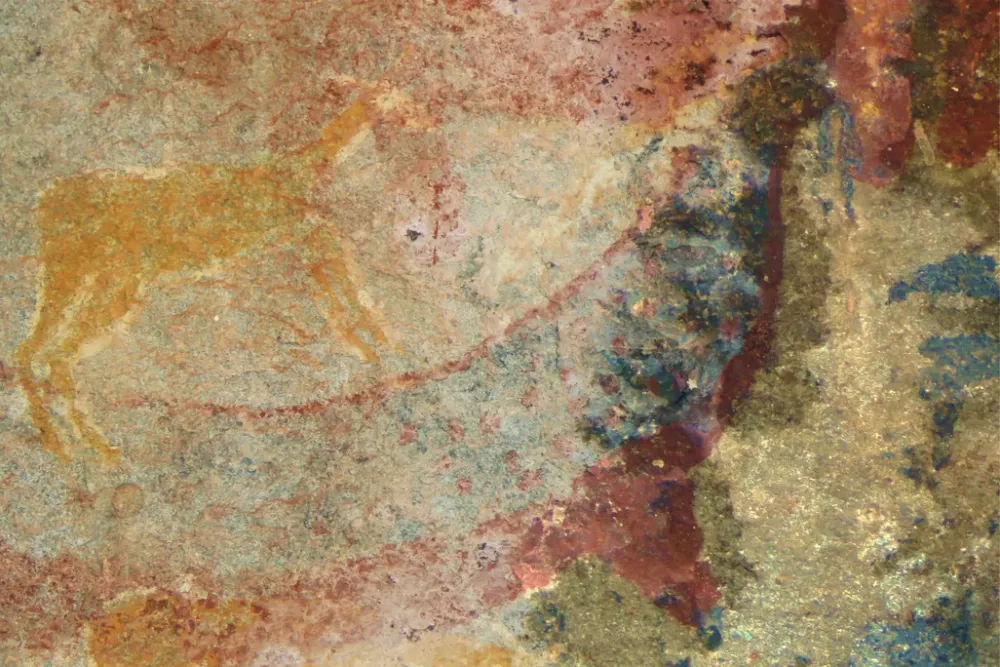
A recently published study suggests that a prominent cave painting known as the Horned Serpent, found at La Belle France farm in South Africa's Karoo region, represents an ancient extinct reptile rather than a mythical creature. The painting, created by the San people prior to 1835, depicts an elongate, curved-bodied animal with paddle-like limbs and large downward-curving tusks. Researchers have proposed it resembles Dicynodon lacerticeps, a dicynodont species that lived approximately 250 million years ago during the Late Permian Period and whose fossils are abundant in the surrounding area.
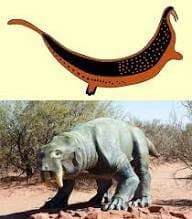
Dr. Julien Benoit of the University of the Witwatersrand led the study, published in PLoS ONE, analyzing morphology similarities between the painting and known dicynodont fossils. The San, known for their detailed wildlife art, may have observed fossilized remains and attempted to reconstruct the animal's appearance. Benoit notes the painting’s body posture mimics a "death pose" commonly found in fossilized dicynodont skeletons, and the spotted skin pattern matches dermal textures seen in mummified specimens. This builds on prior findings that San artwork incorporated ancient trackway imprints, suggesting early proto-palaeontological knowledge.
This interpretation provides insight into prehistoric indigenous knowledge and how fossil remains influenced cultural expressions long before formal paleontology existed. It highlights the San people’s sophisticated observation skills and oral traditions recounting extinct fauna. The study further emphasizes the importance of integrating archaeological, paleontological, and ethnographic evidence when interpreting ancient art, contributing to a broader understanding of human interactions with deep time and the natural world. However, unresolved depictions of other unidentified creatures in the same cave complex indicate a mix of fact and mythology within San artistic heritage.
Source: ShukerNature