Contents
The Setting
By the autumn of 1989, the Cold War was approaching its end. The Berlin Wall would fall in November. Soviet power was contracting. NATO’s front line, which ran through the heart of Europe, was beginning to relax for the first time in four decades. Belgium — a small, densely populated country at the geographic and political centre of the Western alliance, home to both NATO headquarters and a network of U.S. Air Force installations — had never been more strategically significant, nor more watched.
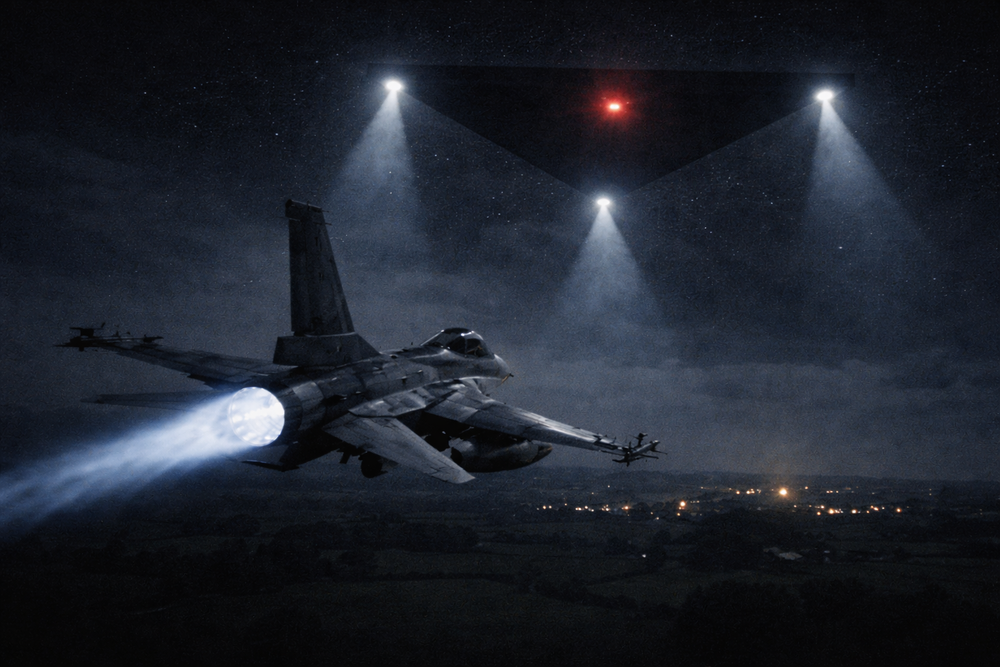
It was against this backdrop that something began crossing Belgian airspace. Not once, not twice — but hundreds of times, over five months, witnessed by thousands of people from every walk of life. Police officers, military personnel, scientists, engineers, schoolchildren. All of them describing, with consistent and striking precision, the same thing: a large, dark, triangular craft moving in near-complete silence, with powerful white lights at each corner and a pulsing red light at its centre. Something that hovered. Something that accelerated to impossible speeds. Something that no government, then or since, has been able to explain.
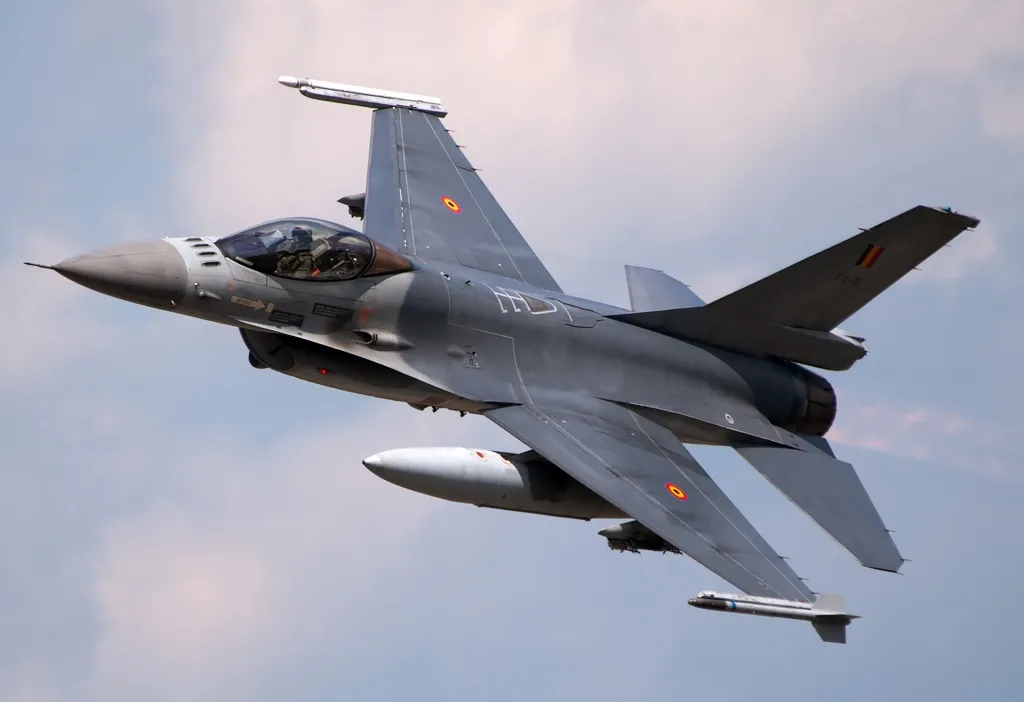
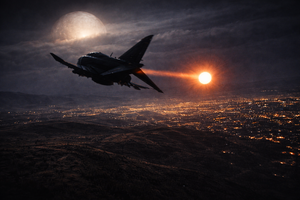
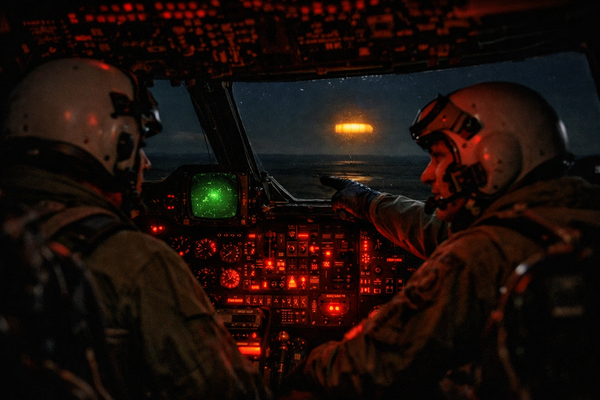
A Belgian Air Force F-16 Fighting Falcon — the same type scrambled on the night of 30–31 March 1990 from Beauvechain Air Base to intercept an unknown object tracked on both ground and airborne radar. The F-16 crews achieved multiple radar locks. They never made visual contact. Image: U.S. Air Force / Public Domain via DVIDS.
The First Night: Eupen, 29 November 1989
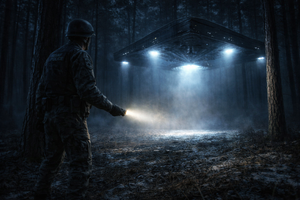
The Belgian wave began, with unusual precision, at 5:20 in the evening on 29 November 1989. Two gendarmes — officers Nicoll and Von Montigny — were on routine patrol near the town of Eupen, close to the German border in eastern Belgium, when they observed a bright light to the right of their vehicle. As they watched, a triangular shape became visible against the darkening sky: a dark, flat platform approximately thirty metres across, carrying three powerful downward-pointing spotlights at each apex and a red flashing light at its centre.
The object moved in silence. It tracked northeast, roughly parallel to their patrol route. When the officers accelerated to keep pace with it, they were able to maintain observation for several minutes. They called their dispatcher. Their dispatcher called it in. By the end of that evening, fourteen gendarmes in the Eupen region had filed independent reports describing an identical object. One hundred and fifty additional witness notifications would follow in the days thereafter.
What the first night established was the consistent signature that would define the entire wave: a triangular or boomerang-shaped craft, enormous in apparent scale, moving with a slow deliberateness that no conventional aircraft could replicate, capable of hovering motionless and then accelerating away at speed, and operating in near-complete silence. Those characteristics would not waver across hundreds of subsequent sightings involving thousands of independent witnesses over the following five months.
“They were so bright you could read by them — like lights on a huge football field. And the whole thing was floating in the air.”
— Gendarme Heinrich Nicoll, Eupen patrol officer
Testimony given to SOBEPS investigators, November 1989. Recounted in Leslie Kean, UFOs: Generals, Pilots, and Government Officials Go On the Record (Harmony Books, 2010), Ch. 3.
Five Months of Sightings
What followed was unlike anything in the documented history of UAP phenomena in Europe. Between November 1989 and April 1990, the Belgian Society for the Study of Space Phenomena — SOBEPS, the Société belge d’étude des phénomènes spatiaux — collected over 2,600 written witness statements. The total number of individuals who reported sightings was estimated at upwards of 13,500. The wave was not confined to any single region: reports came from Eupen, Liège, Namur, Brussels, Wavre, and the rural provinces of Brabant. It spread across the country.
The Belgian government’s response was, by the standards of any nation’s handling of UAP, remarkable. Rather than issuing blanket denials or routing reports through bureaucratic silence, the Belgian Air Force established a formal Special Task Force Unit, under the direction of Colonel Wilfried De Brouwer, Chief of Operations of the Air Staff. The unit worked directly with SOBEPS, shared data with civilian researchers, and held public press conferences. Nothing remotely comparable had occurred in any Western nation before or has occurred since.
Among the witnesses filing reports during this period were police officers, serving military personnel, a Belgian Army colonel who observed the lights while driving with his wife in December 1989, scientists, engineers, and ordinary civilians whose accounts consistently matched in the key details: triangular shape, three bright corner lights, central red light, low altitude, near-total silence, and an ability to hover motionlessly before accelerating at speeds no known aircraft could achieve.

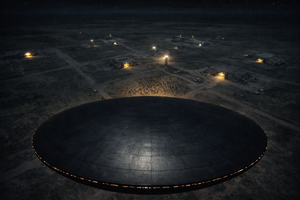
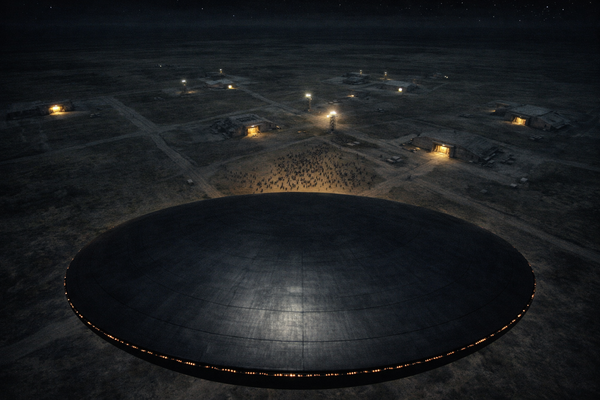
The flat, open countryside of eastern Belgium — the Eupen and Liège regions where the first and most concentrated sightings of the wave occurred. Witnesses across this landscape, many of them trained police and military observers, consistently described the same triangular object with corner lights and a central red flash, moving in near-total silence at low altitude. Image: [CREDIT]
The F-16 Scramble: 30–31 March 1990
By March 1990, the Belgian Air Force had developed a protocol for responding to new sightings: F-16 fighters at Beauvechain Air Base would be placed on standby, ready to scramble the moment any sighting was corroborated by both a police report and a radar contact simultaneously. On the evening of 30 March, that threshold was crossed.
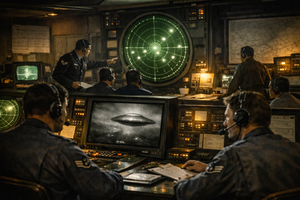
At 22:50, gendarmes near Thorembais-Gembloux south of Brussels reported three unusual lights forming an equilateral triangle moving slowly overhead. The Control Reporting Centre at Glons received the report and requested confirmation. More officers confirmed the sighting. At 23:49, the NATO air traffic radar facility at Semmerzake, eighty miles from Glons, independently detected an unknown target. The order was given: two F-16s scrambled from Beauvechain.
For the next hour, the crews attempted nine separate interceptions. The radar data from that night, subsequently analysed by the Belgian Air Force’s Electronic War Centre under Colonel Salmon and physicist M. Gilmard, documented targets exhibiting behaviour with no conventional aerodynamic explanation. Objects accelerated from approximately 150 km/h to over 1,800 km/h in seconds — well beyond the physical tolerance of any known human pilot. Altitude changes from 9,000 feet to near ground level occurred in under two seconds. On at least one occasion, radar returns from a single F-16 and a ground station correlated simultaneously on the same target, reducing the likelihood of pure instrument error.
The F-16 pilots never made visual contact. The ground witnesses, who had been watching the lights from below, later reported that the objects performed manoeuvres consistent with what the airborne radar had captured — sudden accelerations, sharp altitude changes, and eventual disappearance. By 01:00 the jets returned to base. The targets were gone.
The Belgian Air Force held a formal press conference at NATO headquarters in Evere, Brussels, on 11 July 1990. The radar tapes from the F-16s were partially declassified and presented publicly. This was, and remains, an almost unprecedented act of institutional transparency in the history of government engagement with UAP evidence.
- Wave began 29 November 1989 near Eupen; continued through April 1990 across Belgium
- Over 13,500 reported witnesses including police, military personnel, scientists and engineers
- SOBEPS collected 2,600+ written statements; Belgian Air Force formally cooperated with investigators
- F-16s scrambled from Beauvechain Air Base on night of 30–31 March 1990
- Radar data recorded objects accelerating from 150 km/h to 1,800 km/h and dropping 9,000 feet in under two seconds
- At least one corroborated radar contact between an F-16 and a ground station simultaneously
- Belgian Minister of Defence Leo Delcroix confirmed in writing: no explanation has ever been found
- U.S. authorities formally denied any American aircraft were operating in Belgian airspace
- No conventional explanation — military aircraft, natural phenomenon, or atmospheric effect — has ever been officially accepted
The General’s Testimony
The most significant and credible voice in the Belgian wave is Major General Wilfried De Brouwer, who served as Chief of Operations of the Belgian Air Staff during the entire period of the wave and personally oversaw the F-16 deployments. Unlike the anonymous sources and disputed photographs that characterise many UAP cases, De Brouwer has spoken on the record, at length, for decades.
De Brouwer’s initial assumption — widely shared among Belgian military officials — was that the objects were American experimental aircraft being tested over Belgian airspace without NATO disclosure. He made direct enquiries. The answer, conveyed through official channels, was unambiguous: the U.S. authorities confirmed that no American stealth aircraft were operating in Belgian airspace during the wave. The Belgian Minister of Defence, Leo Delcroix, received the same assurance in writing and passed it on formally: the American aircraft hypothesis, he wrote, could be definitively dismissed.
De Brouwer later contributed to Leslie Kean’s 2010 book UFOs: Generals, Pilots, and Government Officials Go On the Record — the same volume that drew on the testimony of RAF Bentwaters deputy commander Colonel Charles Halt regarding the Rendlesham Forest incident — providing a formal written account of his involvement. His conclusion was measured but unequivocal: the events involved a real, structured phenomenon that could not be explained by any known aircraft, atmospheric condition, or equipment malfunction. The corroboration between visual witnesses, ground radar, and airborne F-16 radar on at least one occasion meant the equipment-error hypothesis could not fully account for the data.
“The Air Force has arrived at the conclusion that a certain number of anomalous phenomena have been produced within Belgian airspace. The nature and origin of the phenomenon remain unknown.”
— Major General Wilfried De Brouwer, Chief of Operations, Belgian Air Staff
Written postface to SOBEPS, Vague d’OVNI sur la Belgique Vol. 2 (1994). Also cited in: Leslie Kean, UFOs: Generals, Pilots, and Government Officials Go On the Record (Harmony Books, 2010), Ch. 3.
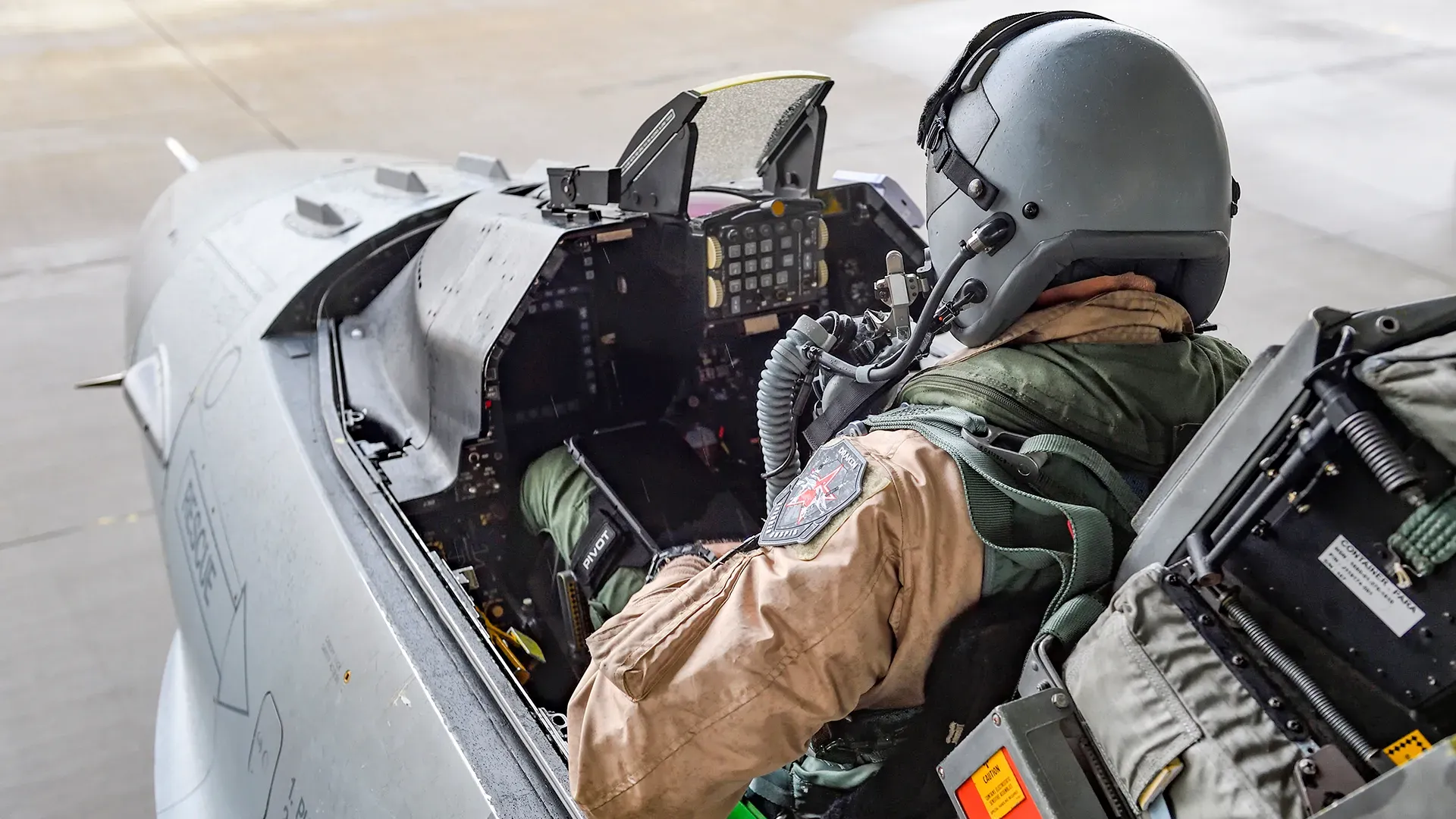
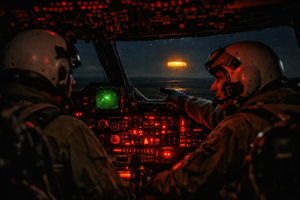
An F-16 Fighting Falcon pilot preparing for a mission. On the night of 30–31 March 1990, two Belgian Air Force F-16 pilots attempted nine radar interceptions of unknown targets over Belgium. The onboard AN/APG-66 radar recorded accelerations and altitude changes that exceeded the performance envelope of any aircraft known to exist. The pilots never saw anything at all. Image: www.twz.com
The TR-3B Question: Man-Made or Unknown?
No discussion of the Belgian wave can avoid the shadow of the TR-3B — the alleged classified American triangular aircraft that has become one of the most persistent and debated legends in the history of black-programme speculation. The triangular shape of the Belgian craft, its apparent stealth characteristics, and its proximity in time to the late-Cold War acceleration of American defence black budgets have made the TR-3B hypothesis the most commonly proposed non-extraterrestrial explanation for what Belgium’s skies contained in 1989 and 1990.
What Is the TR-3B?
The TR-3B legend originated in the early 1990s with reporting by journalist William Scott in Aviation Week & Space Technology, which described a classified Northrop triangular reconnaissance aircraft called the TR-3A “Black Manta.” Scott’s sources claimed the TR-3A was a stealthy flying-wing design that had entered limited service by the 1980s and may have flown alongside F-117 Nighthawks during the Gulf War to provide laser target designation. The TR-3A designation itself is now believed by many analysts to have derived from a mishearing of the “Tier 3” unmanned reconnaissance programme — a real project, though unrelated — and Scott’s reporting was later acknowledged to have blended verifiable facts with rumour and conjecture.
The “TR-3B” variant — an alleged larger, more advanced successor purportedly using plasma field propulsion or even reverse-engineered non-human technology — has no verified documentary basis whatsoever. It emerged in online speculation during the 1990s and has been sustained almost entirely by eyewitness accounts, internet forums, and a 2004 U.S. Navy patent for a triangular spacecraft concept — which, notably, describes a theoretical design and not an operational vehicle. No confirmed photograph, engineering document, or government acknowledgement of the TR-3B as described in popular accounts has ever surfaced.
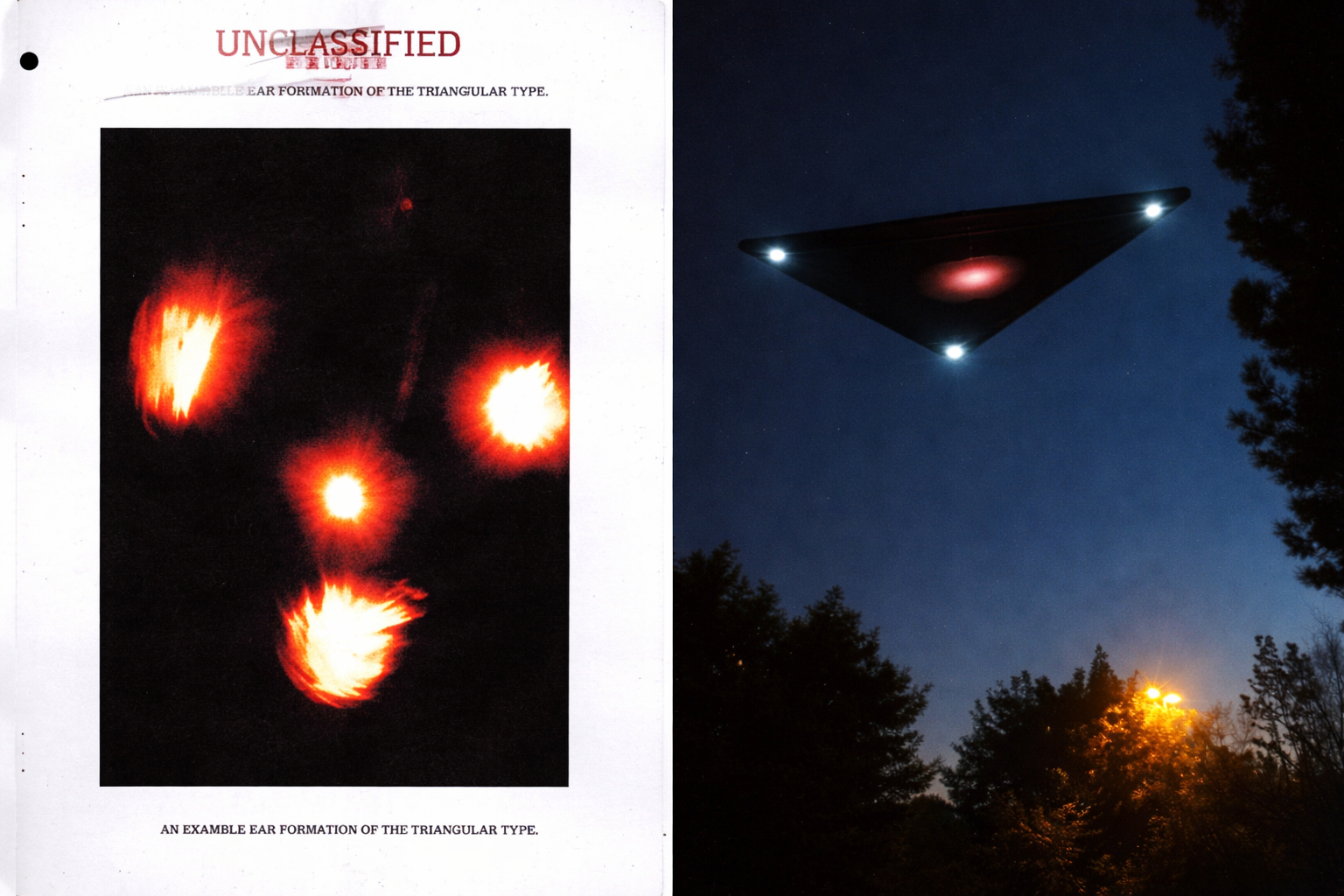
The UK Ministry of Defence’s classified Project Condign report, declassified in 2006, was one of several official acknowledgements that large, silent triangular craft had been observed repeatedly across Western airspace. Black triangle sightings span four decades and multiple continents — from the Hudson Valley in New York in the early 1980s, to Belgium in 1989–90, to the Phoenix Lights of 1997, to the St. Clair County police radio reports of 2000. In each case the description is strikingly consistent: an enormous dark triangular platform, near-silent, with bright lights at each apex, capable of hovering and then accelerating away at speed. No government has ever formally identified what these objects are. Image: UK Ministry of Defence / Crown Copyright. Released under the Freedom of Information Act 2000.
Why the TR-3B Cannot Fully Explain Belgium
There are several reasons to treat the TR-3B as an inadequate explanation for the Belgian wave, even setting aside the absence of evidence for its existence. The objects reported over Belgium were described by experienced military and police observers as enormous — estimates ran to 100–300 feet across — and operating at extremely low altitudes, sometimes just a few hundred feet above populated areas, over a small and densely observed country at the geopolitical heart of NATO. Flying an unacknowledged experimental aircraft of that scale, repeatedly, over allied sovereign territory without disclosure, in an era before stealth technology was capable of the performance the Belgian F-16 radar recorded, would represent an act of extraordinary recklessness toward a treaty partner.
The U.S. Embassy in Brussels and the Defense Intelligence Agency both formally denied any American aircraft were operating in Belgian airspace. The Belgian Minister of Defence received that assurance in writing and declared the American aircraft hypothesis definitively dismissed. Those denials could, of course, be themselves classified cover; the nature of black-programme secrecy makes clean refutation impossible. But the radar performance data — targets dropping from 9,000 feet to near ground level in under two seconds, accelerating from 150 km/h to 1,800 km/h without sonic boom or thermal exhaust signature — exceeds the documented capability of any aircraft confirmed to have existed, then or since. A classified American aircraft that could perform these manoeuvres in 1989 would represent a technology gap so vast it effectively constitutes a separate category of unexplained phenomenon.
The Broader Black Triangle Pattern
The Belgian wave did not occur in isolation. Large, silent, triangular craft have been reported with unusual consistency across multiple countries and decades — and the pattern predates Belgium. In August 1989, trained British airfield observer Chris Gibson watched an isosceles delta aircraft of unknown type refuelling from a KC-135 Stratotanker over the North Sea — a sighting that became part of the evidence base for the alleged Aurora hypersonic programme. In 1990, unusual sonic boom signatures were recorded by seismological instruments across Southern California, consistent with a small vehicle at 90,000 feet travelling at Mach 4–5. In 1997, thousands of residents across Arizona and Nevada witnessed the Phoenix Lights, a vast triangular formation moving silently overhead. In January 2000, a chain of on-duty police officers in St. Clair County, Illinois, broadcast real-time radio descriptions of a massive, silent triangle overhead.
These cases share a consistent signature: a large triangular or boomerang shape, silent operation or near-silence, bright lights at the apexes, a central light, and manoeuvre characteristics inconsistent with conventional propulsion. Whether they represent a single classified programme in extended testing, multiple separate phenomena, or something else entirely, is unknown. What is notable is that the pattern does not read like the gradual revelation of a single experimental aircraft; it reads like a recurring and unacknowledged presence across nearly four decades of airspace.
The TR-3B story is best understood as a placeholder — a way of filing the triangle phenomenon under a human label when no human explanation has been officially confirmed. It may be correct. It may be partially correct. But as an explanation for the Belgian wave specifically, with its F-16 radar data and its formal military press conference and its written ministerial denial of American involvement, it raises as many questions as it answers. The honest position is the one Major General De Brouwer occupied: the phenomenon was real, it was structured, and its origin and nature remain unknown.
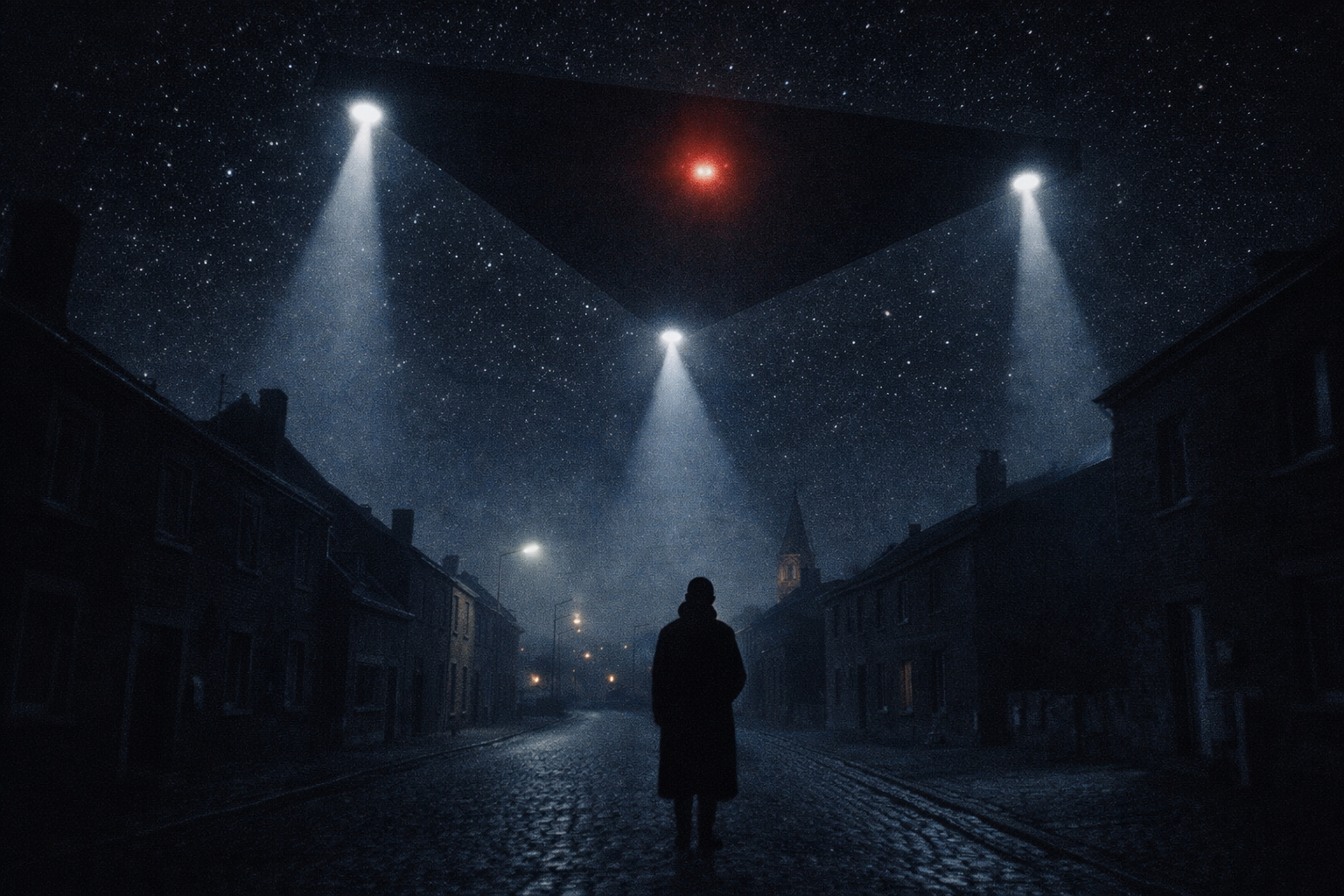
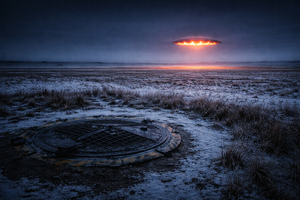
An artist’s illustration of the triangular craft described by witnesses across Belgium between November 1989 and April 1990: a large, dark platform with three powerful corner lights and a central red flash, moving in near-total silence at low altitude. Over 13,500 witnesses — including police officers, military personnel, and scientists — described this configuration with consistent precision. Image: [CREDIT]
The Sceptical Arguments
The Belgian wave has attracted serious sceptical analysis, and that analysis deserves honest engagement. Several of the most commonly cited counter-arguments are addressed below.
Sceptical Argument
The wave was a psychosocial contagion — media coverage triggered mass misreporting
The psychosocial hypothesis holds that initial media coverage of the Eupen sighting prompted thousands of people to retrospectively reinterpret mundane observations as UFOs. There is evidence this dynamic contributed to the volume of reports: many witness statements arrived weeks after events, following SOBEPS’s media solicitation campaigns. Sceptic Brian Dunning, among others, has argued the wave is best explained by this mechanism. However, the hypothesis does not account for the first night of 29 November 1989, during which fourteen independent gendarmes filed contemporaneous reports before significant media coverage existed. It does not account for De Brouwer’s own sightings data from military personnel during the wave. And it provides no explanation for the F-16 radar returns of 30–31 March 1990, which were instrumental readings, not eyewitness impressions.
Verdict: Partially valid for the volume of reports; does not explain the radar data or the first night.
Sceptical Argument
The F-16 radar locks were on each other, not on a real target
This is the most technically substantive counter-argument. Post-analysis by Belgian Air Force Electronic War Centre investigators determined that of the nine claimed radar locks, three were the F-16s locking on each other, and several others appear to have resulted from Bragg scattering — a known atmospheric interference effect. This is a genuine and significant finding. However, the same Belgian Air Force analysis identified at least one occasion where a corroborated contact existed between an F-16 radar and an independent ground station simultaneously — a finding that De Brouwer cited explicitly as weakening the pure interference hypothesis. The radar data, in other words, contains both errors and a residue that cannot be cleanly explained away.
Verdict: Some locks were instrument artefacts; at least one independent corroborated contact remains unexplained.
Sceptical Argument
The famous Petit-Rechain photograph was a confirmed hoax
This is entirely correct and warrants no defence. In July 2011, a man identifying himself as the photograph’s creator demonstrated publicly how he had constructed the image using a styrofoam triangle, black paint, and flashlights suspended from string. For twenty years, the photograph was cited as significant evidence. Its exposure as a hoax is a legitimate blow to some popular presentations of the case. It is, however, irrelevant to the physical radar data, to the testimony of gendarmes on the night of 29 November, and to De Brouwer’s formal assessment. Hoax photographs are a recurring feature of genuine UAP events — they do not, by themselves, negate independent evidence streams.
Verdict: The photograph was a hoax; this does not affect the radar evidence or witness testimony from police and military personnel.
Sceptical Argument
The objects were helicopters, blimps, or misidentified conventional aircraft
This explanation was explicitly examined and rejected by the Belgian Air Force’s own investigation. Major Lambrechts’s formal report dismissed optical illusions, balloons, meteorological inversions, military aircraft, and holographic projections. The radar-recorded acceleration figures of 150 km/h to 1,800 km/h with no acoustic signature are incompatible with any known rotary or fixed-wing aircraft. Some researchers have noted that a minority of reports, particularly those describing low-speed objects with a faint humming noise, could be consistent with helicopters operating at night. The core evidence stream, anchored by the first-night gendarme reports and the F-16 radar data, is not adequately explained by conventional aviation.
Verdict: Rejected by the formal Belgian Air Force investigation; inconsistent with the documented radar performance data.
Why It Matters
The Belgian UFO wave is the most institutionally transparent UAP event in recorded history. No other government has publicly scrambled military aircraft, released partially declassified radar data, held press conferences at NATO headquarters, and formally acknowledged in ministerial writing that the phenomenon remains unexplained. Belgium did all of these things. The response of the Belgian Air Force and its Chief of Operations stands in stark contrast to the institutional suppression that characterises most Cold War UAP encounters — including the missile shutdowns at Malmstrom Air Force Base in 1967, where records went missing and witnesses were quietly sidelined, and the Tehran intercept of 1976, where a DIA report confirming the incident reached the White House without ever generating a public acknowledgement.
What Belgium demonstrates is that transparency is possible — that a military institution can face an unexplained aerial phenomenon, investigate it rigorously, acknowledge the limits of its findings, and say so publicly without institutional collapse or public panic. The model De Brouwer established is the one that UAP researchers and reformers have been trying to persuade other governments to adopt ever since. In the context of the 2023 Congressional UAP hearings in the United States, at which former intelligence official David Grusch testified under oath about alleged non-human recovered materials and a systematic programme of institutional suppression, Belgium’s openness in 1989–1990 reads almost like a rebuke to its allies.
The wave also matters because it has never been resolved. Thirty-five years on, the Belgian Minister of Defence’s written conclusion stands unrevised: no explanation has been found. The nature and origin of what crossed Belgian airspace during those five months remains officially unknown. For a phenomenon witnessed by more than thirteen thousand people, documented by a national air force, and supported by independent radar data, that absence of resolution is not a minor footnote. It is the central fact.
Cold War UFO Case Files Series
The Belgian UFO wave is Case 06 in the Stranger Times Cold War UFO Case Files series. Each article examines a distinct Cold War-era military encounter in the same depth — primary sources, witness testimony, official response, and the sceptical arguments that have been proposed and tested against the evidence.
- Case 01 · Malmstrom AFB Missile Shutdown, USA — 1967
- Case 02 · Minot AFB Encounter, USA — 1968 (Coming Soon)
- Case 03 · Tehran Phantom Intercept, Iran — 1976 (Coming Soon)
- Case 04 · Rendlesham Forest Incident, UK — 1980
- Case 05 · Soviet Missile Base Incident, USSR — 1982 (Coming Soon)
- Case 06 · Belgian UFO Wave — 1989–1990 (This Article)
Sources
- Kean, Leslie. UFOs: Generals, Pilots, and Government Officials Go On the Record. Harmony Books, 2010. (Includes De Brouwer’s written account, Chapter 3.)
- SOBEPS. Vague d’OVNI sur la Belgique, Vol. 1. Brussels, 1991.
- SOBEPS. Vague d’OVNI sur la Belgique, Vol. 2. Brussels, 1994.
- Lambrechts, Major P. Report Concerning the Observation of UFOs During the Night of March 30 to 31, 1990. Belgian Air Force General Staff. Released to SOBEPS.
- De Brouwer, Wilfried (Major General). Postface to SOBEPS Vol. 2; and written account in Kean (2010).
- Delcroix, Leo (Belgian Minister of Defence). Letter to researcher Renaud Marhic confirming no explanation found and dismissing U.S. aircraft hypothesis.
- Gilmard, M. & Salmon, Col. Electronic War Centre Technical Analysis of F-16 Radar Tapes, 1992. Reviewed by Prof. Auguste Meessen.
- Meessen, Auguste. “The Belgian Sightings.” International UFO Reporter, May/June 1991.
- Dunning, Brian. “The Belgian UFO Wave.” Skeptoid Podcast, Episode 538, September 2016.
- Wikipedia. “Belgian UFO Wave.” Consulted March 2026.
— End of Case File —
Research drawn from publicly available documentation, declassified military reports, and on-the-record testimony by serving and retired military officers.
Part of the Stranger Times Cold War UFO Case File series.