Contents
The Setting: The Other Side of the Iron Curtain
By the autumn of 1982, the Cold War had entered one of its most dangerous phases. The newly elected Reagan administration had dramatically escalated its nuclear posture, announcing the Strategic Defense Initiative and deploying Pershing II ballistic missiles in Western Europe. The Soviet leadership under Leonid Brezhnev — who would die in November of that same year — was watching the horizon with intense anxiety. Both superpowers maintained thousands of nuclear warheads on hair-trigger alert, dispersed across missile bases that stretched from the American Great Plains to the steppes of the Ukrainian SSR. The margins for error were measured in seconds.
Byelokoroviche was a small town in the Zhytomyr region of Soviet Ukraine, unremarkable by any measure except one: it sat adjacent to a strategically critical installation belonging to the 50th Missile Division of the Soviet Strategic Rocket Forces, Carpathian Military District. The base housed R-12 intermediate-range ballistic missiles — nuclear weapons pointed at targets in Western Europe, kept in hardened underground silos and manned around the clock by crews trained to an exacting standard of psychological resilience. These men had been selected precisely because they were unlikely to panic. They were about to be severely tested.
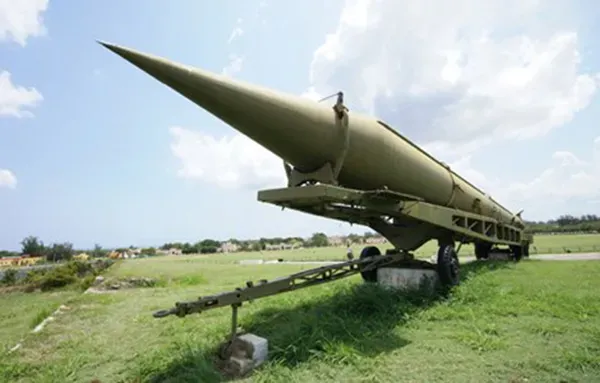
The Soviet R-12 Dvina — NATO designation SS-4 Sandal — an intermediate-range ballistic missile capable of carrying a nuclear warhead to targets across Western Europe. It was R-12 missiles at the 50th Missile Division base near Byelokoroviche, Ukrainian SSR, that activated their pre-launch sequence without authorisation on the evening of 4 October 1982. The same missile type had been at the centre of the 1962 Cuban Missile Crisis twenty years earlier. Image: Public Domain.
4 October 1982: The Incident
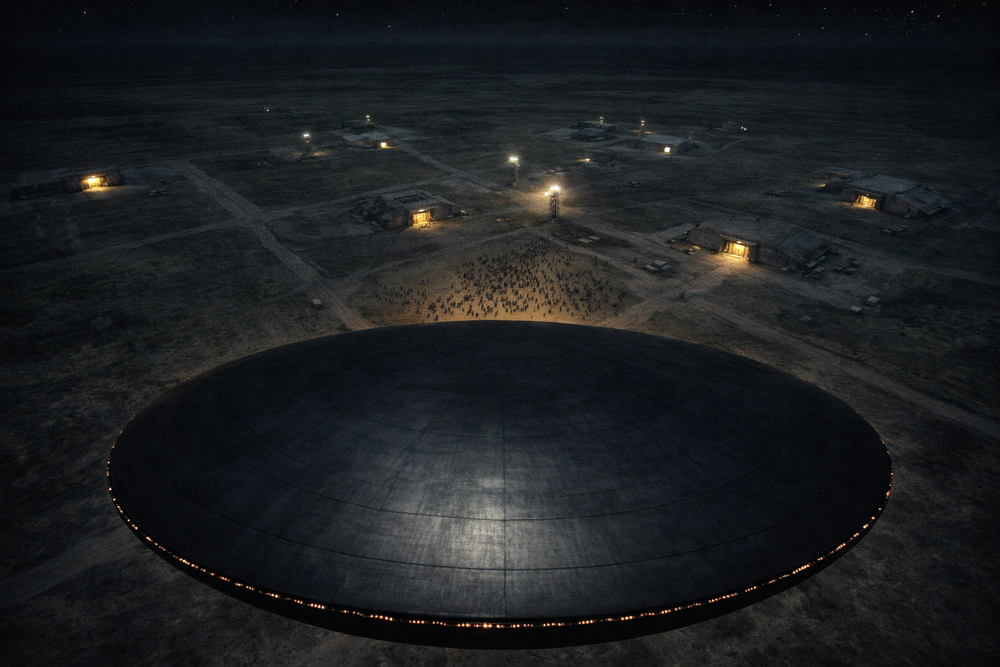
The evening of 4 October 1982 began unremarkably. Vladimir Matveyev, a twenty-year-old radio operator assigned to the 50th Missile Division, was at his post when something appeared in the sky above the base. He was not alone in seeing it. According to accounts gathered by researchers after the fall of the Soviet Union, approximately one thousand soldiers and officers — most of the base’s complement — witnessed the object over the course of nearly an hour.
The object was described consistently: an elliptical or disc-shaped craft, hovering at approximately one and a half kilometres from the base perimeter. Matveyev described it as roughly the size of a five-storey building. Other witnesses, interviewed by the Russian newspaper Life in 2010, described a craft of enormous apparent diameter — estimates reached 270 metres across. It was silent. It showed no navigation lights of a conventional kind. It moved with deliberate slowness, hovering and then repositioning, and it remained in the area for the duration of the incident rather than making a single pass and departing.
As the object hovered, the base’s communications systems began to fail. Radio equipment was disrupted and in some cases rendered inoperative. The interference was selective and localised to the base rather than being a general atmospheric disturbance — a detail noted by investigators reviewing the case and one that mirrors the communications disruptions documented at RAF Bentwaters during the Rendlesham Forest incident two years earlier, where Colonel Halt’s tape recorder malfunctioned and base radio communications failed at key moments.
“It was unbelievable. Approximately one and a half kilometres from us hovered an elliptical-shaped object. It had a perfect geometric shape. I had never seen anything like that before.”
— Vladimir Matveyev, Radio Operator, 50th Missile Division RVSN
Testimony given to Life newspaper journalist Inessa Kornienko, June 2010. Translated and cited in Robert Hastings, UFOs and Nukes: Extraordinary Encounters at Nuclear Weapons Sites (AuthorHouse, 2008), updated research notes.
Fifteen Seconds
What happened next transformed a remarkable sighting into a potential civilisational catastrophe. In the underground missile control bunker, the dual launch-control panels — the hardwired consoles connected to Moscow through redundant command channels — suddenly lit up. Both panels simultaneously. The signal lights indicating that the R-12 missiles were entering their pre-launch preparation sequence had activated.
No order had come from Moscow. No authorisation code had been entered. No button had been pressed. The duty officer, Lieutenant Colonel Plantonev, immediately contacted the Soviet Strategic Rocket Forces command in Moscow directly. The answer was unambiguous: no launch order had been transmitted. Moscow had sent nothing. And yet the consoles were showing that the missiles — nuclear-armed, targeted at cities in Western Europe — were preparing to launch.
For fifteen seconds, the base was in a state of controlled terror. Officers stood at their posts, hands away from all controls, watching the launch preparation indicators and doing precisely what their training required: nothing. The protocol for an unauthorised activation was to wait, verify, and under no circumstances take independent action. Those fifteen seconds were, in the words of Colonel Igor Chernovshev — one of four senior officers dispatched by Soviet military command to investigate — among the most frightening he ever experienced in his military career. Then the indicators reset. The pre-launch sequence terminated by itself. The missiles stood down. The object departed.
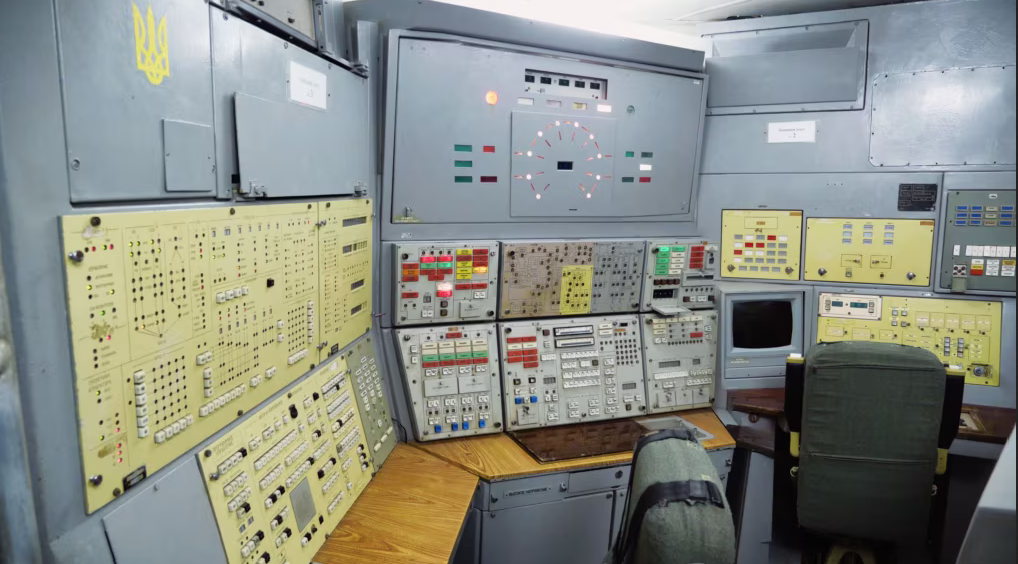
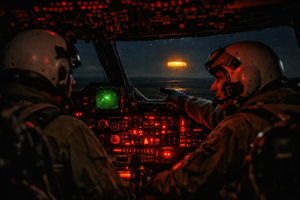
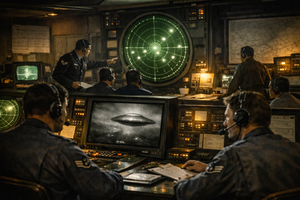
A Soviet nuclear missile launch control bunker of the type manned by crews of the 50th Missile Division at Byelokoroviche. On the evening of 4 October 1982, the dual launch-control panels in a bunker beneath this base simultaneously activated their pre-launch preparation sequence without any order from Moscow and without any action by the crew. For fifteen seconds, nuclear missiles pointed at Western Europe were preparing to fire. Then — as suddenly as it began — the sequence terminated by itself. Image: [CREDIT]
- Date: 4 October 1982, evening, Byelokoroviche IRBM base, Ukrainian SSR
- Approximately 1,000 military personnel witnessed a large elliptical object hovering near the base for close to one hour
- Object estimated at 270 metres in diameter; silent; showed no conventional navigation features
- Base radio communications disrupted and equipment damaged during the encounter
- Both dual launch-control panels simultaneously activated pre-launch preparation sequence without any authorisation from Moscow
- Moscow confirmed no launch order was transmitted; no code was entered by base personnel
- The unauthorised pre-launch sequence lasted approximately 15 seconds before resetting spontaneously
- A four-officer military commission led by Colonel Chernovshev was immediately dispatched to investigate
- Commander-in-Chief of Strategic Rocket Forces subsequently issued standing order R010: if a UFO is sighted, do not panic and do not shoot
- Case was classified; it emerged publicly only after the collapse of the Soviet Union in 1991
The Aftermath and the Order
The Soviet military’s response to Byelokoroviche was swift and institutional. A four-man investigative commission was dispatched almost immediately, headed by Colonel Igor Chernovshev. The commission collected witness statements, reviewed the technical data from the launch-control systems, and assessed the communications disruption. Their formal findings have never been fully declassified, but Chernovshev later spoke on the record about the incident in testimony gathered by ABC News journalists and subsequently in accounts accessed by researcher Robert Hastings.
What followed reveals the gravity with which the Soviet military leadership regarded the event. A few days after the incident, the base complement was assembled for a formal morning inspection. They were read a standing order — Order R010, issued by the Commander-in-Chief of the Strategic Rocket Forces — whose content, as recalled by Matveyev and other witnesses, was as follows: if you see a UFO, do not panic, and do not shoot. The order acknowledged, without explanation, that such encounters might occur again. It provided no explanation of what the objects were, no reassurance about their origin, and no guidance beyond that single instruction. Do not panic. Do not shoot.
Matveyev later described the effect of that order on the men who received it. Looking at the officers who had been stationed at the launch consoles during the incident — the men who had watched the launch indicators activate and had done nothing — he noticed something that has stayed with him. They looked old before their time. Their hair had turned grey.
“During this period, for a short time, signal lights on both control panels suddenly turned on — the lights showing that the missiles were preparing for launch. This could normally only happen if an order had been transmitted from Moscow. No such order had been given.”
— Colonel Igor Chernovshev, Soviet Military Investigation Commission
Testimony given to ABC News Prime Time Live investigation, broadcast 1994. Also cited in: Robert Hastings, UFOs and Nukes: Extraordinary Encounters at Nuclear Weapons Sites (AuthorHouse, 2008).
The Soviet UFO Programme
Byelokoroviche did not occur in an institutional vacuum. The Soviet Union had been investigating unidentified aerial phenomena with the same institutional seriousness — and the same official secrecy — as its American adversary, and for just as long. What distinguished the Soviet approach was its explicit framing of UAP as a potential strategic threat, rather than primarily a public relations problem.
Institute 22 and the Military Investigation Programme
The Soviet Ministry of Defence operated a classified UFO investigation unit known as Institute 22, which gathered and assessed reports from across the Soviet military’s vast infrastructure. Over its operational lifetime the institute investigated approximately 3,000 reported encounters. Of those, roughly five to ten percent remained unexplained when the programme was eventually wound down following the Soviet collapse. That residual figure — 150 to 300 genuinely unresolved cases from within the Soviet military alone — has never been publicly addressed.
The KGB Files and George Knapp
In the early 1990s, American investigative journalist George Knapp — the same reporter who first broke the Bob Lazar Area 51 story — made contact with Soviet sources during the opening of the post-Cold War period and obtained access to a cache of KGB UFO investigation documents. Those files, smuggled out of Russia without the knowledge of Russian intelligence services, revealed that the Soviet Union had run multiple classified UAP programmes simultaneously throughout the Cold War — publicly dismissing the phenomenon as American propaganda while privately investigating it with considerable institutional resources. The documents stopped short of drawing conclusions about the origin or nature of the objects, but their tone made one thing clear: the phenomenon was taken seriously at the highest levels of Soviet government.
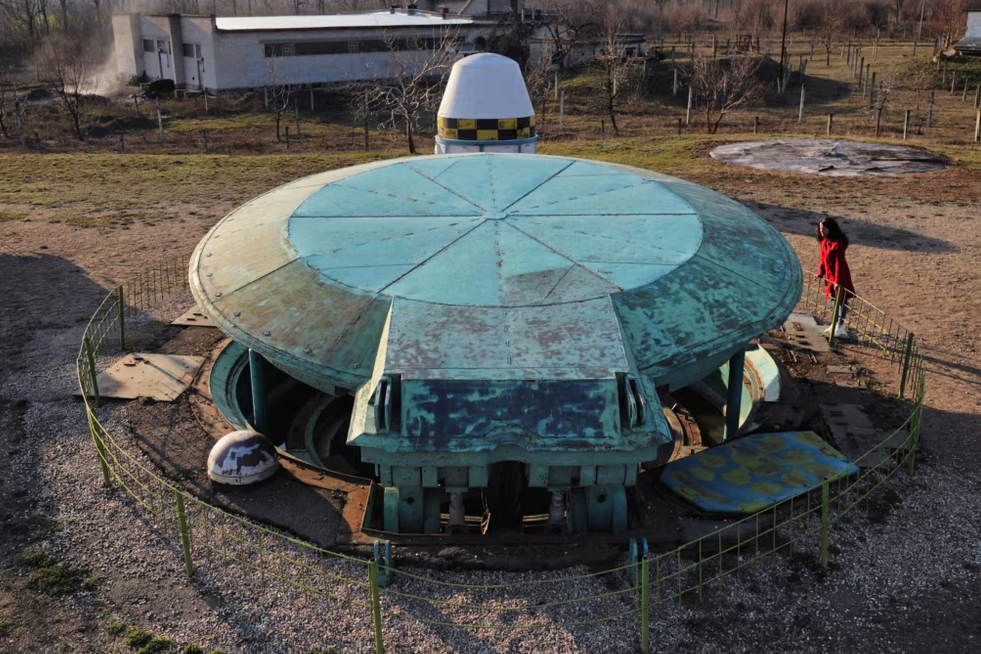
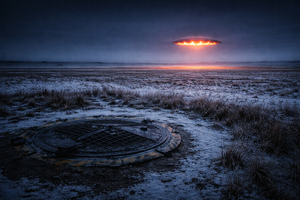
A former Soviet strategic rocket forces installation on the Ukrainian steppe — the landscape in which the 50th Missile Division maintained its R-12 intermediate-range ballistic missiles during the Cold War. These bases were among the most secure and heavily monitored installations in the Soviet Union, manned by personnel selected for psychological stability and absolute adherence to protocol. The events of 4 October 1982 tested both qualities to their absolute limit. Image: [CREDIT]
The Nuclear Pattern: Both Sides of the Cold War
The Byelokoroviche incident is most significant not in isolation but in the context of the accumulating pattern of UAP encounters at nuclear weapons installations on both sides of the Iron Curtain. That pattern, when viewed in aggregate, is difficult to dismiss as coincidence.
In March 1967 — fifteen years before Byelokoroviche — ten Minuteman I ICBMs at Echo Flight, Malmstrom Air Force Base in Montana, went simultaneously offline while security personnel reported a luminous object hovering over the site. At Minot Air Force Base in 1968, a B-52H crew tracked an unknown object on radarscope over a nuclear-armed base while ground security alarms activated at one of the missile sites. In both cases, an object was observed near nuclear assets, electronic anomalies occurred, and no official explanation was ever established.
What sets Byelokoroviche apart from these American cases is the direction of the anomaly. At Malmstrom, missiles went offline — they were disabled, rendered incapable of launch. At Byelokoroviche, the opposite occurred: missiles activated. Their pre-launch sequence initiated without authorisation. If the Malmstrom incidents demonstrated an apparent capacity to disable nuclear weapons, Byelokoroviche raised a question that Soviet military leadership clearly found deeply disturbing: could the same phenomenon also activate them?
That question has never been officially answered by any government. It remains, in the language of the intelligence community, an open collection requirement — which is to say, something that the relevant agencies have an interest in knowing and no confirmed answer to. The standing order issued after Byelokoroviche — do not shoot — suggests that Soviet military leadership reached at least one conclusion: that provoking whatever was in the sky above their missile bases was not advisable.
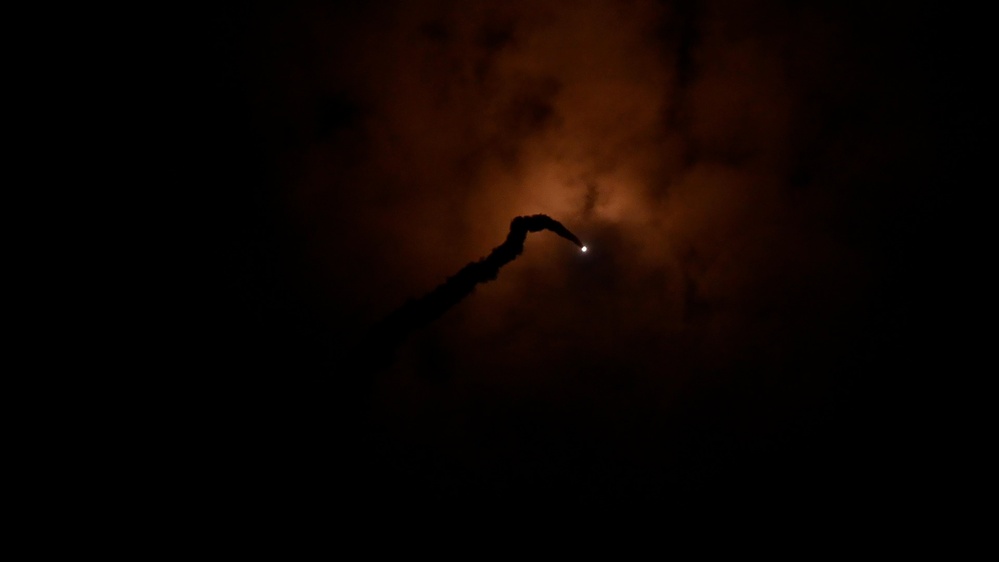
An unarmed Minuteman III ICBM test launch — the same class of missile that went offline without explanation at Malmstrom AFB in 1967. At Byelokoroviche in 1982, the Soviet equivalent — R-12 IRBMs — did something far more alarming: they began activating their pre-launch sequence without any order from Moscow. Both incidents remain officially unexplained. Image: U.S. Space Force / Staff Sgt. Joshua LeRoi / Public Domain via DVIDS.
The Sceptical Arguments
Sceptical Argument
The witness accounts only emerged after the Soviet collapse and cannot be verified
This is a legitimate evidential concern. Unlike the American nuclear base incidents, where partially declassified documents and Project Blue Book records provide some documentary anchor, the Byelokoroviche case rests primarily on testimony gathered after 1991 from former Soviet military personnel who had spent a decade unable to speak. The classified investigation commission’s findings have never been formally released. Researcher Robert Hastings, who has documented the case most thoroughly, acknowledges this limitation explicitly. What the sceptical argument cannot dismiss is that multiple independent witnesses — Matveyev, Chernovshev, Plantonev, and others — gave consistent, detailed, and non-contradictory accounts across different interviews and to different investigators over many years. The consistency of testimony from witnesses who had no plausible coordinating motive is not nothing.
Verdict: A genuine evidential limitation; does not explain the consistency of multiple independent witness accounts.
Sceptical Argument
The launch activation was a technical fault unrelated to the sighting
This is the most straightforward alternative explanation: the simultaneous activation of dual launch-control panels was a rare but explicable electrical or software fault, and the UFO sighting was a coincidence. The Soviet investigation commission was presumably required to consider this possibility. What is notable is that no technical fault was officially identified as the cause — if a mundane explanation had been found, the need for the subsequent standing order (do not panic, do not shoot) would have been significantly reduced. The simultaneous failure of both redundant launch-control panels — systems specifically designed to prevent exactly the kind of spurious activation that occurred — without any identifiable cause is itself an anomaly that deserves explanation regardless of the UFO context. The two phenomena occurring in combination strains the coincidence hypothesis considerably.
Verdict: Possible but unsupported; no technical fault was ever identified, and the dual-panel redundancy system makes a simultaneous spurious activation exceptionally improbable.
Sceptical Argument
The thousand-witness figure is implausible and likely exaggerated
The figure of approximately one thousand witnesses refers to the total complement of the base, most of whom were reportedly outside or able to see the sky during the approximately one-hour duration of the encounter. A Soviet missile base of this type would have had a personnel complement in that range. The figure is not implausible in itself — it simply describes most of a base’s personnel observing something in the sky for nearly an hour. It is comparable in scale to the Belgian UFO wave, where thousands of witnesses including police and military personnel reported identical observations across an extended period. Mass sightings by trained military personnel at a single secure installation are precisely the kind of evidence that is hardest to dismiss on psychosocial grounds.
Verdict: The scale of the claim is unusual but not inherently implausible; a base complement of that size observing a prolonged event is consistent with the known facts.
Why It Matters
The Byelokoroviche incident matters for a reason that goes beyond any single case: it establishes that the UAP phenomenon at nuclear installations was not a uniquely American experience. The same pattern of encounters — unidentified objects near nuclear assets, electronics and communications disrupted, weapons systems behaving anomalously — was occurring on both sides of the Iron Curtain simultaneously, in complete secrecy, in two of the most heavily monitored military environments on earth. Neither superpower told the other. Neither superpower told its own public. Both issued internal orders and carried on.
The direction of the anomaly at Byelokoroviche deserves particular attention. The Malmstrom shutdowns could, at a stretch, be framed as a safety intervention — something disabling weapons rather than activating them. Byelokoroviche cannot be framed that way. Whatever activated those launch-preparation sequences in October 1982 demonstrated a capability to initiate a nuclear launch sequence in one of the most hardened and access-controlled military systems ever built, without authorisation, without physical presence in the bunker, and without leaving any identifiable trace. That capability — if it was demonstrated deliberately rather than accidentally — is among the most consequential and unsettling facts in the history of the nuclear age.
It is worth noting that in September 1983 — less than a year after Byelokoroviche — Soviet early-warning officer Lieutenant Colonel Stanislav Petrov famously declined to report a false missile launch alarm as real, preventing a Soviet retaliatory strike against the United States based on what turned out to be a satellite malfunction. The world came to the brink of nuclear war through a technical error. At Byelokoroviche, something that was not a technical error had already brought it there first. Nobody outside the Soviet military knew.
The 2023 Congressional UAP hearings in the United States, at which former intelligence official David Grusch testified under oath about alleged non-human recovered materials and a systematic programme of institutional suppression, did not address the Soviet nuclear base encounters. They should. The pattern of incidents — Malmstrom, Minot, Tehran, Rendlesham, Byelokoroviche, and the broader Belgian wave — taken together describes not isolated curiosities but a sustained and unacknowledged presence at the most sensitive military installations of the Cold War era. The honest question is not whether these incidents happened. The honest question is what was doing it, and what, if anything, any government has since found out.
Cold War UFO Case Files Series
The Byelokoroviche incident is Case 05 in the Stranger Times Cold War UFO Case Files series. Each article examines a distinct Cold War-era military encounter in the same depth — primary sources, witness testimony, official response, and the sceptical arguments that have been proposed and tested against the evidence.
- Case 01 · Malmstrom AFB Missile Shutdown, USA — 1967
- Case 02 · Minot AFB Encounter, USA — 1968
- Case 03 · Tehran Phantom Intercept, Iran — 1976
- Case 04 · Rendlesham Forest Incident, UK — 1980
- Case 05 · Soviet Missile Base Incident, USSR — 1982 (This Article)
- Case 06 · Belgian UFO Wave — 1989–1990
Sources
- Hastings, Robert. UFOs and Nukes: Extraordinary Encounters at Nuclear Weapons Sites. AuthorHouse, 2008. (Primary English-language research source for Byelokoroviche.)
- Kornienko, Inessa. “UFO Activated Nuclear Missiles.” Life (Russian newspaper), 16 June 2010. (Interviews with Matveyev and other witnesses; translated by Hastings.)
- Ensor, David. “Soviet UFO Secrets.” ABC News Prime Time Live television investigation, broadcast 1994. (Includes on-record testimony from Chernovshev and Plantonev.)
- Stonehill, Paul. The Soviet UFO Files: Paranormal Encounters Behind the Iron Curtain. Quadrillion Publishing, 1998.
- Knapp, George (KLAS-TV / NewsNation). KGB UFO investigation documents, obtained 1991–1993. Partially released 2026.
- Wikipedia. “Byelokoroviche incident.” Consulted March 2026.
- Wikipedia. “Institute 22.” Consulted March 2026.
- Wikipedia. “UFO sightings in Russia.” Consulted March 2026.
- National Press Club. UFOs and Nukes Press Conference. Washington D.C., 27 September 2010. (Context for broader nuclear UAP pattern.)
— End of Case File —
Research drawn from publicly available documentation, post-Soviet witness testimony, and on-the-record accounts by former Soviet military personnel.
Part of the Stranger Times Cold War UFO Case File series.