Contents
- Iran in 1976: A Cold War Ally on the Frontline
- The Initial Reports
- First Scramble: Nazeri Loses Everything
- Second Scramble: Jafari and the Dogfight
- Sub-Objects, Ground Traces and the Beeper Signal
- The DIA Report: A Classic That Reached the White House
- Debunking the Debunkers
- Aftermath: Revolution, Records and Silence
- The Unanswered Questions
- Primary Documents
- Cold War UFO Case Files Series
- FAQ
In the pre-dawn hours of September 19, 1976, two Imperial Iranian Air Force F-4 Phantom II interceptors were scrambled into the airspace above Tehran to intercept an unidentified object that had been reported by civilians, confirmed visually by a general standing on his roof, and tracked on ground radar. What followed over the next two hours was not a brief or ambiguous encounter. It was a sustained, multi-phase aerial engagement in which both aircraft experienced systematic instrumentation failures, one pilot found his weapons console dead at the precise moment he attempted to fire, and the object itself appeared to release smaller luminous sub-objects that manoeuvred independently before rejoining the primary craft. The following morning, a search team traced a signal from the alleged landing site to a farmhouse whose occupants reported a loud noise and brilliant light in the night.
The Tehran incident is unique in the Cold War UAP record for the breadth and calibre of the institutions that took it seriously. The U.S. Defense Intelligence Agency produced a formal assessment that was distributed to the White House, the Secretary of State, the Joint Chiefs of Staff, the NSA and the CIA. That assessment described the case as an outstanding report, one that met all the criteria necessary for a valid study of the UAP phenomenon. The Iranian military classified the object as unidentified. The pilot who led the second intercept, Parviz Jafari, later a General, spent the remainder of his career speaking publicly about what he encountered. No government has ever produced a credible conventional explanation for what disabled two NATO-equipped fighter aircraft in the skies above Tehran on the night of September 18 to 19, 1976.
Iran in 1976: A Cold War Ally on the Frontline
To understand the full weight of the Tehran incident, it is necessary to understand what Iran was in 1976. Under Shah Mohammad Reza Pahlavi, Iran was one of the United States' most strategically important allies in the Middle East, a bulwark against Soviet expansion toward the Persian Gulf. The Imperial Iranian Air Force was equipped with American aircraft including the F-4 Phantom II and, by 1976, was in the process of acquiring F-14 Tomcats, among the most advanced fighter aircraft in the world at the time. American military advisors and technical personnel were stationed at Iranian air bases. The IIAF's pilots flew U.S.-made aircraft, trained with U.S. procedures, and operated within a command structure closely integrated with American military doctrine.
This context matters for a reason that the sceptical literature consistently ignores. The suggestion that the Tehran incident can be explained by pilot incompetence, unfamiliarity with night flying, or faulty equipment at an under-resourced air force is historically illiterate. The pilots who flew on the night of September 19, 1976 were operating American-built aircraft maintained by American technicians at a base where the U.S. military had a direct operational presence. The claim that they were incapable of distinguishing Jupiter from a manoeuvring object at close range, and that this confusion somehow caused two separate aircraft systems to fail at proximity and recover at distance, is not a serious explanation. It is a characterisation that dissolves on contact with the historical record.
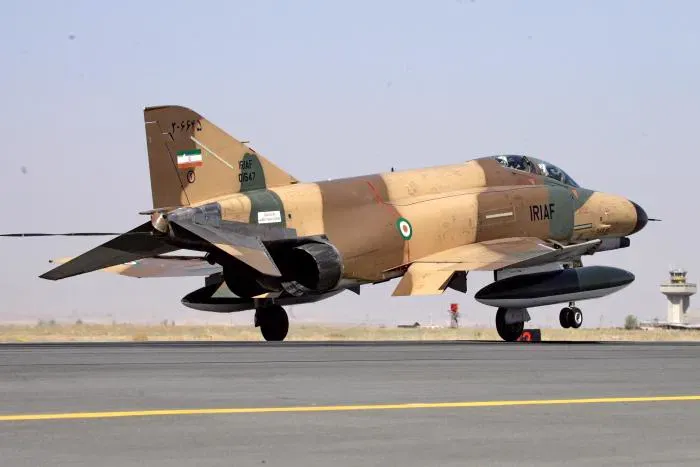
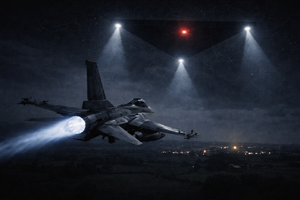
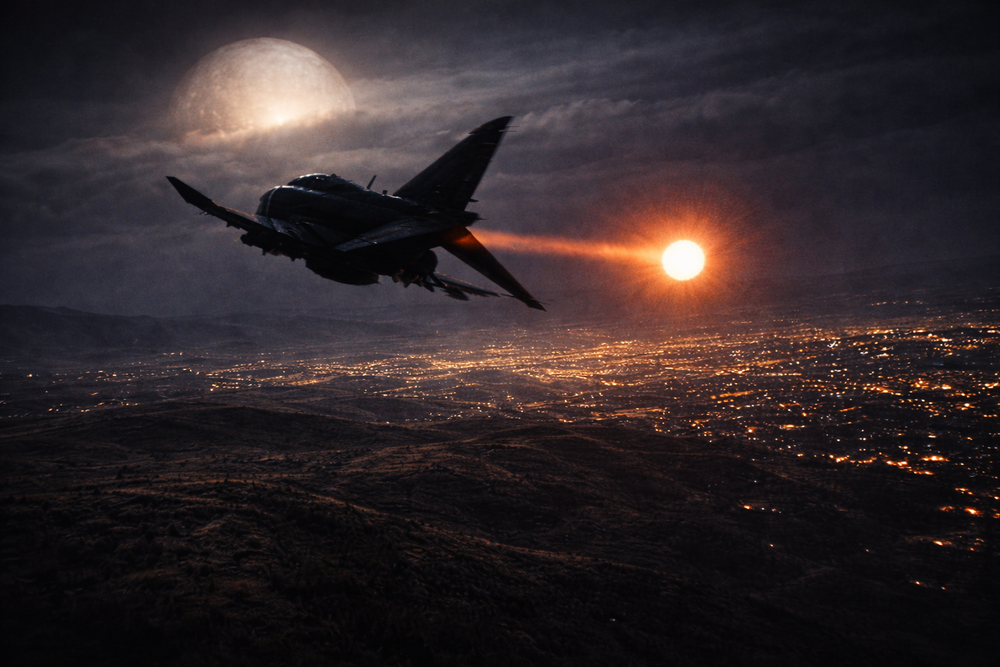
The F-4 Phantom II, the aircraft type flown by the Imperial Iranian Air Force on the night of September 19, 1976. Two Phantoms were scrambled from Shahrokhi Air Force Base near Hamadan. Both experienced systematic instrumentation and communications failures as they approached the object. Both recovered normal function when they withdrew. Download from: dvidshub.net/image/7468356 — U.S. Air Force / Public Domain.
The Initial Reports
Shortly after midnight on September 19, the Imperial Iranian Air Force command post in Tehran's Shemiran district began receiving telephone calls from civilians reporting a luminous object in the sky to the north of the city. The calls described something that did not behave like any conventional aircraft: bright, multicoloured, moving erratically, at times appearing to hover. The night duty officer, General Nader Yousefi, initially attributed the reports to a star or planet. He then looked for himself from the roof of his house. He immediately called the tower at Mehrabad Airport. The tower supervisor, Hossein Pirouzi, an experienced air traffic controller who was leading a training session when the calls began, confirmed the object through binoculars. He described a luminous cylindrical object approximately six thousand feet above the ground, sitting horizontally in the sky, glowing red, yellow and orange.
Pirouzi's observation is significant in ways that are rarely foregrounded in sceptical analyses. He was not a pilot unfamiliar with night conditions, not a civilian untrained in atmospheric observation, and not a single witness. He was a professional air traffic controller conducting a formal training exercise at the time. His assessment that the object was not an aircraft, not a star, and not any phenomenon he recognised was the direct trigger for General Yousefi's decision to scramble an interceptor. The tower radar at Mehrabad was undergoing maintenance that night and was not available, but the visual confirmation from Pirouzi and Yousefi independently, at distance, was sufficient. The first F-4 was airborne from Shahrokhi Air Force Base at 01:30.
First Scramble: Nazeri Loses Everything
The first aircraft, flown by Lieutenant Yaddi Nazeri, climbed toward the object and obtained radar contact at approximately 25 nautical miles. As Nazeri closed the distance, the aircraft began to fail. Instrumentation degraded. Communications collapsed, both UHF and intercom. The F-4 was effectively blinded. Nazeri broke off the intercept and turned for home. According to the official documentation, all systems were restored the moment the aircraft withdrew and was no longer on an approach vector toward the object.
That pattern of failure at proximity and recovery at distance is the single most important detail in the entire Tehran case. It is not consistent with a faulty aircraft, because a genuinely malfunctioning system does not restore itself when the aircraft changes heading. It is not consistent with electronic interference from a known natural phenomenon, because no natural phenomenon was identified in the vicinity. And it is not consistent with pilot error, because systems failures are not caused by the direction in which a pilot flies. The pattern implies a directed, proximity-dependent effect whose source was whatever the object was. The first scramble ended inconclusively, but it established the pattern that the second would confirm.
Second Scramble: Jafari and the Dogfight
At 01:40, General Yousefi authorised a second scramble. Major Parviz Jafari, a squadron commander and experienced pilot, launched with First Lieutenant Jalal Damirian as his weapons officer. Jafari acquired radar contact at 27 nautical miles. The object's radar return was comparable in size to a Boeing KC-135 Stratotanker. Visually, as Jafari closed the distance, it presented as an intensely bright light flashing through red, green, orange and blue so rapidly and so brilliantly that Jafari later said he was unable to see the craft's body behind it.
As Jafari continued his approach, the object began to move, accelerating in a way that kept consistent separation from the F-4. The pursuit took them south toward the outskirts of Tehran. Then a smaller luminous object separated from the primary craft and came directly toward Jafari's aircraft at high speed. Jafari interpreted this as an attack and attempted to fire an AIM-9 Sidewinder infrared guided missile. At the precise moment he moved to fire, his weapons console went dead. Communications failed. Instrumentation collapsed. Jafari executed an evasive manoeuvre, breaking away from the approaching sub-object, which then ceased its approach and returned to the primary craft. The moment Jafari's aircraft was no longer on an attack vector, systems began to restore.
“I was startled by a round object which came out of the primary object and started coming straight toward me at a high rate of speed. I thought it was going to collide, so I broke off. The aircraft’s weapons control system failed. My communications failed. As I turned away, everything came back.”
— Major Parviz Jafari, Imperial Iranian Air Force, pilot of the second F-4 scramble
Testimony given at the National Press Club, Washington D.C., November 12, 2007. Also cited in: Kean, Leslie, UFOs: Generals, Pilots, and Government Officials Go On the Record (Harmony Books, 2010), Chapter 5.

Tehran and its surrounding airspace was the theatre for the September 1976 encounter. The object was initially observed north of the city, pursued south as Jafari gave chase, and sub-objects were reported descending toward the outskirts. A search team traced a signal the following morning to a farmhouse whose occupants reported a loud noise and bright light. Replace with your preferred Tehran aerial image.
Sub-Objects, Ground Traces and the Beeper Signal
During the second engagement, a total of three smaller objects were observed separating from and returning to the primary craft. The first, as described above, moved toward Jafari's aircraft before returning when he broke off. The second descended rapidly toward the ground south of Tehran and appeared to land or settle in an open field, where it illuminated the surrounding terrain with a sustained glow visible to the aircrew. A third was observed passing low over Mehrabad Airport's control tower, at which point the tower's own communications equipment failed, as did the electronics aboard a commercial airliner operating in the area at the time.
The following morning, Jafari and his crew flew a helicopter to the location where the second sub-object appeared to have descended. The site proved to be a dry lake bed. No physical traces were immediately identifiable in daylight. The crew then flew a search pattern to the west and began picking up a regular electronic beeping signal, which grew stronger as they approached a small farmhouse. When they landed and questioned the occupants, the residents described a loud noise and a brilliant light the previous night. The beeping signal was subsequently identified as consistent with a distress beacon of the type installed on U.S. military C-141 transport aircraft, which were known to eject their beacons under certain conditions over mountainous terrain. This detail, which sceptics have occasionally used to reduce the significance of the ground evidence, cuts in both directions: it confirms that a search was conducted, that a signal was found, and that the DIA investigators considered the site worth documenting in a formal intelligence report.
- Object initially reported by multiple civilians to the IIAF command post, confirmed visually by General Yousefi and air traffic controller Hossein Pirouzi independently
- First F-4 scramble: radar contact at 25 nm, total instrumentation and communications failure on approach, full system recovery on withdrawal
- Second F-4 scramble: radar contact at 27 nm, radar return comparable to a Boeing KC-135, object visually described as intensely brilliant multicoloured light
- Weapons console failure on Jafari's aircraft at the precise moment he attempted to fire an AIM-9 Sidewinder, with full recovery on breaking off
- Three sub-objects observed separating from and returning to the primary craft; one descended toward the ground south of Tehran
- Mehrabad Airport tower communications and a nearby commercial airliner's electronics both failed during the primary object's low pass
- Ground search the following morning produced an electronic beeper signal traced to a farmhouse whose occupants confirmed loud noise and bright light
- U.S. Defense Intelligence Agency report distributed to the White House, Secretary of State, Joint Chiefs of Staff, NSA and CIA described the case as a classic meeting all criteria for a valid UAP study
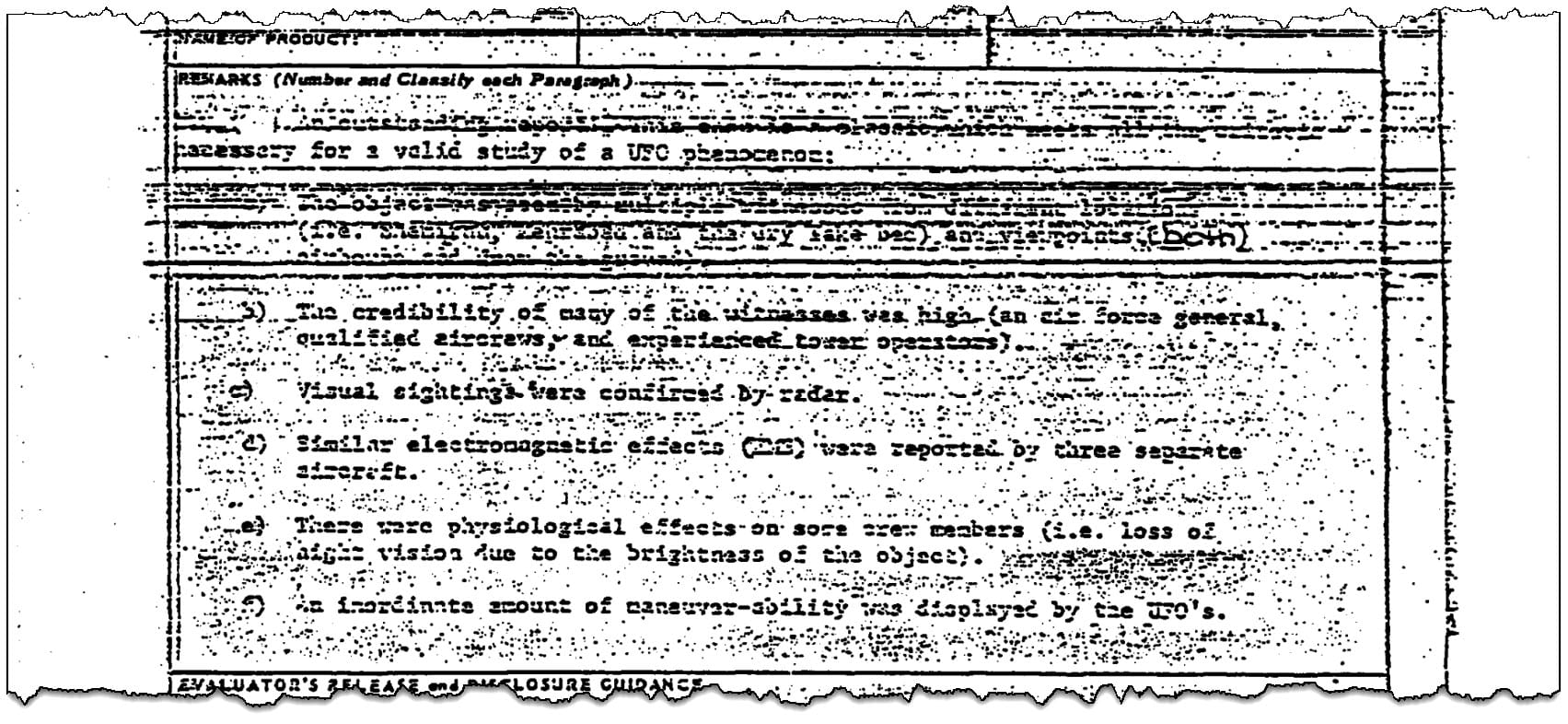
The declassified U.S. Defense Intelligence Agency assessment of the Tehran incident, released under FOIA. The DIA evaluator wrote that the case was outstanding and met all criteria for a valid UAP study. The report was distributed to the White House, Secretary of State, Joint Chiefs of Staff, NSA and CIA. It is one of the most significant documents in the history of official UAP research. Available via The Black Vault: theblackvault.com/casefiles/the-1976-iran-incident
The DIA Report: A Classic That Reached the White House
On the day of the incident, the U.S. Defense Attaché in Tehran forwarded an initial report to the Defense Intelligence Agency. A full DIA Intelligence Information Report followed, running to four pages and summarising the incident in formal military language with a matter-of-fact precision that makes its conclusions all the more striking. The DIA evaluator's summary assessment has been quoted so frequently in the UAP literature precisely because it is so unambiguous. The case, the evaluator wrote, was an outstanding report that met all the criteria necessary for a valid study of the UAP phenomenon: multiple witnesses from different locations and physical viewpoints, both airborne and from the ground; instrumented aircraft and ground-based radar; reports from credible observers with multiple witnesses to each event; physical effects on the aircraft and their equipment; and a phenomenon observed by experienced military officers.
That report was distributed to the White House, the Secretary of State, the Joint Chiefs of Staff, the NSA and the CIA. General John Secord, then chief of the U.S. Air Force mission in Iran, attended a high-level briefing with Iranian authorities and the pilots and air traffic controllers involved. The incident was taken seriously at the highest levels of both governments. The fact that no public official explanation was ever produced is therefore not evidence that the incident was trivial. It is evidence that the incident generated significant institutional attention and was then deliberately removed from the public record.
Debunking the Debunkers
The Tehran incident has attracted serious sceptical analysis, most notably from journalist Philip Klass in his 1983 book and from aerospace writer James Oberg. Their explanations, examined against the primary evidence, reveal the same methodological weakness found in the Blue Book analysis of the Minot case: a strategy of explaining isolated elements in separation rather than accounting for the convergence of evidence as a whole.
The Object Was Jupiter or the Star Capella
Philip Klass and James Oberg both proposed that the primary object was the planet Jupiter, which was bright in the Tehran sky in September 1976, with the star Capella as an alternative candidate. The astronomical misidentification hypothesis faces several insurmountable problems. Jupiter is a fixed point source at astronomical distance. It does not close on an aircraft, maintain separation at a consistent range, manoeuvre to the south, or separate into three independently manoeuvring sub-objects that then return to rejoin it. Jafari's radar return showed a contact comparable in size to a Boeing KC-135. Jupiter does not generate a radar return of any kind, at any range, on any aircraft radar system. Moreover, Klass himself had to concede that he could not prove his Jupiter theory. The most a planet can explain is the initial civilian reports of a bright light in the sky. It explains nothing that occurred once the aircraft were airborne, nothing about the instrumentation failures, and nothing about the sub-objects. Klass also, as Enigma Labs researchers have documented, falsely stated that only one aircraft experienced equipment failure, when the primary documentation clearly records both did.
Verdict: A planet cannot generate radar returns, manoeuvre, release sub-objects, or cause proximity-correlated instrumentation failures on two separate aircraft. The explanation accounts for at most the initial civilian visual reports.
Equipment Failures Were Pre-Existing Faults
Klass cited a Westinghouse technician's claim that one of the F-4s had a history of electrical problems and had been repaired only a month before the incident, and a McDonnell Douglas supervisor's suggestion that the radar may have been in manual tracking mode. These claims have several problems. First, Klass falsely attributed the equipment failures to only one aircraft, when the primary DIA documentation records both aircraft experiencing failures on approach and recovery on withdrawal. A pre-existing fault in one aircraft cannot explain identical proximity-correlated failures in two separate aircraft on the same night. Second, the defining characteristic of the failures documented in Tehran was not that they occurred, but that they recovered consistently when the aircraft withdrew. A genuine pre-existing electrical fault does not resolve itself when the pilot changes heading. The proximity-correlated recovery pattern is the evidential core of the case, and it is precisely this pattern that the equipment fault hypothesis cannot address.
Verdict: Cannot account for proximity-correlated recovery in either aircraft. Klass's factual error in attributing failures to only one jet further undermines the credibility of his analysis.
Pilots Were Tired, Inexperienced at Night Flying and Misperceiving Meteors
Brian Dunning proposed that Jafari and other crew may have misidentified the Gamma Piscids and Southern Piscids meteor showers active on September 19, and that the pilots may have been unaccustomed to night flying. The Metabunk forum discussion of this theory also noted, via American technicians, that the Shahrokhi pilots had limited night flying experience. This line of argument has been comprehensively rejected by independent researchers for several reasons. Meteors are transient events lasting seconds. They do not hover, maintain consistent separation from a pursuing aircraft, produce sustained radar returns, or release multiple sub-objects that independently manoeuvre and return. The object tracked by Jafari held station relative to his aircraft across the entire southern pursuit, a period of many minutes, not seconds. Furthermore, the suggestion that pilot inexperience caused radar contacts, communications failures and weapons system failures in two separate aircraft simultaneously is not a coherent causal chain. Inexperienced pilots do not malfunction their own avionics by looking at the sky incorrectly.
Verdict: Meteors cannot sustain radar returns, maintain station relative to a moving aircraft, or cause avionics failures. Fatigue and inexperience are not causal mechanisms for instrumentation collapse.
The DIA Report Was Merely a Forwarding Document With No Real Analytical Weight
Some sceptical commentary has attempted to minimise the DIA report by characterising it as a routine forwarding document that simply relayed Iranian Air Force claims without independent verification. The distribution list alone refutes this. A forwarding document sent to the White House, the Secretary of State, the Joint Chiefs of Staff, the NSA and the CIA is not a routine piece of paperwork. It is a document that was assessed at the highest levels of the U.S. intelligence and military establishment as warranting the attention of those institutions. The DIA evaluator's written assessment, describing the case as a classic meeting all criteria for a valid UAP study, represents an explicit analytical judgment, not a passive transmission. General Secord's subsequent attendance at a high-level briefing with Iranian authorities and the pilots confirms that the incident received direct human intelligence attention beyond what appears in the declassified written record.
Verdict: The distribution list and the evaluator's explicit written assessment confirm the DIA report carried genuine analytical weight. The suggestion it was merely administrative is contradicted by its content and its audience.
Aftermath: Revolution, Records and Silence
The Tehran incident occurred three years before the Iranian Revolution of 1979, which brought down the Shah and transformed Iran from a close U.S. ally into a hostile state. That political transformation had a direct and irreversible consequence for the documentary record of the 1976 incident: all Iranian military archives became inaccessible to Western researchers, where they have remained. The Iranian officers most directly involved, including General Yousefi and General Jafari, eventually went into exile in the United States, where both gave repeated on-the-record testimony about what they experienced. Their accounts have been substantially consistent across multiple decades of interviews, television appearances and public presentations.
General Jafari, who rose to command rank before leaving Iran, spoke at the National Press Club in Washington in November 2007 alongside other military officers from multiple countries who had experienced UAP encounters. His account of the September 1976 engagement, delivered in public under his own name and rank, has never been retracted or qualified. Leslie Kean's landmark 2010 book, in which Jafari contributed a detailed first-person chapter, brought the Tehran case to a wider readership and established it as one of the reference cases in modern UAP research. The case was cited in the context of the 2021 ODNI Preliminary Assessment on UAP, which acknowledged that UAP had been reported by military personnel with instrumentation effects and that the phenomenon warranted serious investigation.
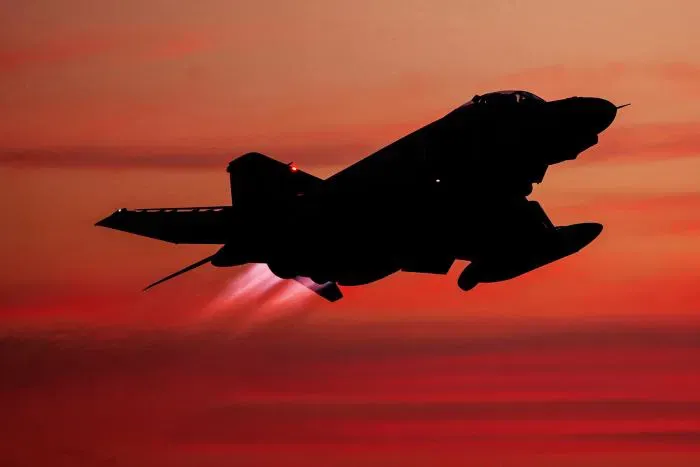
The F-4 Phantom II was among the most capable fighter aircraft in the world in 1976. The Imperial Iranian Air Force operated American-built Phantoms maintained by American technicians. The suggestion that the Tehran incident can be attributed to pilot incompetence or equipment familiar to under-resourced operators is contradicted by the historical record of the IIAF at that time. Download from: dvidshub.net/image/6235351 — U.S. Air Force / Public Domain.
The Unanswered Questions
The Tehran incident produced more high-level official documentation than almost any other Cold War UAP case, and yet the questions at its centre have never received a credible official answer. Nearly fifty years after the event, the following remain without resolution:
- What mechanism caused both aircraft systems to fail on approach and restore on withdrawal in a consistent, proximity-correlated pattern across two separate aircraft?
- What generated the radar return comparable in size to a KC-135 Stratotanker, tracked by Jafari at 27 nautical miles and confirmed on ground radar?
- What were the three sub-objects, and what physical principle allowed them to manoeuvre independently and return to the primary craft?
- What descended and appeared to land south of Tehran, and what generated the beeper signal traced to the farmhouse the following morning?
- What did General Secord's high-level briefing with Iranian and American authorities establish, and where is the record of that briefing?
- What Iranian military documentation of the incident existed before the 1979 Revolution, and has any of it survived?
Primary Documents and Further Research
- The Black Vault: Full Case File with Declassified DIA Documents The most comprehensive publicly available collection of primary documentation including the DIA report, State Department cables, and witness statements.
- DIA Intelligence Information Report: Iran UFO 1976 (PDF) The declassified Defense Intelligence Agency assessment, released under FOIA. Distributed to the White House, Joint Chiefs, NSA and CIA.
- USAF Security Services MIJI Newsletter: Tehran Incident Write-Up (DoD PDF) The U.S. Air Force Security Services quarterly MIJI newsletter editorial on the Tehran incident, acknowledging the case as notable and unresolved.
- Enigma Labs: Tehran Incident Reference Entry Comprehensive analytical reference including primary source citations, timeline, and assessment of the sceptical arguments.
Cold War UFO Case Files Series
The Tehran incident is the third case in the Stranger Times Cold War UFO Case Files series. It shares key structural features with the earlier cases at Malmstrom and Minot: credible trained witnesses, multi-platform instrument corroboration, proximity-correlated effects on military hardware, and an official response that acknowledged the incident in internal documents while declining to address it honestly in public. Tehran adds a dimension neither previous case possessed: the documented reaction of a foreign military and two allied intelligence communities, both of which concluded that what occurred was unidentified and significant. The weapons system failures witnessed here would echo again in a Soviet missile base in Ukraine six years later, where proximity to an unidentified object triggered an unauthorised nuclear launch sequence.
- Case 01 · Malmstrom AFB Missile Shutdown, USA — 1967
- Case 02 · Minot AFB B-52 Encounter, USA — 1968
- Case 03 · Tehran Phantom Intercept, Iran — 1976 (This Article)
- Case 04 · Rendlesham Forest Incident, UK — 1980
- Case 05 · Soviet Missile Base Incident, USSR — 1982
- Case 06 · Belgian UFO Wave — 1989–1990
Frequently Asked Questions
What makes the Tehran 1976 UFO incident significant?
Three things set Tehran apart from most military UAP cases. First, the breadth of institutional documentation: the U.S. DIA produced a formal assessment distributed to the White House, Joint Chiefs, NSA and CIA. Second, the proximity-correlated instrumentation failures across two separate aircraft, a pattern that rules out pre-existing faults and has never been explained. Third, the quality and consistency of the witnesses: professional military pilots, a general, and an experienced air traffic controller, all providing accounts that have remained substantially consistent for nearly fifty years.
Was it really Jupiter?
Philip Klass proposed Jupiter as the primary object. Jupiter was bright in the Tehran sky in September 1976 and may account for the initial civilian reports of a bright light. It cannot account for the radar return comparable to a KC-135 Stratotanker, the manoeuvring and pursuit across the southern Tehran airspace, the release of sub-objects, or the proximity-correlated instrumentation failures on two aircraft. Klass himself could not prove his theory and acknowledged it was only likely. No planet generates radar returns or disables avionics.
What happened to General Jafari?
Parviz Jafari rose to General rank in the Imperial Iranian Air Force before the 1979 Revolution. He subsequently emigrated to the United States. He has spoken publicly about the incident on many occasions, including at the National Press Club in Washington in November 2007, in Leslie Kean's 2010 book, and in multiple documentary films. His account has remained consistent and detailed across decades of public testimony.
How does Tehran compare to other Cold War UAP cases?
Tehran is the only Cold War UAP case to have generated formal documentation distributed simultaneously to the White House, Secretary of State, Joint Chiefs, NSA and CIA. It shares the proximity-correlated systems failure pattern with the Minot B-52 case of 1968 and the weapons-adjacent anomalies of Malmstrom 1967, but uniquely involves an attempted weapons engagement: a pilot attempting to fire a missile at close range whose system failed at the precise moment of the attempt.
Sources
- Defense Intelligence Agency. Intelligence Information Report: Iran UFO Incident, 19 September 1976. Declassified via FOIA, released 1977.
- Kean, Leslie. UFOs: Generals, Pilots, and Government Officials Go On the Record. Harmony Books, New York, 2010. Chapter 5: General Parviz Jafari.
- Klass, Philip J. UFOs: The Public Deceived. Prometheus Books, 1983. Chapter on the Tehran incident.
- Jafari, Parviz. Testimony at National Press Club, Washington D.C., November 12, 2007.
- Pirouzi, Hossein. Interviews conducted by Bob Pratt, National Enquirer, October and November 1976.
- U.S. Air Force Security Services. MIJI Quarterly Newsletter editorial on the Tehran incident, 1976. Archived at media.defense.gov.
- Hastings, Robert. UFOs and Nukes: Extraordinary Encounters at Nuclear Weapons Sites. AuthorHouse, 2008.
- Tulien, Thomas. Sign Oral History Project references to the Tehran case within the broader Cold War UAP record. minotb52ufo.com.
— End of Case File · Tehran 1976 —
Research drawn from declassified U.S. DIA and State Department documentation, FOIA-released records,
and on-the-record testimony from named former military personnel.
Part of the Stranger Times Cold War UFO Case File series.