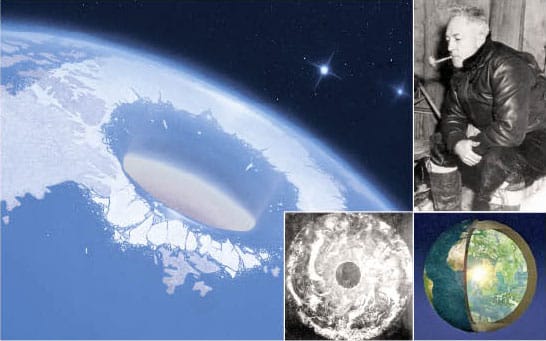
In 1968, the ESSA-7 satellite, operated by the United States Department of Commerce, captured images of the North Pole that sparked renewed interest in the hollow Earth theory. One photograph showed the pole shrouded in clouds, while a second, cloud-free image revealed a conspicuous dark area where the pole should have been. This was widely interpreted by proponents like ufologist Ray Palmer as proof of a vast hole at the pole, potentially an entrance to an underground civilisation. The theory was bolstered by early 20th-century polar explorer Vice Admiral Richard E. Byrd’s alleged flights beyond the poles, where he purportedly reported lush landscapes beneath the ice. These claims, popularised in works by Amadeo Giannini and others, suggested a “donut-shaped” Earth with massive cavities at each pole, inhabited by advanced beings linked to UFO activity.
Closer investigation reveals important contradictions and clarifications. The “hole” visible in satellite composites is understood by scientists as a result of image stitching from multiple time points over 24 hours, during which the poles were in darkness and thus appear black in the final mosaic. Byrd’s purported reports of tropical animals and forests underground stem largely from second-hand accounts and speculative fiction rather than verified logs. Geological and seismic measurements conclusively demonstrate that Earth consists of a layered structure: a solid crust, mantle, liquid outer core, and solid inner core, with no hollow cavities. The accounts of Byrd flying thousands of kilometres beyond the poles are inconsistent with geographic reality, as these routes would traverse open ocean or thick ice rather than entering the Earth’s interior. Despite this, the theory remains influential among some UFO researchers who associate it with secret bases for extraterrestrial craft, often linked to unexplained volcanic phenomena such as those at Popocatépetl.
The hollow Earth concept is deeply embedded in folklore and myth, from ancient Mesopotamian journeys to the underworld, Greek tales of Orpheus, to Hindu and Buddhist traditions of subterranean realms like Agharta. It has also inspired significant literary works by Poe, Verne and Burroughs, which fed popular fascination. Scientifically, belief in a hollow planet was considered in early modern eras by figures such as Edmund Halley and Leonard Euler but was later dismissed due to advances in geology and seismology. The persistence of hollow Earth themes in UFO lore reflects broader human fascination with hidden worlds and lost civilisations, often intertwined with mystery and the paranormal. This cultural backdrop continues to shape interpretations of ambiguous evidence, despite established scientific consensus to the contrary.
Source: Ancient Code