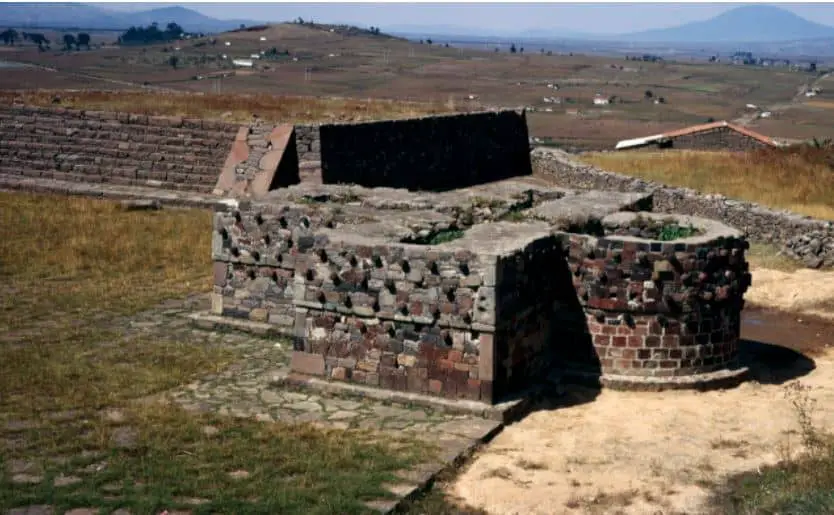
At the archaeological site of Calixtlahuaca, near present-day Toluca, Mexico, researchers have uncovered a stone monument known as Monument Number 4 or the Cross Altar, which intriguingly resembles the ancient Egyptian Ankh cross. This discovery was made within the complex that includes a structure resembling a Tzompantli—a type of rack historically used by Mesoamerican cultures to display skulls of sacrificial victims or enemies. The site sits at an altitude of approximately 2,500 metres and contains several other unearthed and yet-to-be-excavated structures. The Ankh, commonly recognised as the Egyptian glyph for “life” or eternal life, is one of the most important yet enigmatic symbols in Egyptian culture, often depicted in tomb art as held by deities associated with the afterlife. The presence of a similar symbol in Mexico raises questions regarding cultural exchanges or parallel symbol development across continents.
Key details about the Calixtlahuaca Cross Altar highlight that it is decorated with skull carvings embedded within the stone, echoing the function of a Tzompantli but featuring a distinct cross shape much like the Egyptian Ankh with its characteristic loop. Only a few of the original skull carvings remain, with replicas filling in for missing pieces. The mystery is intensified by the fact that while the indigenous Aztec and Maya cultures used a form of the Tau cross in their symbolism, the addition of the Ankh-style loop is unique to this structure. Archaeologist Rich Cassaro notes that both Egyptian and Mesoamerican civilisations exhibited parallels such as pyramid-building, solar symbolism, and afterlife beliefs, which may offer some explanation. Nevertheless, definitive evidence of direct contact or cultural transmission is lacking, and the anomaly remains an open question. The broader significance lies in exploring how such symbols embody the shared human contemplation of life after death, and whether these reflect independent development or ancient intercultural links.
Contextually, the Tzompantli and related skull rack motifs are a well-documented feature throughout Mesoamerica, famously associated with the Aztec capital Tenochtitlan and other sites across Mexico and Central America. These constructions served ritualistic and mnemonic purposes related to warfare, sacrifice, and cosmology. The adoption or independent emergence of an Ankh-like symbol at Calixtlahuaca adds a remarkable dimension to the understanding of Mesoamerican iconographic traditions. Meanwhile, the Ankh itself appears not only in Egyptian art but also in other ancient Mediterranean cultures such as the Minoans and Mycenaeans, where variants of the Tau cross were used. This suggests that the Ankh's form may have held broader symbolic currency beyond Egypt. In the study of ancient symbols and possible prehistoric trans-oceanic contacts, the Calixtlahuaca find adds valuable material for comparative research on how different societies visualised concepts of life, death, and the cosmos. Further excavation and interdisciplinary study at the site may illuminate the origins and meanings behind this enigmatic cross, contributing to wider debates on cultural diffusion and parallel evolution in ancient civilizations.
Source: Ancient Code