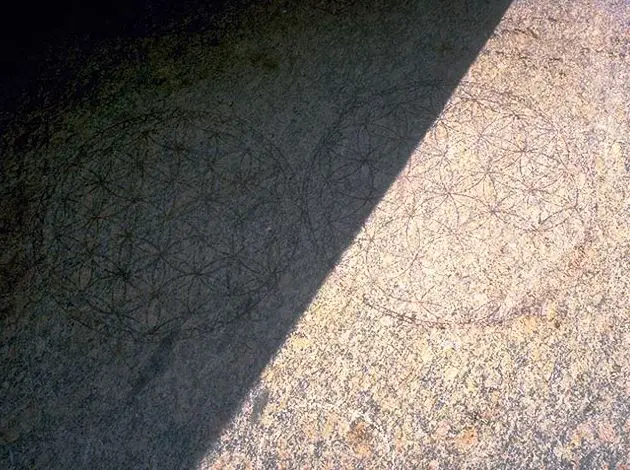
The Flower of Life is a geometric figure composed of multiple evenly spaced, overlapping circles forming a distinct hexagonal pattern. This symbol appears in many cultures and religions across the globe, with depictions dating back thousands of years. One notable example is found in the Temple of Osiris at Abydos, Egypt, where red ochre drawings of this design adorn granite columns. Researchers identify the pattern as containing 19 complete circles within a larger enclosing circle, further highlighting its intricate mathematical construction. The presence of this symbol in diverse regions suggests a shared ancient understanding of space, time, and fundamental aspects of existence.
The pattern’s significance extends beyond its aesthetic form; it is considered by some to represent foundational spiritual beliefs and cosmic order. The Flower of Life is linked to the geometric foundations of nature and has inspired figures such as Leonardo da Vinci in their work. Mapping sacred sites worldwide with the Flower of Life’s proportions reveals that many ancient monuments and standing stones align with key points in the pattern, indicating its possible use in sacred architecture. Additionally, the symbol relates closely to the Tree of Life in Kabbalistic tradition, which is thought to derive from this geometric figure. The Flower of Life is often cited as a visual representation of the origins of existence, incorporating elements from the Platonic solids and the Metatron’s Cube, which are central to both ancient philosophy and modern interpretations of the universe’s structure. Beyond ancient contexts, contemporary researchers like Nassim Haramein have explored its relevance to space, gravity, and the underlying mathematical fabric of reality. Overall, the Flower of Life exemplifies how ancient geometric patterns continue to inspire spiritual, scientific, and philosophical inquiry into the nature of life and the cosmos.
Source: Ancient Code