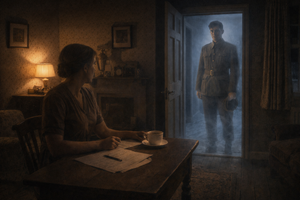
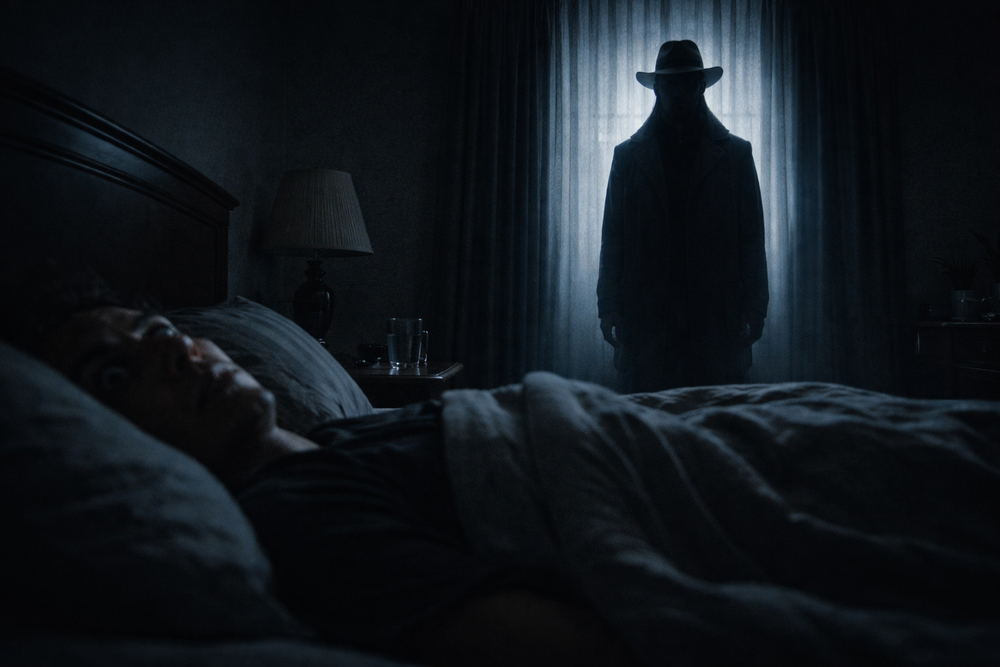
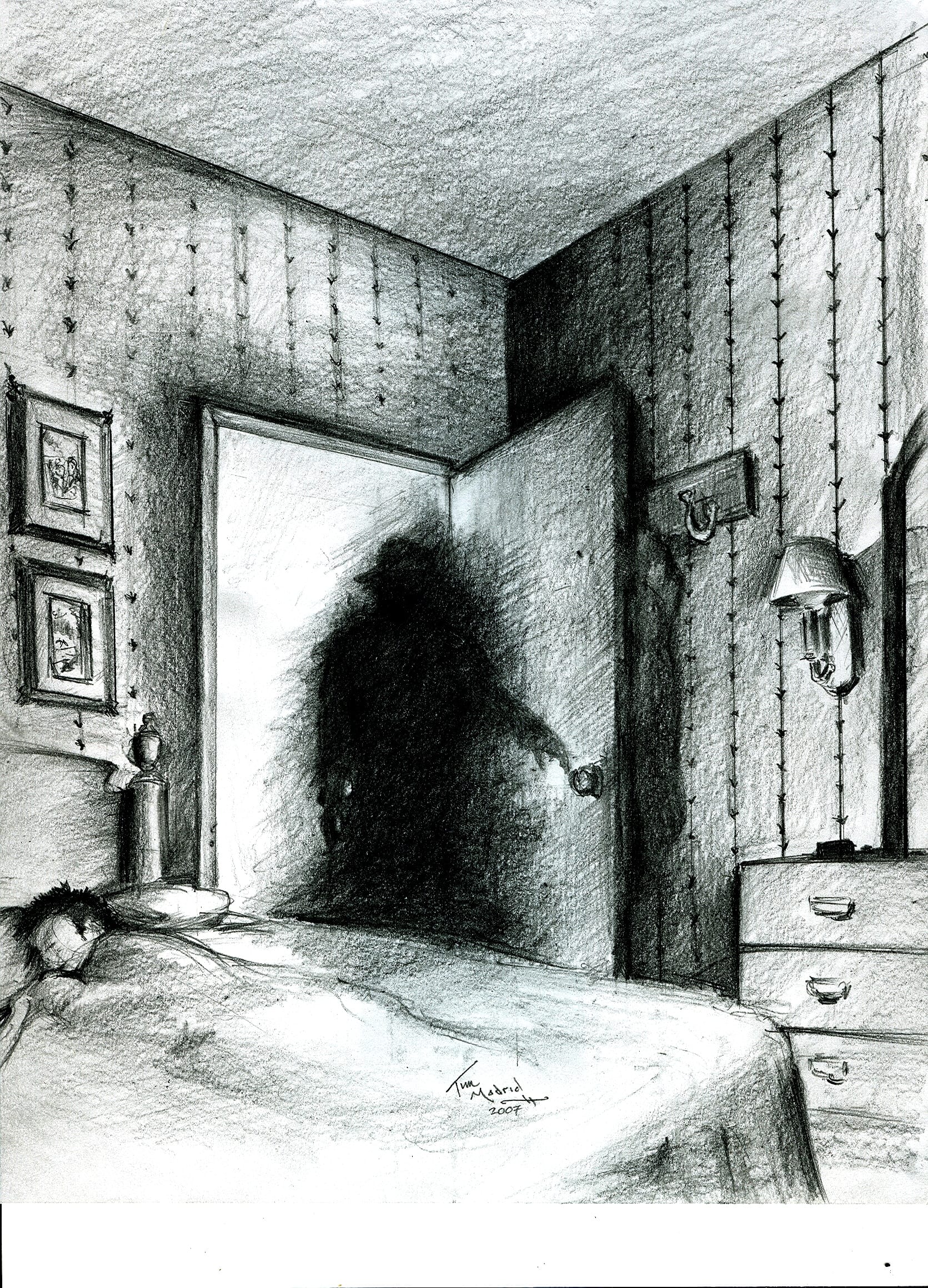
You wake at 3am. The room is dark and quiet and completely familiar — and there is someone standing in the corner. Tall. Completely still. Wearing a wide-brimmed hat and a long dark coat. No face. Just the certainty, absolute and physical, that it is watching you. You try to move. You cannot. You try to call out. Nothing comes.
If you recognise that description, you are not alone. Thousands of people across every continent have reported this encounter in detail so consistent — the hat, the coat, the stillness, the paralysis, the watching — that researchers have given it a name: the Hat Man. The descriptions predate the internet by centuries. They predate the word for what they describe. They keep arriving, from people who have never heard of each other, with the same details in the same order.
Sleep science has a partial explanation. What it cannot account for is the part that matters most.
"The experience is not caused by prior belief. The belief is caused by the experience."
— David J. Hufford, The Terror That Comes in the Night (1982)
The figure belongs to a broader category that researchers call shadow people — humanoid silhouettes seen in the peripheral vision, in darkened rooms, at the edges of sleep and waking. The Hat Man is the most specific variant: always tall, always still, always watching, always wearing that hat. He is the detail that doesn't dissolve under scrutiny. The detail that remains when everything else has been explained.
The Territory
A Figure as Old as Darkness
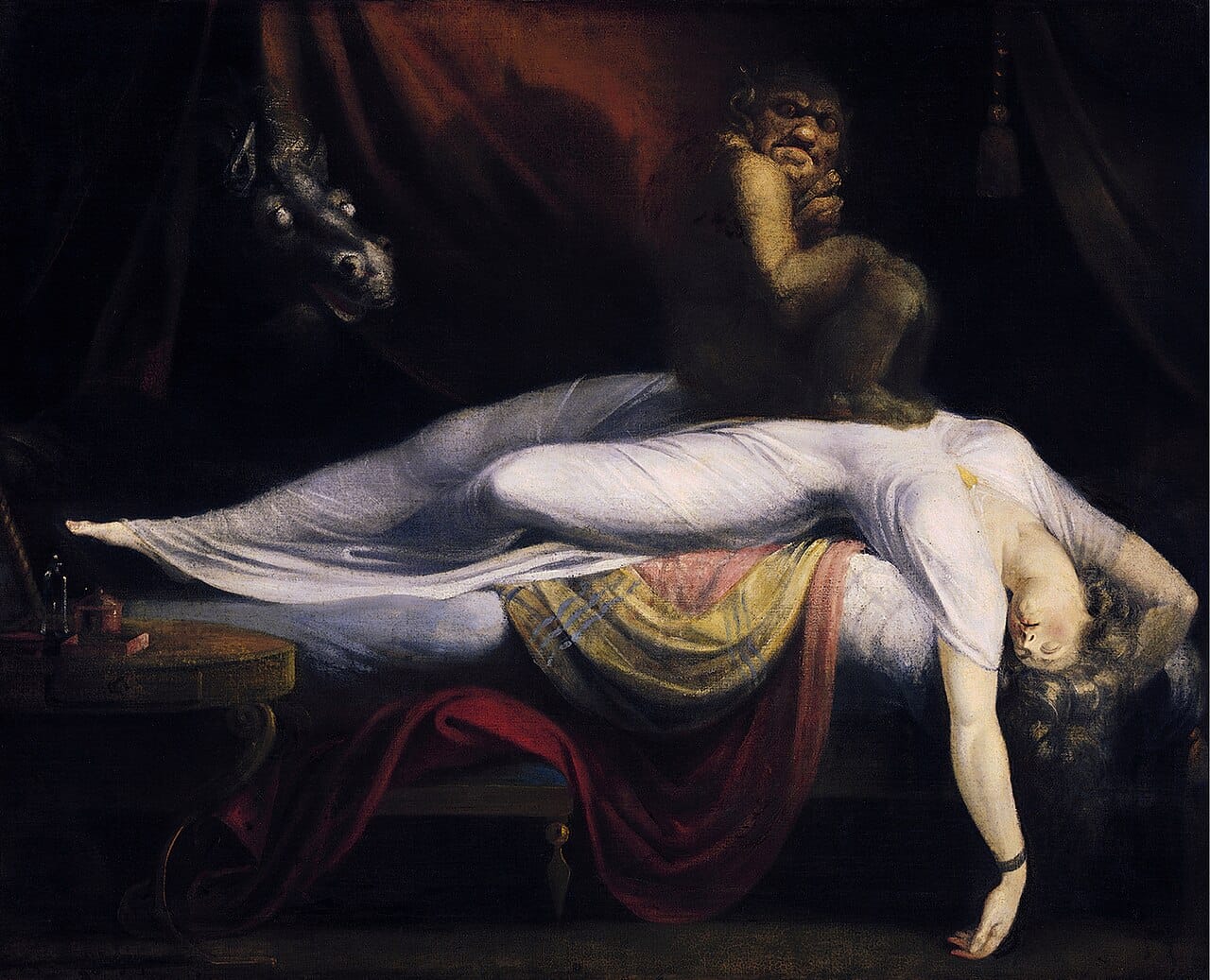
The impulse to name the figure in the dark is prehistoric. Cultures across the world developed specific terms for the presence that arrives in the night — not a ghost in the conventional sense, but something that pins the sleeper down and watches. In Newfoundland it was called the Hag. In Japan, the kanashibari — the invisible chains that hold you to your sleeping mat while something unseen presses down. In Scandinavia, the mara, from which the word nightmare directly derives: a spirit that rides sleeping humans, crushing the breath from them. West African traditions, Indigenous American traditions, Chinese folklore, Islamic jurisprudence — the same entity, described independently, across civilisations that had no contact with one another, with identical core features: night, paralysis, a presence, weight on the chest, the sensation of being watched by something that should not be there.
What is distinctive about the Hat Man is how specific he is. General shadow people vary in form — sometimes tall, sometimes small, sometimes animal-shaped. The Hat Man does not vary. He is always tall. He always wears the hat. He is always male in presence, even to witnesses who cannot explain how they know that. He does not approach. He watches. Then, eventually, he recedes. That consistency of detail, appearing independently across thousands of accounts from people with no knowledge of each other's experiences, is what makes the Hat Man something more than a local legend.
The first dedicated systematic collection of Hat Man accounts began in 2001, when Timothy M. Brown Jr. launched The Hatman Project — a site specifically for documenting reports. Within years, hundreds of submissions had arrived from across the world, all describing the same figure. What made those submissions significant was not their number but their specificity: witnesses had not read other accounts before submitting their own. The convergence was not influenced by prior knowledge. It preceded it.
The Case Room
The Documented Encounters
Stacy Alejos was a child in Texas when she first saw him. She had woken in the night and was looking out of her bedroom window when she noticed a tall, dark figure standing outside beyond the fence. Its arms were stretched along the top of the fence posts. As she watched, it began moving sideways — keeping those outstretched arms on the fence the entire time, as though feeling its way along. She could hear dried leaves crunching under its feet. It was not behaving like a person. It was not behaving like anything she had a name for. Her account, collected and documented decades later, is one of thousands that share the same fundamental features: darkness, stillness, proximity, and the absolute certainty that the figure is aware of the witness.
What distinguishes the more clinically significant Hat Man reports from general shadow people encounters is a specific and recurring context: sleep paralysis. The witness wakes, or believes they are awake, and finds themselves completely unable to move. The Hat Man is present. The encounter lasts until the paralysis breaks. Then he is gone. This pattern is documented consistently enough that researchers have built a neurological framework around it — and it is a solid one. Sleep paralysis occurs when the brain moves toward or away from REM sleep and the atonia that normally immobilises the body during dreaming persists into partial wakefulness. The sleeping brain, half-awake and still generating dream imagery, produces what neurologists call the intruder hallucination: a perceived presence in the room, often visual, almost always threatening.
Dr David Hufford, in his landmark 1982 study The Terror That Comes in the Night, was the first researcher to systematically document the cross-cultural consistency of sleep paralysis encounters and their relationship to paranormal belief. His central finding was that the experience itself — not cultural priming, not prior belief, not expectation — generates the accounts. People who had never heard of sleep paralysis, who had no cultural framework for the night visitor, reported the same core features independently. The belief, Hufford argued, is caused by the experience. Not the other way around.
The relationship between the Hat Man and pharmacology adds a further layer of documented strangeness. High-dose diphenhydramine — the antihistamine found in Benadryl — produces, in a meaningful percentage of cases, hallucinations of a hat-wearing shadow figure so consistent and specific that it became a documented phenomenon in its own right. The mechanism is understood: diphenhydramine's anticholinergic properties at high doses produce delirium with vivid visual hallucinations. What is not understood is why the delirious brain, across thousands of separate individuals, chooses the same hat. The figure appears not to be an arbitrary product of a chemically disrupted visual cortex. It appears to be something the disrupted brain reaches for.
That observation sits at the uncomfortable edge of the neurological explanation. Sleep paralysis produces the intruder hallucination. Anticholinergic delirium produces the Hat Man specifically. Both mechanisms are understood. What the mechanisms don't explain is the content of what they produce — why this particular figure, with this particular hat, watching with this particular quality of attention, across cultures and centuries and pharmacological states that have nothing else in common.
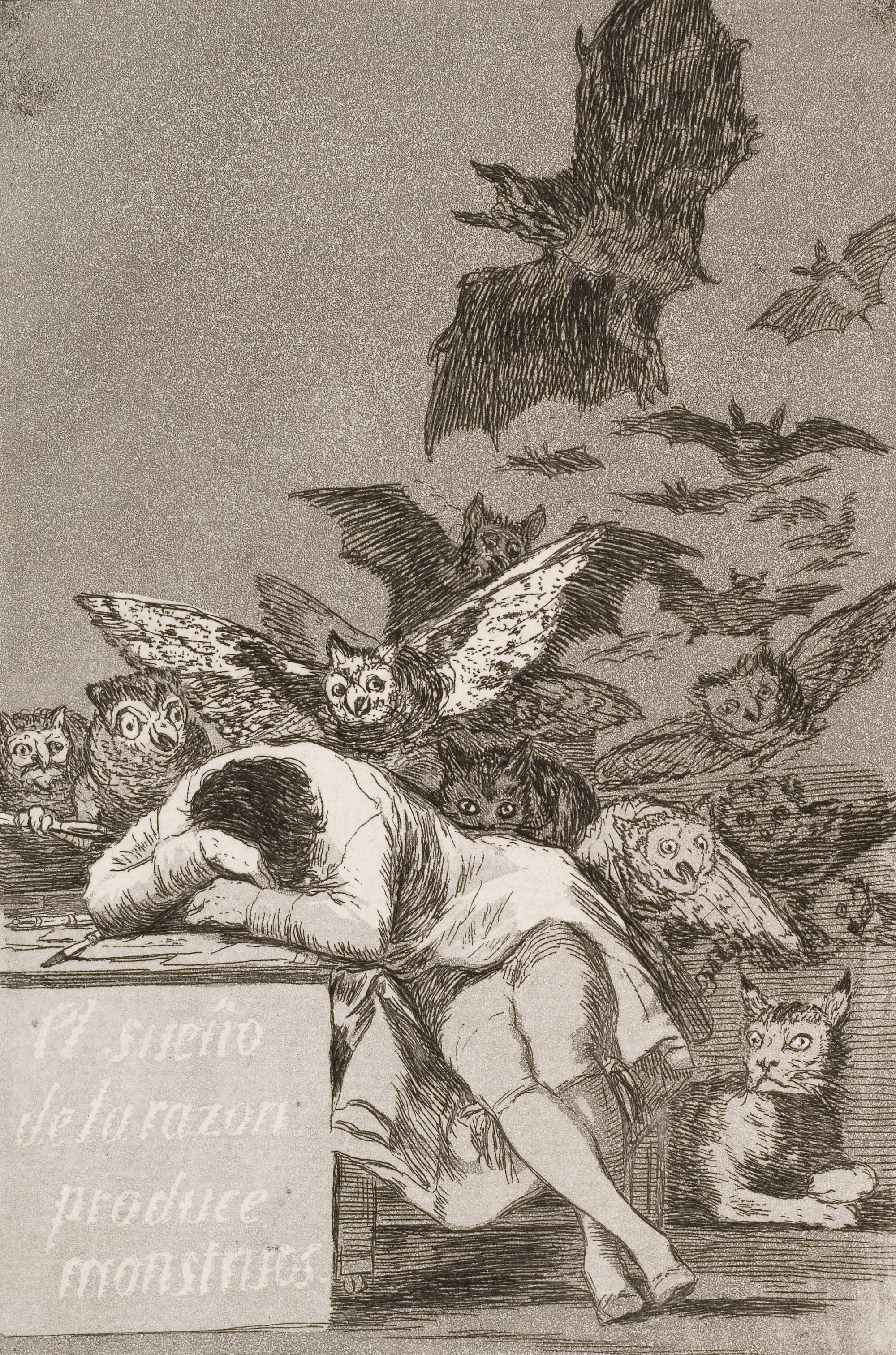
The Hmong cases are the most extreme documentation of what the night figure can do when it meets a mind that has no framework for it. Between 1978 and 1988, the CDC documented 117 deaths among Hmong refugees resettled in the United States from Laos — healthy young men who died in their sleep with no identified cause. Dr Shelley Adler's research, published as Sleep Paralysis: Night-mares, Nocebos and the Mind-Body Connection (2011), proposed that the terror of the nocturnal encounter — the dab tsog, the crushing night spirit of Hmong tradition — combined with compounding stressors from war trauma, displacement, and the inability to perform protective ancestral rituals, triggered fatal cardiac events. Subsequent genetic research found that Brugada syndrome, a cardiac conduction disorder, has higher prevalence in Southeast Asian populations and may have been a contributing factor. But Adler's research was clear: the terror was the proximate cause. The thing in the dark killed people who had no way to tell themselves it wasn't real.
The Explanations
What Sleep Science, Neurology and the Unexplained Record Say
The neurological case for the Hat Man as a product of sleep paralysis is strong and should be engaged with seriously. Sleep paralysis affects approximately 8% of the population regularly and is well-characterised across multiple large studies. The atonia of REM sleep — the motor paralysis that prevents the dreaming body from acting out its dreams — persists into partial wakefulness. The visual cortex, still generating dream imagery, produces the intruder hallucination. The posterior insula, which processes body awareness and threat response, fires in a pattern consistent with perceived presence. Researchers studying populations in North America, West Africa, Japan, Turkey, China, and Newfoundland consistently find the same core figures appearing in sleep paralysis accounts: the Crusher, the Watcher, and the Hat Man. Same entity, multiple cultures, completely separate development.
The honest limitation is what that explanation doesn't cover. A meaningful number of Hat Man encounters occur outside of paralysis entirely. Witnesses describe being fully upright, fully awake, moving freely, with the figure visible in a lit room. Children — who typically report encounters before any exposure to horror media or paranormal concepts — describe the figure with a specificity that resists the cultural priming explanation. The Hat Man, in these accounts, does not dissolve when the witness stands or turns on the light. He retreats. That is a behavioural distinction the sleep paralysis model cannot address.
The archetype interpretation — proposed by several researchers working in Jungian frameworks — suggests that the Hat Man is a symbol of authority, judgment, or death that the human unconscious generates independently across cultures. This accounts for the emotional weight of the encounter and for some of its cross-cultural consistency. It does not account for the shared visual specificity. Symbols generated by the unconscious do not produce matching silhouettes. The hat is not a symbol. It is a hat. The same hat, described by people with no connection to one another, across five hundred years of recorded testimony.
As with the doppelganger cases, the honest position is this: the science explains a subset of encounters well. It struggles most with the cases where the figure is observed by a fully mobile, fully conscious witness in ordinary conditions — or where more than one person in the same space reports the same figure simultaneously. Those cases remain, in the accurate sense of the word, unexplained.
Case Summary · Key Facts
- Cross-cultural variants of the night visitor documented independently across at least six major civilisations with no contact between them
- The Hat Man specifically — tall, wide-brimmed hat, long coat, watching, non-approaching — described with matching detail across thousands of independent modern accounts
- Sleep paralysis intruder hallucination confirmed as a neurological mechanism for a significant subset of cases
- Diphenhydramine (high-dose Benadryl) produces Hat Man-specific hallucinations via anticholinergic delirium — mechanism understood, content unexplained
- 117 Hmong sudden deaths in the US (1978–88) documented by the CDC and linked by research to nocturnal terror encounter
- A substantial proportion of reported encounters occur outside sleep paralysis states in fully mobile, fully awake witnesses
- Status: Partially explained. Core visual specificity and non-paralysis encounters remain unresolved.
The Open Door
The Hat in the Dark
The sleep science is real and should be taken seriously. The intruder hallucination is a documented neurological event. The cross-cultural consistency of the night visitor is, at least in part, explained by the consistency of the sleeping brain under stress. That explanation is satisfying for the majority of cases.
What it doesn't satisfactorily explain is why the specific visual content — the hat, the coat, the watching stillness, the deliberate non-approach — is so precisely consistent across thousands of accounts from people with no connection to one another, including accounts that long predate any shared cultural framework. The brain, in producing the intruder hallucination, is not generating random imagery. It is reaching for something. The same something, reliably, across centuries.
Whether that something is purely internal — a pattern embedded so deeply in the architecture of the human nervous system that it produces the same figure regardless of culture or century — or whether it is pointing at something else entirely, is a question that neuroscience has not yet answered. The Hat Man watches from a corner of the room that science has partially illuminated. The rest of the corner remains dark.