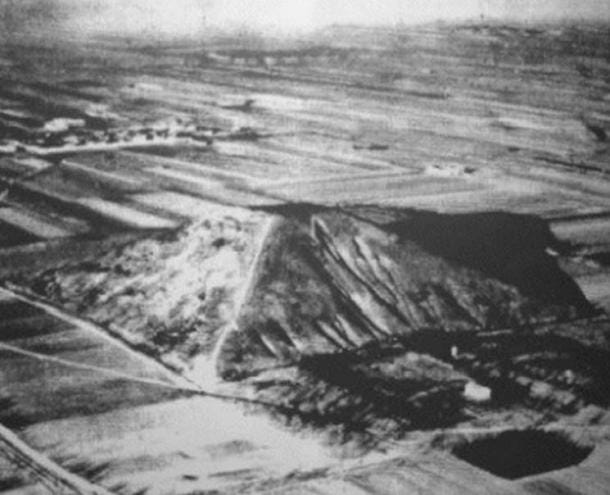
In the closing stages of World War II, American pilot James Gaussman reportedly discovered an immense pyramidal structure while flying low over northern China near the city of Xi’an. Forced to return to base due to engine trouble, Gaussman made several passes over the feature, photographing the enormous formation before filing a detailed report with his superiors. Despite the initial documentation, the discovery was largely forgotten within US Air Force archives until the late 1980s when Australian writer Brian Crowley uncovered and published one of Gaussman’s photographs. A similar sighting was documented earlier, in March 1947, when Colonel Maurice Sheehan described flying over a pyramid measuring approximately 300 by 450 metres. Such dimensions would significantly surpass Egypt’s Great Pyramid of Giza, making the Chinese structure arguably the largest pyramid in the world.
Multiple pilots and aerial reconnaissance have reportedly observed similar pyramid-shaped sites in the region around Xi’an. Indeed, American spy satellite imagery is said to corroborate the existence of these massive, pyramid-like formations. Nevertheless, the Chinese government denies the presence of such structures. Historical accounts from European explorers and traders in the early 20th century mention several pyramid sites in this area, with some expeditions reportedly recovering metallic fragments nearby. Laboratory tests on these fragments purportedly indicated an age of around 8,000 years and returned an unidentified metallic composition not matching any known materials in contemporary science. These claims remain controversial due to a lack of official archaeological evidence and the opaque nature of both local and international research on the subject.
The purported Chinese pyramids resonate with a long-standing body of regional folklore and mystery surrounding ancient monumental architecture. Unlike the Egyptian pyramids, which are universally accepted and extensively studied, these Asian counterparts remain shrouded in secrecy, partially due to political sensitivities and restricted access to excavation. The vast scale of the formations, if confirmed, would suggest an advanced palaeocivilisation capable of monumental engineering far earlier than commonly accepted. This also aligns with a pattern of unacknowledged or underground archaeological findings reported in China, where historical narrative control is tightly managed. Investigations into these phenomena highlight challenges in distinguishing natural geological formations from man-made structures, particularly in areas featuring loess plateaus and unique sedimentary patterns. Consequently, the Chinese pyramids continue to fuel debate among archaeologists, historians, and the Fortean community about humanity’s prehistoric technological capabilities and the true extent of ancient civilisations in East Asia.
Source: Ancient Code