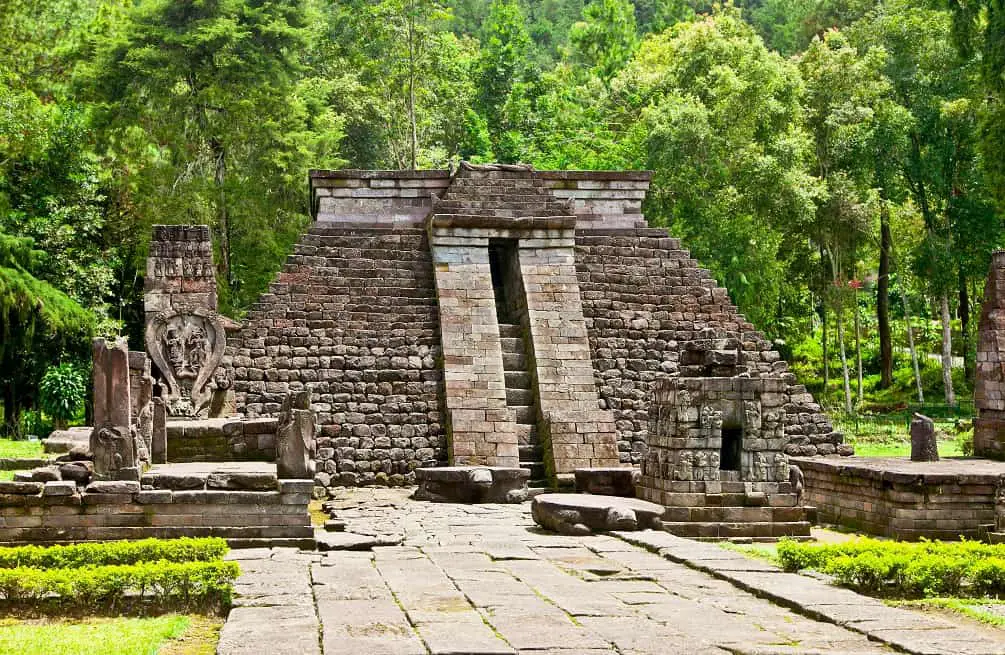
On the western slopes of Mount Lawu in Central Java, Indonesia, stand two unusual Hindu temples: Sukuh and Cetho. Sukuh is thought to date from the 15th century, while Cetho has been linked to the 5th century, although this is debated. Both were reportedly built by the Majapahit Empire, which thrived between the late 13th and early 16th centuries as one of Southeast Asia’s most powerful empires. Unlike most Majapahit constructions, these temples have unique pyramid structures with stone stairways that bear a striking similarity to those found in ancient Maya pyramids in Central America. The temples exhibit a style unlike the traditional red sandstone edifices typical of Majapahit architecture, sparking curiosity among archaeologists regarding their origins and cultural significance.
What makes Sukuh and Cetho exceptional is their architectural divergence from standard Majapahit temple designs, including the use of river stone in Cetho’s construction, which is atypical for the empire’s known material palette. The pyramid-shaped Sukuh temple, coupled with the stairways ascending its centre, closely mirrors elements commonly associated with Maya pyramids such as those at Tikal and Chacchobén. In addition to the structural similarities, certain decorative motifs and statues found at these Indonesian sites are also remarkably reminiscent of Maya artworks, a fact which complicates existing historical and archaeological interpretations. Witness accounts and further investigations reveal that these temples possess a visual language and symbolic elements absent in other local examples, and yet there are no definitive records linking these two distant cultures. This raises questions about the possibility of coincidental resemblance, lost intercultural contacts, or parallel development of similar architectural forms.
Contextually, the Majapahit Empire, known primarily for its orthodox Hindu-Javanese cultural expression and extensive maritime influence in Southeast Asia, shouldn’t be expected to produce constructions echoing Central American designs. The Maya civilisation flourished from roughly 2000 BCE to the 16th century CE on an entirely different continent, separated by an ocean with no confirmed direct contact with Southeast Asia. Pyramid-building is a global phenomenon but the specific design elements at Sukuh and Cetho—such as the steep central staircases and decorative relief styles—are less commonly replicated. This enigmatic resemblance invites broader consideration of ancient transoceanic cultural diffusion theories, though such ideas remain highly contentious and lack solid evidence. Understanding these temples within the framework of local Javanese spiritual practices, the decline of the Majapahit Empire, and regional trade networks may yet yield clearer insights into their unusual construction and cultural significance.
Source: Ancient Code