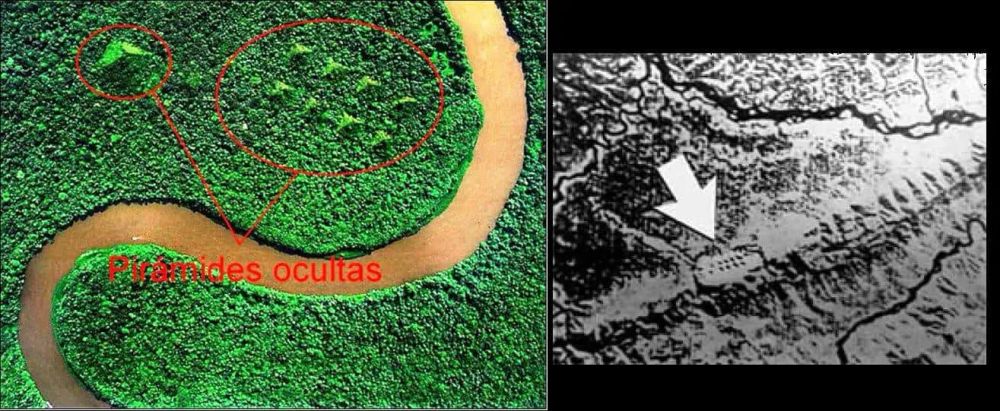
In the dense and largely unexplored jungles of southeast Peru, a group of pyramid-like structures known as the Pyramids of Paratoari has intrigued archaeologists and researchers since their discovery on a NASA satellite photograph released in 1976. These formations, situated in the Manu region of the Amazon rainforest, first came to attention through satellite image C-S11-32W071-03. While some experts propose these are natural truncated ridge spurs shaped by natural processes, others argue for an anthropogenic origin, suggesting these structures were deliberately constructed by an unknown ancient civilisation. Expeditions to the area have uncovered Incan artefacts such as petroglyphs, paved roads, and platforms, which lend some weight to the theory of past human occupation. The debate continues amid contrasting interpretations of the evidence, with no definitive consensus reached to date.
Eyewitness accounts and scientific surveys provide varied perspectives on the Pyramids of Paratoari. Those advocating for their artificial origin point to the symmetrical positioning and geometric uniformity of the pyramids, arguing that such regularity is unlikely to have resulted from natural geological processes. Contrastingly, sceptics highlight similarities between these formations and naturally occurring sandstone spurs, which can adopt pyramid-like shapes through erosion. The comparison has often been drawn to the “Bosnian pyramids” in Visoko, where similar disputes persist over natural versus man-made origins. Despite modern technological advances such as satellite imagery and exploration tools like Google Earth, fieldwork remains challenging in the dense rainforest setting, which complicates direct archaeological investigation. If confirmed as man-made, these structures could represent a lost chapter in Amazonian history, shedding light on pre-Incan or other unknown cultures.
Contextually, the Pyramids of Paratoari should be understood within the wider framework of Amazonian archaeology and indigenous history. The Madre de Dios region has long been suspected as a refuge for the Inca following Spanish incursions in the 16th century, making it plausible that some structures were erected for strategic or ceremonial purposes. Beyond Inca influence, the Amazon hosts a variety of pre-Columbian cultures known for advanced earthworks, such as geoglyphs and ancient fortified sites, often hidden beneath dense foliage. Satellite-based remote sensing has increasingly become an invaluable tool in revealing these formerly concealed landscapes, revolutionising our understanding of the area's historical geography. However, the notion of pyramid-like monuments in such a context remains contentious because pyramids are not typical for South American indigenous architecture compared to other pyramid-building cultures worldwide. Thus, the Pyramids of Paratoari compel a cautious re-examination of regional archaeological assumptions while awaiting comprehensive on-site studies.
Source: Ancient Code