
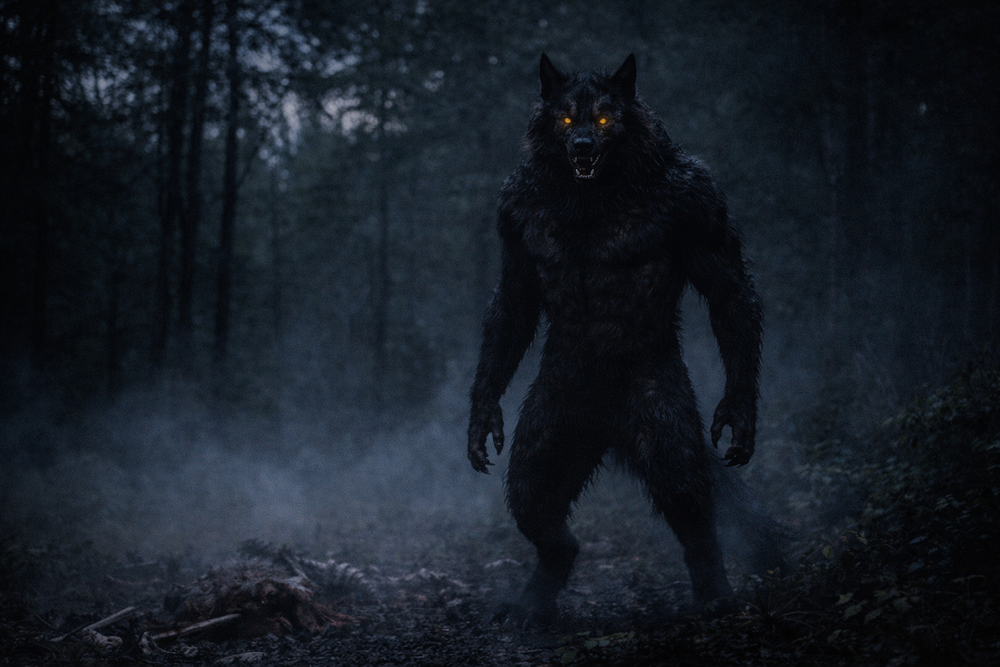
For several decades, numerous witnesses across North America have detailed encounters with large, canine-like creatures that differ significantly from known wolves or coyotes. These entities, often described as upright or bipedal, have been reported in rural and wooded areas from the northern United States to Canada. The accounts span from the mid-20th century to the present, with a notable increase in reports during the 1970s and ongoing witness submissions since. These creatures are commonly referred to as "Dogman" and are frequently associated with violent or aggressive behaviour towards humans and livestock. Evidence remains largely anecdotal, consisting of eyewitness descriptions, occasional photographs, and physical signs such as unusual tracks and animal carcasses. No conclusive scientific verification exists for these reports, yet the consistency of descriptions suggests a phenomenon worth further investigation.
Witness testimonies describe the Dogman as standing between six to eight feet tall, covered in thick fur, possessing a human-like body shape combined with distinctly canine features such as pointed ears, elongated snouts, and glowing eyes. Some encounters detail the creature displaying unusual agility and speed, often emerging suddenly from dense forest or rural environments. Several reports mention the creature’s aggression, citing attacks on pets, livestock mutilations, and threatening behaviour towards humans. Contradictions arise in variations of size and form, with some accounts referencing more wolf-like appearances and others suggesting a hybrid resembling a werewolf archetype. Photographic evidence remains inconclusive, generally low-quality images or ambiguous shadows, while tracks discovered are often larger than typical wolf prints and sometimes exhibit anomalous characteristics, such as partial hand-like impressions. The significance of these findings lies in the persistent nature of reports across vast geographic regions, hinting at the possibility of an unidentified species or an enduring folkloric construct embedded within North American culture.
The Dogman phenomenon fits within a broader category of cryptids that blur the line between known wildlife and mythological creatures, frequently intertwined with regional folklore involving shapeshifters and forest spirits. Like many cryptids, the Dogman may serve as a modern myth propagated through community narratives and media. From a biological standpoint, no known canid corresponds to the descriptions, suggesting that if the creature exists, it could represent a misidentified known species, a rare evolutionary offshoot, or an undiscovered cryptid. The cultural impact is notable, with tales of Dogman sightings permeating local legends especially in areas of dense forest and wilderness, manifesting in reports that echo folklore themes of guardianship or malevolent predators. The concept of upright canines also parallels global myths such as the werewolf, underscoring humanity’s complex relationship with predatory animals and the wooded environment. While scientific validation remains absent, the Dogman continues to capture attention as a focal point of American and Canadian Fortean studies, consistent with other cryptids that challenge the boundaries of zoology and folklore.
Source: Phantoms and Monsters