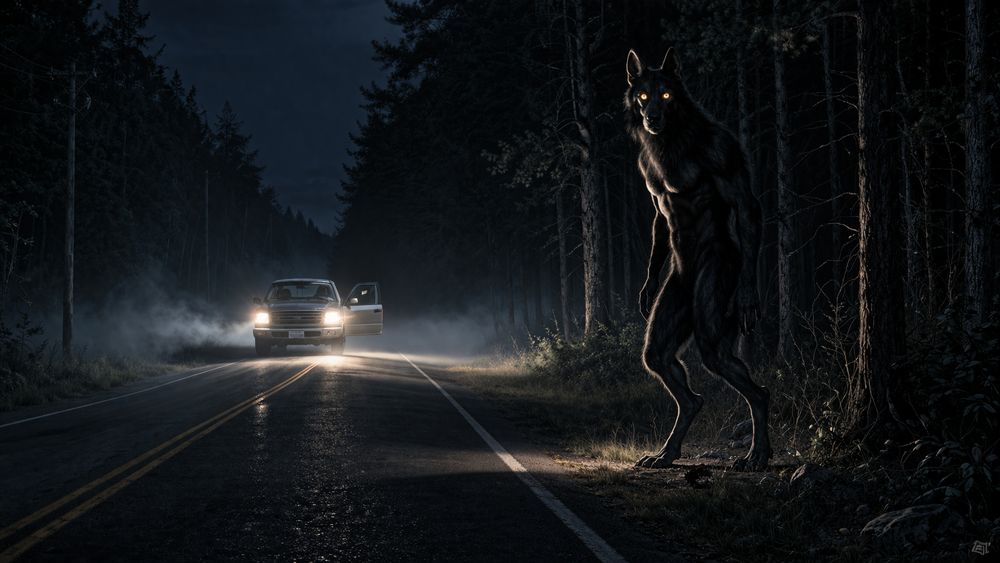
From the Great Lakes to the Texas border country, an impossible creature appears regularly to people who have nothing to gain from lying, and those files are getting thicker by the year.
Across hundreds of witness accounts, spanning more than a century and separated by hundreds of miles, certain details recur with a consistency that is difficult to dismiss as cultural contamination or shared mythology
The encounter typically happens at night, or in the liminal space at the edges of dawn and dusk. The witness is doing something ordinary: driving along a rural road, walking a woodland trail, sitting at the campfire. Something catches their attention, and they turn their head, only to be startled by the sight of a tall ominous figure standing at the tree line. It has a canine head, long muzzle, ears which are set high on the skull, and eyes that glow with a light that seems to suggest active shine, rather than passive reflection. By most estimates, this creature stands between six and eight feet tall.
Disquiet and disbelief turns to fear when the creature slowly turns its own head and fixes its gaze upon the hapless witness, it snarls and then for the witness nothing is ever quite the same again .
Witnesses to Dogman are not by and large suggestible or sensation-seekers and accounts compiled by researchers over the past three decades include law enforcement officers, experienced hunters and forestry workers, farmers who have spent their working lives in close proximity to large woodland animals. The majority have had no prior interest in cryptid phenomena and many waited years before reporting what they saw; with a significant number only coming forward after hearing that others had described the same thing independently.
Dogman is not a variation on the werewolf story, an important distinction which we shall return to; For many who have encountered it, The Dogman is real and its story begins, not within the covers of a gothic horror novel, but in the dense forests of the Great Lakes and the flat farmlands of the rural midwest.
What Is Cryptozoology? A brief overview
Before venturing further into the Dogman specifically, it is worth briefly outlining what cryptozoology is (and is not), because the term carries enough baggage to obscure the genuine intellectual interest of the subject.
Cryptozoology, coined by Belgian-French zoologist Bernard Heuvelmans in the 1950s, is the study of animals whose existence has not been confirmed by mainstream science. The word means, essentially, the study of hidden animals. Cryptozoology is a field that lives on the frontier between zoology, folklore, and witness testimony. Dismissed as pseudoscience by stuffy acedemia yet it has an unusual track record of success: several creatures once dismissed as cryptids are now recognised species. The okapi, an animal combining the features of a giraffe and a zebra, was considered folklore in central Africa until 1901. The giant squid, basis of the kraken legend, was not photographed alive in its deep-sea habitat until 2004. The coelacanth, a fish believed extinct for 65 million years, was pulled up in a fisherman's net off South Africa in 1938.
The lesson of cryptozoology is that disbelief can be just as intellectually lazy as credulity. Something can be unlikely without being impossible. And when accounts are consistent, persistent, and come from independent witnesses with nothing to gain and plenty to lose by speaking out, they warrant careful attention, rather than automatic dismissal.
Don't call me a Werewolf
The most common mistake people make when first engaging with the Dogman material, is to treat the phenomena as a synonym for werewolf. Dogman is not a werewolf, there is a distinction here, which is not merely taxonomic, that goes right to the heart of what this phenomena is an where it comes from.
A werewolf, in its folkloric and mythological form, is a cursed human being who transforms into an murderous wolfman. It is a story about transgression, about the thin membrane between the civilised and the feral. The werewolf is defined by its transformation,in a way that Dogman isnt.The Navajo tradition of the yee naaldlooshii, the skinwalker, belongs firmly in this category: a person who has chosen to acquire animal form through deliberate flouting of societal norms, moving at night in the skin of a predator among people who would recognise them by day.
Dogman on the other hand does not transform, and throughout the dogman tradition there has never been any intimation of it being human in origin. Through every consistent witness account, Dogman is bipedal, it walks upright on two legs in the manner of a person, rather than the optional bipedalism of a bear rearing up in alarm. Its legs are digitigrade, meaning it walks on its toes like a canine. Its torso is broadly humanoid in proportion, the head is that of a large canine, a wolf or large dog with a long muzzle, large erect ears, and eyes set forward in the skull in the way of a predator.
Witnesses consistently describe its height when standing fully upright, as between six and eight feet. Its fur ranges from black to dark brown to grey. The most recurrent physical detail, reported independently by witnesses who clearly have no knowledge of each other's accounts, is the eyes: amber or yellow-gold, sometimes described as red, always described as shining in a way that suggests active illumination rather than simple reflection. And almost universally, witnesses report the same psychological effect: an immediate, overwhelming sense of dread, of being in the presence of a predator that is also, somehow, aware of them in a way that goes beyond simple animal alertness.
It is this intelligence behind the eyes that most people struggle to articulate when descrbing their experiences a detail which makes the Dogman phenomenon difficult to dismiss as a case of simple misidentification.

Deep Roots: The Creature Before the Legend
The earliest reliably documented Dogman report from a named witness is Robert Fortney's 1937 account from Paris, Michigan, in which he described being confronted by a large bipedal canine which seemed to be leader to a pack of wild dogs. Further accounts also exist from Allegan County in the 1950s and from Manistee and Cross Village in 1967.
Encounters with upright, wolf-like figures do not begin in nineteenth-century Michigan, they reach back much further. Long before European settlement, the Odawa and Ojibwe peoples held traditions of wolf-like beings capable of moving between human and animal forms. These were not just stories. They carried practical meaning: warnings about specific places, guidance on how to behave within them, and recognition that certain encounters belonged to a different category of reality, often at moments or locations where boundaries were thin. What is notable is the alignment. The modern “Dogman” hotspots identified by researchers—particularly along the Lake Michigan shoreline and around ancient burial and effigy mound sites map with striking consistency onto the same landscapes these earlier traditions treated as significant.
Researcher Linda Godfrey, spent three decades investigating the Dogman and related phenomena, she broke the Beast of Bray Road story in Wisconsin back in the early 1990s, and was one of the first to systematically document correlation of dogman sightings with sacred places and liminal zones. After accumulating hundreds of witness reports, Godfrey noticed that sightings tended to cluster near effigy mounds, (earthworks shaped like animals), which are found in exceptional concentrations in Wisconsin and along the Lake Michigan shore. The Traverse City area of Michigan, which has one of the highest concentrations of ancient mounds and Dogman reports, provides the clearest example of this overlap. Whether the correlation reflects spiritual tradition, genuine geographic pattern, or something else entirely remains one of the most intriguing open questions in the field.
Globally, the bipedal canine figure appears in human iconography with remarkable consistency. In ancient Egypt, Anubis the god of the dead and the guardian of transitions between worlds was depicted as a man with the head of a jackal, standing upright, presiding over liminal thresholds. The Cynocephali, a race of dog-headed humans, appear in Greek, Roman, and medieval European sources, described with enough geographical specificity to suggest they were more than pure invention. Medieval bestiaries include them alongside animals that genuinely existed. St. Christopher, in early Eastern Orthodox iconography, was sometimes depicted with a canine head. The persistent appearance of this figure, across cultures with no apparent connection to each other, is either a remarkable coincidence of human imagination or evidence of something with a longer history than the American cryptid literature acknowledges.
1887 to Now: The Michigan Dogman and the April Fool which Changed Everything
The modern Dogman narrative in Michigan ran as a current of local oral tradition for nearly a century before it surfaced publicly. Sightings were reported but not widely disseminated. The creature existed in the register of things known but not spoken about in polite company, the kind of knowledge that moves between hunters, farmers and people who spend time in the deep woods, it does not reach newspapers.
That changed on April 1st, 1987, when Steve Cook, a disc jockey at WTCM-FM in Traverse City, Michigan, aired a song called "The Legend." Cook had written it as an April Fool's joke, a mock folk ballad recounting Dogman sightings through Michigan history, intended to amuse and then be forgotten. What happened instead was one of the more remarkable moments in the history of American cryptid research. The phone lines did not ring with laughter. They rang with people who said they had seen it too.
Cook may have composed "the Legend", but he didn’t invent it, instead his song gave a name to something which, until that point, had no shared reference. People who had carried strange, unresolved experiences for years suddenly had the language to describe and a place to send their accounts; and send they did, The calls didn’t stop,they continued for weeks. Many reports came from people who had never heard of the Michigan Dogman before. Their encounters had occurred years, sometimes decades earlier, but they had kept quiet, telling only their closest kin through fear of ridicule, or because they lacked a frame of reference to hang their experiences on.
Cook's fateful radio broadcast finally gave those people the incentive to come forwards and describe what they had seen, adding their accounts to a now rapidly growing stack of witness testimony, that ominously described how a large bipedal canine was prowling through the dark corner's of Michigans rural heartland. Cook, who had donated the song’s proceeds to animal shelters, now found himself unintentionally at the centre of a growing body of witness testimony.
As the reports came in, a pattern started to emerge in Michigan. which suggested a ten-year cycle, with reports clustering in years ending in seven 1887*, 1897, 1917, 1937, 1957, 1967, 1977, 1987, 1997. Whether this reflects genuine biological behaviour, cyclical public attention, or something stranger is not resolved. The next cycle year would be 2007, during which the Gable Film surfaced, A grainy, disturbing piece of footage purporting to show the creature. Although The Gable film was later shown to be a deliberate hoax, (admitted to by the filmmaker themselves), it is worth noting, not to diminish the wider phenomenon but because the Dogman evidence base is one that requires rigorous filtering. Hoaxes, misidentifications, and media-amplified hysteria exist alongside accounts that are genuinely difficult to explain.
* Cook admitted that he had invented the story of the 1887 Wexford County lumberjack encounter to make the song work, but claimed he was unware of the wider significane of the 10 yearly cycle.
Bray Road: The Journalist, the Witnesses, and the Creature in the Cornfields
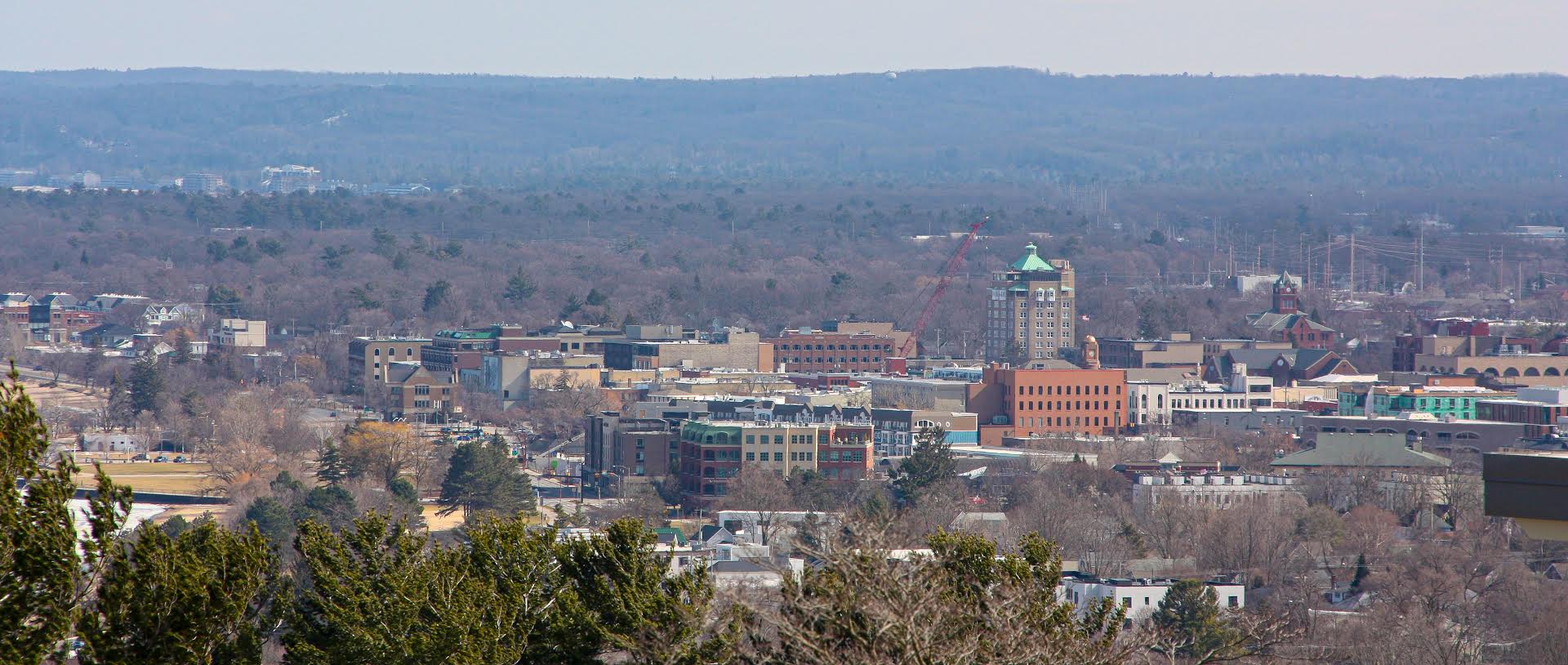
In the late 1980s and into the early 1990s, something was happening on and around a rural road in Walworth County, Wisconsin. Bray Road runs through farmland outside the small town of Elkhorn a place Linda Godfrey described as looking like a Christmas card and whatever was happening there was happening to multiple people, independently, over several years.
The first documented encounter in the modern Wisconsin record dates to 1936,when a night watchman named Mark Shackleman was patrolling the grounds of St. Coletta School for Exceptional Children in rural Jefferson. The school's property included several preserved Native American burial mounds. On consecutive nights, Shackleman observed a large, dark figure on all fours, digging into one of the mounds. On the second night, as Shackleman approached with his flashlight, the figure stood up, and snrled at him. Rising to over six feet tall, the sound it made was by Shacklman's account, half-animal and half-something else. He caught the smell of rotting flesh before the creature turned and left. Shackleman never saw it again and he told almost nobody for decades.
Shacklman's encounter occurred several miles from Bray road, but is considered to be part of the wider series of events owing to similarities of account. The cluster of sightings which put Bray Road on the map did not first occur until 1989.
On the night of October 31st that year ( A convienient date for sceptics) Lori Endrizzi was driving home from a late shift at a bar in Elkhorn. At round one-thirty in the morning, her headlights caught a shape by the roadside, hunched over what appeared to be roadkill. As the light of her vehicle illuminated the creature it stood up. Endrizzi later described it to Godfrey as standing around six feet tall, covered in shaggy grey-brown fur, with a long canine muzzle, glowing yellow eyes, and clawed hands proportioned more like hands than paws, holding the carcass with its palms upward. She slowed down enough to get a clear look at the creature, which stared back at her. Lori then drove away hard and did not stop until she was home. Endrizzi wasn't one to seek the limelight, she was in her thirties, worked a straightforward job, and had no prior interest in the paranormal. Godfrey noted her calm demeanour and the internal consistency of her account across multiple interviews.
Two years later, on October 31st, 1991, an eighteen year old named Doristine Gipson was driving the same road. This time something large ran into the side of her car, she stopped and got out to investigate, only to see a large, fur-covered creature rising from the ground where it had apparently been struck by the vehicle. Then it charged straight towards her! Gipson leaped back into her car, floored the gas pedal and drove! It was rainng hard, and as she accelerated, the creature jumped onto the boot of the car, managing to cling on for a time, before eventully sliding off into the road and dissapearing into the darkness of the rear view mirror. When a terrified Gipson arrived home, her family examined the vehicle and found gouges consistent with large claws in the bodywork.
Godfrey was assigned to cover the story for the local Walworth County Week newspaper. She arrived sceptical and left changed. Not neccesarliy a convert to a simple monster story; Godfrey was too careful and intellectually honest for that, but convinced that the witnesses were telling the truth as they experienced it, and that it could not be explained by citing wolves, bears, or large dogs. Over the following decade, the sightings Godfrey documented formed the basis for her book The Beast of Bray Road, and launched what became a thirty year career investigating canine humanoid phenomena and other cryptids across North America. New sightings of dogman continue to be reported in the Bray road area , most recently in Spring Prairie 2018 and in Lyons in 2020 long after the initial wave had subsided.
Godfrey herself, writing on her website, arrived at a position that is more epistemologically careful than either true believer or simple dismisser: "There is a high probability that everyone is not always seeing the same thing. There could be a biological, physical animal seen by some, while others see phantoms or supernatural entities from a variety of sources. A few may be misidentifications or hoaxes."
It is not a satisfying conclusion, but it is an honest one, and it has the merit of taking the full range of data seriously. Linda Godfrey died in late 2022 after a long illness. The field of canine humanoid research lost its most rigorous and humane practitioner.

The Land Between the Lakes: Where the Legend Gets Darker
If the Bray Road accounts represent the Dogman at its most documentable multiple named witnesses, an on-the-record journalist and a body of consistently cross-referenced testimony, then the Land Between the Lakes represents it at its most unsettling.
The The Land Between the Lakes (LBL) National Recreation Area is a 276-square-mile wilderness of dense forest, wetlands, and campgrounds straddling the Kentucky-Tennessee border, flanked by Kentucky Lake and Lake Barkley. It receives around one and a half million visitors a year. It is also one of the most persistent and disturbing Dogman sites in the American record, with accounts going back to before European settlement and a core incident from the early 1980s that has attracted investigators and filmmakers for decades without being either confirmed or definitively debunked.
The earliest European references to the LBL creature come from French trappers and traders working with Shawnee fur traders in the region. They described being warned of a massive, wolf-like figure that walked upright and was known locally as the Loup garou, the same term French settlers would carry with them into Louisiana, where it became the Rougarou. A later Shawnee legend speaks of a shape-changing shaman killed in wolf form by members of his own village for abusing his powers ( echos of skinwalker); his spirit, the story goes, still walks the forest seeking revenge. Whether the French trappers encountered the same being described in Shawnee tradition, or two separate traditions converging on the same geography, is an open question.
The modern LBL incident that most defines the legend and is the most controversial is commonly dated to April 7th, 1982. A man named Roger, whose surname is not publicly recorded describes being the only survivor of an attack on a family of four who were RV camping in a remote area of the park. According to Roger's account, an encounter with a large, upright canine creature outside the vehicle escalated over the course of an evening into an attack on the camper itself. The details of the account are graphic enough that it is treated with serious caution even by researchers sympathetic to the broader phenomenon, and the story contains several elements that cannot be independently verified.
What gives it ongoing traction in the investigative community is a combination of factors: The account's internal consistency across multiple tellings over many years, the testimony of local law enforcement figures who have spoken off the record or guardedly about unusual animal-related incidents in the park, and the fact that a section of the LBL known as Moss Creek was subsequently gated and closed to overnight camping. The reason given at the time was a random stabbing although many locals found this explanation inadequate.
In one of the more recent accounts, a woman driving a road connecting the KY 68 to the Lake Barkley Resort at night observed a deer bursting from the treeline and crossing directly in front of her vehicle. Immediately behind the deer, and so close to the driver's side window that she later said she could have reached out and touched it, came something else. She described it as approximately seven to seven and a half feet tall, three feet wide, stocky, with matted medium-brown fur. It appeared to register surprise at the proximity of her headlights before disappearing after the deer into the forest. The encounter lasted seconds. She pulled over and sat in the car for an extended period before she could drive again.

The Geography of Dread: Mapping Dogman
One of the most significant developments in Dogman research over the past two decades has been the systematic mapping of sighting clusters. The North American Dogman Project, founded in Ohio and now operating with several hundred members globally, has applied forensic methodology to the compilation of witness accounts, treating the data the same way a detective would treat a case file rather than how a folklore enthusiast would treat a good story.
What that mapping reveals is not a random scatter of reports across the country. It is a pattern. The highest concentrations of sightings run along the Lake Michigan shoreline from the tip of the Upper Peninsula, down through western Michigan, across the state line into northwestern Indiana, and north again into Wisconsin. From there, a secondary corridor follows the Mississippi River valley south through Illinois. The Land Between the Lakes in Kentucky sits at the southern end of what some researchers have called the Dogman corridor a rough north-south spine of concentrated activity that broadly follows ancient waterway systems and, crucially, the concentration of pre-Columbian earthwork sites.
The burial and effigy mounds correlation is not the only geographic pattern. Researchers have noted that a significant number of Dogman encounters occur in what geography describes as edge zones the precise boundaries between two different types of terrain. Where forest meets farmland, water meets dry ground, or where wilderness meets suburb. Those places which appear most commonly in the reports include: rural roads cutting through forest, the edges of cornfields, the margins of lakes. all are liminal spaces,zones of transition.
This pattern has two possible readings. The materialist reading is straightforward: a large predator that hunts near the edge of forest and open ground would naturally be observed in exactly these locations, because they are the places where humans and the forest margin intersect. The alternative reading, one that Godfrey herself entertained seriously in her later work is that the creature, whatever it is, is associated in some functional way with threshold spaces. That it appears at boundaries not because a large animal happens to hunt there, but because there is something about those boundaries that is relevant to its nature.
The Sightings Beyond the Midwest: Texas, the East Coast, and a Global Canine
The Dogman is not entirely a Midwestern creature, despite the Midwest being its best-documented territory. Reports have been filed from at least 38 US states, and the international picture is stranger still.
In Texas, a concentration of sightings along the corridor between San Antonio, Houston, and the Dallas-Fort Worth area generated the documentary The Dogman Triangle in 2024, which brought researchers Lyle Blackburn and Ken Gerhard into an investigation that quickly outgrew its geographic premise. The accounts from Texas share the physical template of the Michigan and Wisconsin cases: bipedal, canine-headed, large and aggressive. But they come with some notable additions, for example Texas witnesses more frequently describe the creature imitating human vocalisations, calling out in ways that sound almost but not quite like words, or reproducing sounds from the surrounding environment with unnatural precision. This behaviour, also reported by some Skinwalker witnesses, is one of the more disturbing and recurring details in the more recent literature.
The phenomenon is not confined to North America either. Encounters have been documented in Mexico, including a 2005 incident in the remote Balsas forest in Sinaloa where two teenagers had to hide in a tree overnight, while avoiding an upright canine creature they could not identify as any known animal.
From upstate New York, to the swamp territories of Louisiana (where the Rougarou tradition provides ready-made cultural context), from the forests of the Pacific Northwest, to rural Georgia, the reports come in. Most of the Pacific Northwest accounts are quietly absorbed into the Bigfoot literature, where the researchers have different reporting categories alongside dedicated witness interview infrastructure. But a subset of them, described by witnesses as specifically canine-headed and bipedal rather than primate-like, do not fit comfortably into the Sasquatch file.
The British equivalent is less well-known but still important The Black Shuck tradition of East Anglia. Shucks are large, spectral black dogs which are associated with storms and death, they often appear as bipedal rather in many accounts rather than four-legged, with sightings tending to cluster at liminal locations: crossroads, churchyards, coastal paths.
The Hexham Heads case of 1972 in Northumberland, in which a pair of carved stone heads found in a garden were associated with a rash of reported wolf-like entity sightings in the area, sits in the same territory. Nick Redfern, who has investigated the British cases alongside the American record, has noted the recurrence of the creature's appearance at or near sites of ancient human burial. Again suggesting a tradition which exists across unconnected cultures and distance.
Rationalising the irrational
The most common sceptical explanation is misidentification specifically, bears. An American black bear suffering from mange loses most of its fur, exposes patchy grey skin beneath, and can appear at a distance to be something quite different from a healthy specimen. When a mangy bear rises onto its hind legs which bears do regularly in alarm, curiosity, or aggression it can reach six or more feet in height and move with surprising fluidity. This explanation must accounts for a number of Dogman sightings without question , but it does not account for all of them, and it notably fails to account for the most detailed and close-range accounts from experienced observers who know what bears look like.
Encounters with Wolves, large feral dogs, and dog-wolf hybrids have also been proposed as explainers for the Dogman phenomenon; Indeed Grey wolves can reach the shoulder height of a large dog and appear enormous in poor light, but they do not, under any circumstances, walk sustainedly on their two back legs or have a broadly humanoid body. The two descriptions are anatomically incompatible with any known North American predator.
The possibility of an undiscovered biological species, a large, bipedal canid that has somehow avoided scientific documentation is the hypothesis that most researchers find most difficult to take seriously. The argument against it is straightforward: a population of animals large enough to generate hundreds of sightings across multiple states and multiple generations would leave physical evidence; hair,scat, bodies, tracks beyond ambiguity. Not withstanding the notion that nature has somehow contrived to produce a species of canids which has found a succesful biolological niche to inhabit by adapting to travel on two legs as opposed to four. None of this evidence exists in a form that has withstood scientific scrutiny. But absence of evidence is not evidence of absence, we have been wrong about this before, and the woods of North America are larger and less thoroughly surveyed than most people assume.
Then there are the explanations that fall outside the materialist framework and this is where the field becomes genuinely interesting rather than merely controversial.
The Woo Question: Interdimensional, Ultraterrestrial, or Something Else?
The Dogman, resists the biological species hypothesis more strongly as the evidence accumulates. The reason is due to a set of recurring characteristics in the witness accounts that simply do not fit a flesh-and-blood predator. The creature appears and disappears in ways that do not correspond to the movement of large animals through terrain. Witnesses report it simply vanishing before their eyes, in a manner that cannot be explained by the lighting conditions and the available concealment.
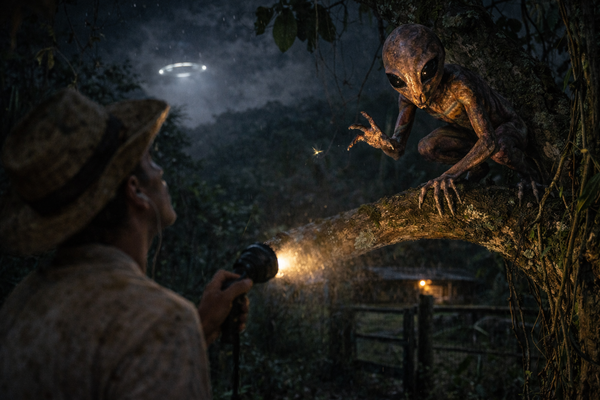
Dogman is also often witnessed in close association with light anomalies: Unexplained illuminations, sudden flashes, balls of light. In a number of LBL accounts specifically, the creature is reported in conjunction to what witnesses describe as a feeling of compressed time, the sense that more or less time has passed, than the clock records.
When cryptid phenomnena starts crossing over into UFO encounter territory then and we are definitely not in Kansas anymore
These are the details that push the Dogman out of cryptozoology proper and into what researchers like John Keel and Jacques Vallée termed theUltraterrestrial hypothesis: the idea that certain anomalous phenomena, including some UFO encounters, cryptid sightings, and paranormal or poltergeist activity do not represent biological animals or nuts and bolts alian spacecraft.
Instead they represent entities or phenomena that exist in a relationship to our physical world which is neither fully material or supernatural. Keel's term was ultraterrestrial. Vallée prefers to speak of an intelligence operating through the cultural forms most relatable to the observer. Whatever language one uses, the core idea is that the phenomenon is something that interacts with human perception and cognition as much as with the physical world.
The portal hypothesis, is an idea which suggest the Dogman inhabits places which act as thresholds between states or realities although the most speculative explanation, it is an idea that fits the geography better than most. Sightings tend to cluster around burial mounds, bodies of water, locations identified in Native traditions as spiritually active, as well as road crossings and forest edges. That pattern is difficult to explain if the creature is simply a biological predator. Predators follow prey.
Skinwalker Ranch in Utah, one of the most intensively investigated anomaly hotspots in North America, has produced multiple canine entity reports alongside its better-known UFO and poltergeist phenomena. Researchers working in the Land Between the Lakes have noted a similar pattern: UFO sightings clustering in the same geographic areas as Dogman reports. This does not establish a causal connection but it is a correlation that recurs across independent datasets and one the biological species hypothesis has no framework to explain.
The most intellectually honest conclusion is this: something is happening. It has been happening for a long time. It is not adequately explained by misidentified animals, and it does not sit comfortably within the categories we currently rely on. “Biological creature,” “supernatural entity,” “psychological phenomenon” these may be useful labels, but they are not sufficient. Whatever lies behind these encounters appears to operate at the edges of those definitions, and may not be contained by them at all.
Why Now? The Extraordinary Rise of Dogman Research
Twenty years ago, the Dogman occupied a small corner of the cryptozoology community's attention. Bigfoot commanded the field. The Loch Ness Monster held the popular imagination. The Dogman was niche, regional, and insufficiently photogenic for the cryptid mainstream.
Something has changed. The North American Dogman Project now coordinates hundreds of researchers globally. Dedicated podcasts, with Dogman Encounters Radio chief among them, have accumulated libraries of audio testimony that run to hundreds of hours. The Small Town Monsters documentary series has produced multiple Dogman-specific films. In 2024 alone, several significant research volumes and documentaries specifically focused on the canine humanoid phenomenon were released. On TikTok, Dogman content accumulates hundreds of millions of views. New sightings are reported and discussed online, with geographic data attached, in real time.
Several factors are driving this acceleration. The collapse of the barrier between witness and platform, and the removal of the newspaper or television producer as gatekeeper between a person with an unexplained experience and an audience, has allowed a body of testimony to accumulate that was always there but never had anywhere to go. People who saw something in 1994 and told nobody are now finding communities that take them seriously and ask detailed questions. The quality of the data is improving accordingly.
The growing serious academic interest in anomalous phenomena more broadly, reflected in the US government's UAP disclosure process, the mainstreaming of consciousness research, and the renewed philosophical respectability of non-materialist framings, has also created an environment in which the Dogman is easier to discuss without automatic dismissal. The cultural window has opened. What was fringe is becoming a legitimate field of enquiry, and the Dogman, with its deep roots, its geographic coherence, and its unusually consistent witness record, is one of the phenomena best positioned to benefit.
The Open File
No body has been recovered. No clear, unambiguous photograph exists. No DNA sample has been extracted and sequenced to a species outside the known biological record. The Dogman evidence base, for all its volume and its internal consistency, remains in the category of the unproven.
Whatever the Dogman is, it has been here longer than we have been looking for it. And it has been watching us considerably longer than we have been watching back.
The file remains open.
-
Not a Werewolf: The Dogman Rabbit Hole You are here
- Case File 01: The Werewolf Folder — Wisconsin's Beast of Bray Road
- Case File 02: The Land Between the Lakes
- Case File 03: April Fool — How a Radio Joke Unlocked a Century of Silence
- Case File 04: Black Shuck and the British Canine Tradition
- Case File 05: The Skinwalker Connection