
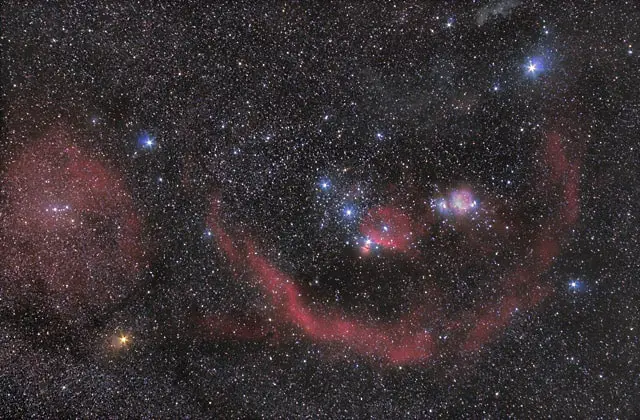
The Orion constellation, one of the night sky’s most recognisable patterns, has been a source of fascination for millennia. Named after a giant hunter from Greek mythology, Orion is visible from November to February and lies along the celestial equator, making it observable from most inhabited regions on Earth. It contains two of the brightest stars in the sky: Rigel and Betelgeuse. Historical and archaeological evidence traces Orion’s significance back over 30,000 years, as seen in prehistoric ivory carvings discovered in Germany’s Ach Valley. The constellation is also notable for hosting two meteor showers, the Orionids and Chi Orionids, and several prominent nebulae including the Orion Nebula (M42), a region rich in star formation.
Key details of Orion’s stars outline its complex structure; for example, its three-star belt—Alnilam, Mintaka, and Alnitak—are massive and extremely luminous, situated between 700 to 900 light years from Earth. Alnitak alone is estimated to be 100,000 times brighter than the Sun. The constellation’s cultural impact spans multiple ancient civilisations worldwide. Egyptian lore associated Orion with Osiris, a god linked to rebirth and afterlife, suggesting a celestial connection to resurrection myths. The so-called Orion correlation theory proposes that the three pyramids of Giza mirror Orion’s belt stars, a claim supported by chronological alignments around 10,450 BC. Despite its mythological underpinnings, these ideas engage both archaeologists and astronomers in debates over symbolic versus astronomical alignment interpretations.
Orion’s enduring presence in world culture reveals a broad universality in observing this constellation. From Babylonia’s “Heavenly Shepherd” to the medieval Muslim term al-jabbar meaning “the giant,” its image has inspired numerous interpretations and mythologies. In North America, the Hopi people’s mesa formations are thought to mimic Orion’s belt, reflecting a cosmological resonance that influenced settlement and ritual. Scientific observations continue to explore the dynamics within Orion’s stars, which move cohesively through space, an indication of their likely common origin. The constellation’s multiple Messier objects, including several nebulae and star clusters, make it vital for studies on stellar birth and evolution. Orion, therefore, stands as a critical intersection between astronomical science and ancient cultural history, linking humanity’s early skywatching to modern astrophysics.
Source: Ancient Code