
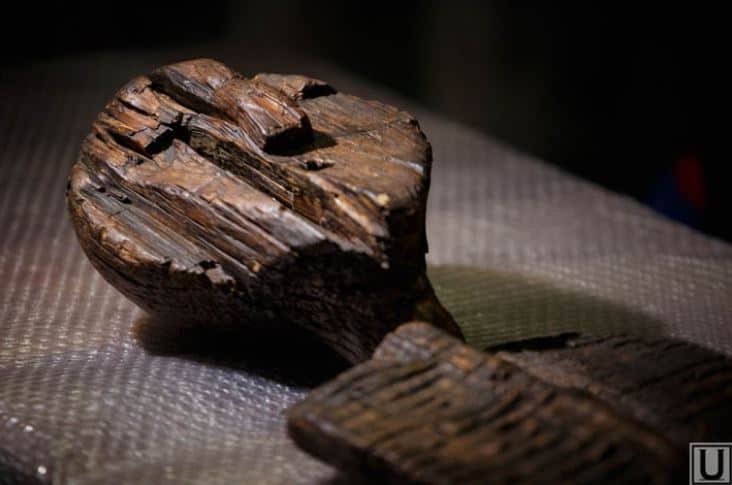
The Shigir Idol, the oldest wooden statue in the world, was discovered in 1890 near Kirovgrad in the Sverdlovsk region of the Ural Mountains. Radiocarbon dating estimates its origin at approximately 7,500 BCE, placing it deep in the Mesolithic period, predating the Egyptian pyramids by several millennia. The statue originally stood around 5.3 metres tall, comparable to a two-storey house, but only 2.8 metres remain today. Much of the artefact was lost during political conflicts in 20th-century Russia, although Siberian archaeologist Vladimir Tolmachev documented the missing sections with detailed sketches. This enigmatic statuette, made of larch wood, is currently housed in the Yekaterinburg History Museum. Its surface is adorned with intricate geometric patterns and symbolic carvings whose meanings remain inscrutable despite ongoing research.
The Shigir Idol is carved with repeating motifs including straight lines, zigzags, and anthropomorphic faces—seven in total, one of which is rendered three-dimensionally. Researchers hypothesise that the straight lines may symbolise natural boundaries such as horizons or divisions between earth and sky, or even metaphysical thresholds separating different realms or worlds. Despite decades of scholarly attention, the coded messages remain undeciphered and pose significant challenges due to the age and uniqueness of the symbols. The complexities are compounded by the loss of nearly half the statue’s original height and the degradation wood undergoes over millennia. The idol’s purpose remains speculative; some suggest it served as a spiritual or ritual object, possibly representing ancestral deities or acting as a cosmological map. The Shigir Idol is thus a crucial fragment of prehistoric belief systems and poses questions about the symbolic language of Mesolithic peoples in northern Eurasia.
Contextually, the Shigir Idol contributes significantly to our understanding of early human artistic and religious expression, marking a striking contrast with contemporaneous stone or bone artefacts. Its scale and craftsmanship imply an advanced level of societal organisation and spiritual complexity during a period otherwise characterised by hunter-gatherer bands. Similar Mesolithic findings are relatively rare, and none approach the idol’s intricacy or preserved scale. In the broader sphere of prehistoric art, the Shigir Idol challenges assumptions about the development of symbolic thought, suggesting that abstract and perhaps cosmological concepts were encoded by people living in the Eurasian forest-steppe environment over 9,000 years ago. Furthermore, it highlights Siberia’s role as a critical and often overlooked nexus in human cultural evolution. The idol’s enduring mystery continues to inspire interdisciplinary collaboration among archaeologists, anthropologists and linguists dedicated to unveiling the cognitive worlds of our distant ancestors.
Source: Ancient Code