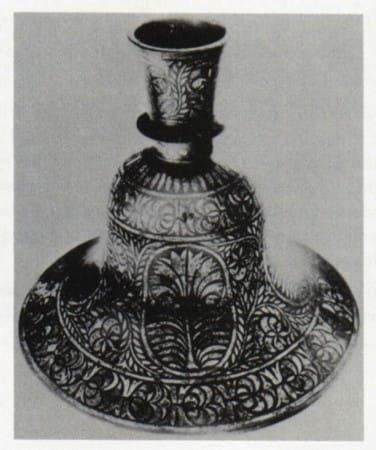
The Dorchester Pot is a small, bell-shaped vase excavated in 1852 from Meeting House Hill in Dorchester, Massachusetts, during a rock-blasting operation. Measuring approximately 11.5 cm in height with a diameter of 16.5 cm at the base and 6.4 cm at the opening, the pot is crafted entirely from zinc and ornamented with silver inlay, featuring six floral designs on its sides and a decorative vine or crown motif at its base. It is acclaimed for its precise metalwork, suggesting the hand of a master craftsman. The most contentious aspect of the pot lies in its provenance, as it was reportedly embedded in the Roxbury Conglomerate, a rock formation dated geologically to the late Ediacaran Period, approximately 570 to 593 million years ago. This dating implies an extraordinary antiquity for a metal artefact, placing it in a period well before known human metallurgy.
The authenticity of the pot’s origin remains highly debated due to contradictory evidence and a lack of surviving documentation. While the initial discovery was recorded in an 1852 issue of Scientific American, the pot subsequently vanished without trace. Some scholars argue the pot’s presence within the ancient rock strata is due to its embedment before the explosive rock fracture, thus suggesting enormous geological age. However, others propose it could have been introduced into fissures or displacements in the rock post-deposition, or is simply a 19th-century artefact misplaced or misrecorded. The detailed botanical motifs portrayed on the pot have drawn attention, with some botanists positing that the depicted species are extinct, dating several millennia back, though this identification is not universally accepted. Outside mainstream archaeology, proponents of alternative archaeology and ancient astronaut theorists cite the pot as evidence of advanced prehistoric civilisations or extraterrestrial influence, though these claims lack corroboration from peer-reviewed research.
The Dorchester Pot intersects with several disciplinary debates in archaeology, geology, and palaeobotany. The Roxbury Conglomerate itself is a well-studied formation known for its late Precambrian age and lack of any verified human or technological artefacts from that era. The pot’s supposed zinc and silver composition and craftsmanship contradict established timelines for metallurgy, which began in the Chalcolithic period around 5,000 years ago. The pot thus challenges the understanding of prehistoric metallurgy and human cultural development, should its provenance be confirmed. This case exemplifies how anomalous artefacts must be diligently examined in context—the stratigraphic integrity, provenance, and replication attempts are critical. The loss of the pot makes conclusive analysis impossible at present, emphasising the importance of safeguarding and thoroughly documenting artefacts that lie outside conventional paradigms. Until rediscovered or subjected to modern scientific interrogation, the Dorchester Pot remains an unresolved enigma in Fortean studies and archaeological discourse.
Source: Ancient Code