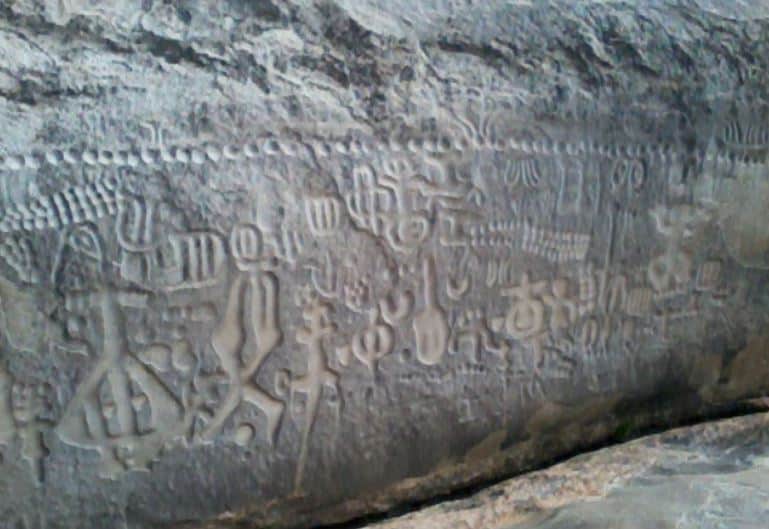
Situated in the middle of the Inga River near the Brazilian city of Inga, the Inga Stone, also known by its indigenous Tupi name Itacoatiara do Ingá, is a remarkable archaeological site measuring approximately 46 metres in length and nearly four metres in height. This vertical gneiss formation covers an area around 250 square metres and bears an extensive array of intricate carvings, including depictions of animals, fruits, abstract symbols, and notably, representations of the Milky Way and the constellation Orion. Scholars date the engravings to at least 6,000 years ago, making the site one of the oldest and most significant astronomical records in South America. The precision and detail of the carvings suggest advanced craftsmanship, although their exact meaning and purpose remain undeciphered.
The Inga Stone’s carvings have drawn numerous theories and debates among archaeologists and researchers. Brazilian scholar Gabriele Baraldi, for example, posits that the inscriptions reflect unknown ancient technologies, while others have speculated on potential Phoenician or even extraterrestrial origins, though no conclusive evidence supports these hypotheses. Local native Brazilian tribes rarely depicted celestial phenomena, making the astronomical motifs on the stone particularly unusual. Damage over time due to weathering and vandalism—especially the destruction of nearby stones in the mid-20th century—has eroded many of the original symbols, complicating interpretation and preservation efforts. Various stones in the region lack the unique stylistic features seen on the Inga Stone, emphasising its singularity in ancient workmanship. Comparative studies have noted geometric similarities with symbols found on Easter Island, though no concrete cultural links have been established.
Contextually, the Inga Stone holds a unique place within Brazilian and broader South American archaeology where pre-Columbian practices typically did not emphasise detailed celestial mapping. Most native cultures of the Amazon associated the heavens with mythological rather than strictly astronomical ideas, contrasting with the precise star configurations carved on the Inga Stone. This suggests the creators had a sophisticated understanding of celestial patterns, potentially for ritual or calendrical purposes. The site ties into a wider tradition of megalithic and rock art globally, where ancient peoples used natural rock formations as canvases for symbolic expression and cosmic observation. The Inga Stone’s enigmatic designs continue to challenge established understandings of prehistoric cultural and technological capabilities in the region, urging further multidisciplinary study to unravel its secrets without resorting to unfounded speculation.
Source: Ancient Code