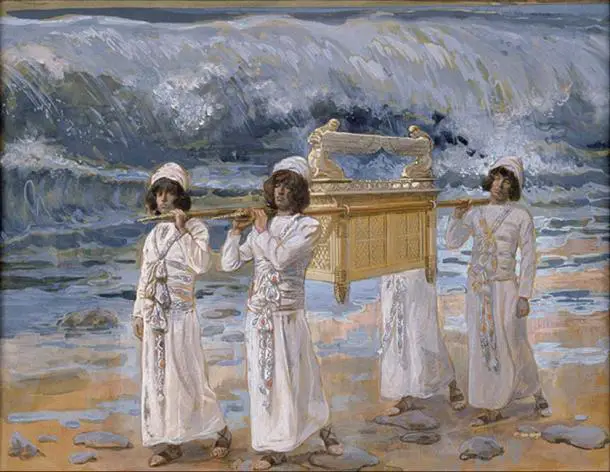
The Ark of the Covenant is a richly described biblical artefact believed to have been constructed approximately three thousand years ago by the Israelites to house the stone tablets inscribed with the Ten Commandments. According to the Book of Exodus, it was built by divine command through Moses on Mount Sinai and subsequently carried by the Israelites throughout their forty-year desert journey. The Ark was placed within the Tabernacle, a special tent that accompanied the tribes wherever they camped. Its significance is underscored in various biblical accounts, including its role in several Old Testament miracles. Notably, it is said to have stopped the flow of the Jordan River and contributed to the fall of Jericho’s walls. Beyond the Ten Commandments tablets, the New Testament letter to the Hebrews adds that the Ark contained Aaron’s rod, a jar of manna, and the earliest Torah scroll.
Key details of the Ark’s description include precise measurements—approximately 131 by 79 by 79 centimetres—crafted from acacia wood and overlaid with gold. It was adorned with a golden ‘kapporet’ or cover, and fitted with four gold rings through which poles were inserted to carry it, though these poles were never to be removed. The Ark was typically concealed beneath a richly coloured veil when transported. After the Babylonian conquest of Jerusalem, the fate of the Ark becomes obscure; biblical and historical sources diverge on whether it was destroyed, taken, or hidden. The Greek third book of Ezra notes that the Babylonians seized many holy vessels but does not explicitly confirm the Ark’s fate. In modern times, Ethiopian tradition claims the Ark resides in the Church of St Mary of Zion in Aksum, guarded by a designated keeper who alone may view it. Access to verify the Ark’s authenticity has never been granted, maintaining its mystery. Another hypothesis situates the Ark beneath the Temple Mount in Jerusalem, though archaeological investigation there is prohibited due to the site's religious sanctity.
Contextually, the Ark of the Covenant holds a unique place within biblical and archaeological studies as an enduring symbol of divine presence and covenant. The biblical narrative assigns it a central role in Israelite religious life and national identity. Its purported miraculous powers link it firmly to the genre of sacred relics which are common in many ancient cultures but rare in their preservation and influence. The Ark’s connection to Ethiopian Christianity adds a rare inter-cultural thread, demonstrating how religious artefacts can migrate into broader mythic and cultural tapestries. In addition, the Ark’s possible location under the Temple Mount situated it within the complex geopolitical and religious conflicts of Jerusalem, highlighting the intersection of archaeology, faith, and modern political realities. Despite centuries of interest, the Ark of the Covenant remains an elusive object both historically and archaeologically, continuing to provoke scholarly debate and speculative theories while firmly residing in the realm of ancient religious artefacts.
Source: Ancient Code