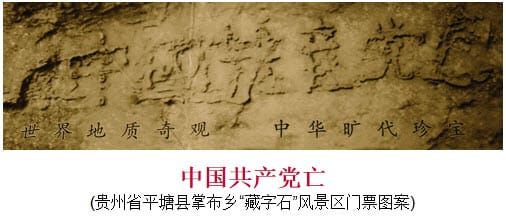
In the Qiannan Pingtang National Geological Park in China, a remarkable stone known as the Hidden Character Stone has drawn considerable attention for bearing what appears to be Chinese characters on its surface. Discovered during the cleaning process for the Duyun International Photography exposition, the stone lies wedged in a narrow crevice between two cliffs. Scientific examinations date the rock to approximately 270 million years ago, placing it in the Permian period, long before human civilisation existed. Despite this, the characters on the stone seemingly read “The Chinese Communist Party Collapses” in a combination of Simplified and Traditional Chinese script. This discovery has been subject to investigation since 2003 by several prestigious Chinese institutions, including the Chinese Academy of Sciences and the Chinese University of Geosciences.
Key details of the discovery reveal that the characters form a square-foot surface, with no evident signs that they were artificially inscribed by humans. Researchers such as Li Ting-dong, Liu Bao-jun, and Li Feng-lin have argued that the inscriptions are truly natural, given the geological age of the stone and absence of tool marks. The characters are arranged left to right, a style not historically used during early Chinese script development, and the inclusion of Simplified characters, which were only introduced in the mid-20th century, poses further challenges to orthodox explanations. Skeptics argue that the inscriptions may be a modern hoax intended to increase local tourism, citing the stone’s location near a village. However, geologists confirm the stone’s age and the conditions of its fall from a mountain cliff near the Zhangbu river valley, supported by the indentation on the ground where it presumably landed. The vice-editor of the People’s Daily, Liang Heng, cautioned against dismissing the phenomenon but also acknowledged the extraordinary nature of a geological formation seemingly capable of writing political slogans.
From a broader contextual standpoint, the Hidden Character Stone challenges conventional palaeontological and archaeological knowledge. Typically, natural rock formations can occasionally resemble symbolic forms or patterns, but the combination of clearly recognisable characters forming a coherent modern political message undermines straightforward explanations. The Permian period, when the rock formed, represents a time long predating human written language by hundreds of millions of years, and the scientific consensus holds that Chinese characters only emerged several millennia ago. Similar occurrences of naturally patterned stones or fossil formations mimicking letters fall within the realm of pareidolia, where the human mind interprets vague stimuli as familiar shapes. However, the complexity and specificity of this inscription are unprecedented. This anomaly demands rigorous interdisciplinary investigation incorporating geology, linguistics, palaeontology, and possibly newer scientific methods to ascertain if the markings are natural or an extraordinary, unexplained phenomenon.
Source: Ancient Code