
There's a particular kind of dread that comes with seeing yourself in a place you know you aren't. Not a reflection. Not a twin. Just you — standing there, looking back, in a room you've never entered or on a road you've never walked. It's the kind of experience that breaks something in your understanding of the world, quietly and permanently.
People have been reporting it for centuries. And here's the thing that should probably unsettle you more than the reports themselves: nobody has fully explained it yet.
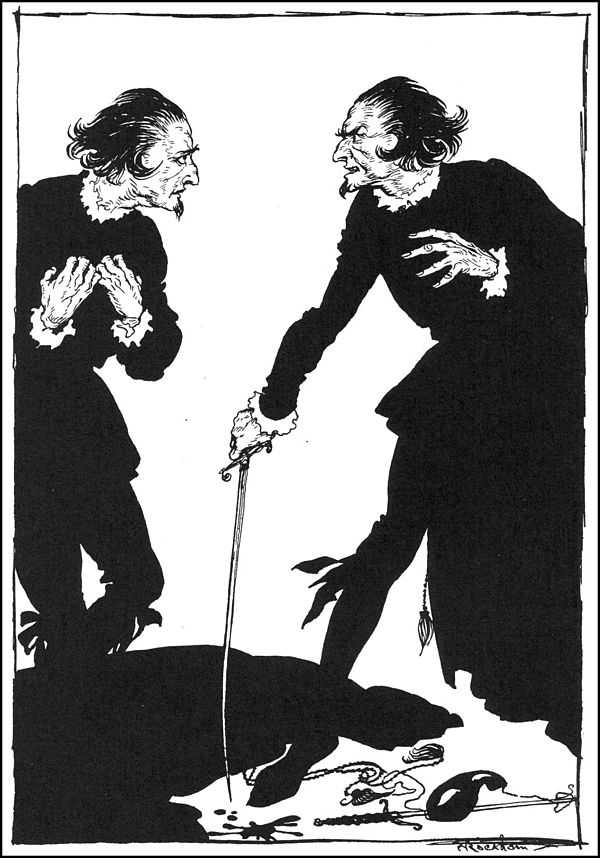
"The endless series of shadow and doppelgänger figures in mythology, fairy tales and literature — from Cain and Edom, by way of Judas and Hagen, to Stevenson's Mr. Hyde — again and again such figures have appeared and made their bow before human consciousness, but the psychological meaning of this archetype of the adversary has not yet dawned upon mankind."
— Erich Neumann, Depth Psychology and a New Ethic (1949)
The word comes from German — Doppelgänger, meaning "double walker." First coined in print in 1796 by the novelist Jean Paul Richter, who dropped it into a footnote as though naming something that already needed a name. Which, by then, it probably did. But what he was naming is far older than the word he gave it.
The Territory
Four Thousand Years of the Double
Ancient Egyptian theology described the ka — a spiritual double of the living self, existing alongside the physical body and persisting after death. Not a soul in the Christian sense, but a genuine duplicate: present, visible under certain conditions, and intimately connected to the fate of its original. Norwegian tradition gave the world the vardoger, a phantom predecessor that would arrive somewhere before the real person, do the same things, speak the same words — leaving witnesses confused when the actual individual turned up moments later doing exactly what they'd already seen done. Anglo-Saxon folklore called the phenomenon a fetch. German tradition named it the Doppelgänger. The specific mechanics differed across each culture. The essential strangeness was identical across all of them.
What they were all reaching toward is this: an exact, visible duplicate of a living person, seen by others or by the person themselves, occupying a space the original is not. Sometimes it mimics. Sometimes it acts independently. Occasionally it speaks. Nearly always — and this is the detail that runs consistently through every culture that recorded it — it is treated as an omen. Usually a dark one.
Four thousand years. Every continent that left a written record. All arriving at the same description, independently, without contact. That's either a remarkable coincidence of human psychology, or it is pointing at something real that we haven't yet found the right instruments to measure.
The Case Room
The Documented Encounters
The cases that have endured scrutiny aren't anonymous rural legends. They involve named individuals — in several instances, people of significant historical standing — whose accounts were recorded by credible contemporaries.
Emilie Sagée was a French schoolteacher employed in 1845 at the Pensionat von Neuwelcke, an exclusive girls' school near Wolmar in what is now Latvia. Her case was documented by the American statesman and author Robert Dale Owen, who interviewed witnesses directly. One afternoon in class, while Sagée wrote at the blackboard, her exact double appeared beside her — mimicking every movement, holding no chalk. Thirteen students watched it happen simultaneously. The incidents continued for months, growing bolder. One summer afternoon, forty-two students were working in the hall when they noticed Sagée in the garden outside. Her chair at the front of the room was empty. Then it wasn't. Her double appeared in it, sitting quietly, while the real Sagée remained visible through the window. Two students approached the figure. They described passing through it — encountering a resistance they compared to pushing through thick fabric. Sagée herself had no awareness that anything had occurred. She was eventually dismissed — not because of the incidents themselves, but because the parents of her students were frightened. A model teacher, undone by something she couldn't control and didn't know was happening.
Abraham Lincoln's encounter was more intimate. On the night of his first election in 1860, he lay on a couch and glanced toward a mirror. Two faces looked back — his own, and beside it, a second Lincoln, identical in every feature but perceptibly paler. He rose; the second face vanished. When he lay back, it returned. His wife Mary became convinced it meant he would be elected twice but would not survive his second term. She was correct on both counts. The journalist Noah Brooks recorded this account in his 1895 memoir Washington in Lincoln's Time, drawn directly from conversations with Lincoln himself.
Johann Wolfgang von Goethe, riding toward Drusenheim in a distracted state, saw a man approaching on the road dressed in a grey suit trimmed with gold. The figure vanished almost immediately. Eight years later, riding that same road in the opposite direction, Goethe looked down and realised he was wearing precisely that suit. He had been his own doppelganger — seen from the past, appearing in his own future. He recorded the incident in his autobiography Dichtung und Wahrheit, written between 1811 and 1833.

Queen Elizabeth I of England reportedly encountered her own double lying pale and motionless on her bed toward the end of her reign, arranged as if laid out for burial. She died within days. Court accounts from the period record this, though documentation is partial. Perhaps the most clinically precise modern case belongs to a 40-year-old Italian schoolteacher studied by Dr Franziska Anzellotti at the University of Chieti-Pescara. The woman had experienced recurring doppelganger encounters for decades — episodes so distressing she had attempted suicide twice. In monitored clinical sessions, EEG equipment recorded clear epileptic activity concurrent with each appearance. Not metaphor, not delusion — a measurable electrical event in the brain, producing what felt, to the experiencing mind, exactly like encountering another self.
That clinical case is important. But notice what it doesn't explain: Sagée's forty-two simultaneous witnesses. Lincoln's wife. Goethe's prospective apparition seen eight years before he replicated it.

The Explanations
What Science, Folklore and Physics Actually Say
The medical term for seeing yourself is heautoscopy — from the Greek, "to observe oneself." It is a documented, studied neurological phenomenon, not a fringe theory. Research by neuroscientists Olaf Blanke and Lukas Heydrich at the Ecole Polytechnique Fédérale de Lausanne, published in Brain (Oxford Academic, 2013), identified the left posterior insula as consistently implicated in heautoscopic cases. The posterior insula integrates sensory signals, body awareness, and emotional processing. When it misfires — through seizure, brain lesion, or extreme physiological stress — the brain can generate a secondary representation of the self that is visually and spatially present. The science here is solid, and it matters. It tells us something genuinely unsettling about how fragile the felt sense of being a single, located self actually is. The self is a construction. An impressively robust one, most of the time. But a construction nonetheless.
The honest limitation is that this explanation accounts well for the subjective experience — one person seeing themselves. It has considerably less purchase on the witnessed cases. Forty-two students don't simultaneously experience posterior insula misfires.
The older esoteric frameworks weren't operating from ignorance when they took a different approach. Theosophical tradition, as developed by Helena Blavatsky in the 19th century, described the etheric double — an energetic duplicate of the physical form that could, under certain conditions, become perceptible to others. Whether or not one accepts that framework literally, it was a serious attempt by serious people to account for a class of experience that the neuroscience of their era couldn't touch. The Jungian concept of the Shadow — the unintegrated self, the aspects of psyche we refuse to acknowledge — doesn't posit literal apparitions, but understands instinctively why cultures have always imagined the double as threatening. What you won't look at has a way of looking back.
On the physics: it's worth being honest that this is genuinely speculative territory. Brian Greene, the Columbia University physicist, has argued in The Hidden Reality that if space is genuinely infinite — as standard cosmological models suggest — then matter can only arrange itself in a finite number of configurations. Which means that at some incomprehensible distance, every particle arrangement constituting you is duplicated. Your physical double exists. Possibly many times. Whether that has any bearing on what people have been witnessing across four millennia of recorded history is, to put it carefully, an open question that physics is not yet equipped to answer.
Case Summary · Key Facts
- Documented independently across Ancient Egyptian, Norse, Anglo-Saxon, and Germanic traditions — cultures with no contact with one another
- Named, credible witnesses across multiple centuries; several cases involving simultaneous multi-witness observation
- Neurological mechanism (heautoscopy / posterior insula disruption) confirmed for subjective cases via peer-reviewed research at EPFL and University of Chieti-Pescara
- Multi-witness cases remain unexplained by current neurological models
- No physical evidence has ever been recovered; no official investigation has ever been conducted
- Status: Unresolved
The Open Door
What Remains
What the doppelganger cases that endure have in common is not that they are unexplained — plenty of strange things go unexplained. It's that they are inexplicable by the frameworks we currently have, even when those frameworks are applied generously and in good faith. The neuroscience covers some cases. The physics gestures at possibilities. The folklore traditions, taken seriously rather than dismissed, describe something remarkably consistent across cultures that had no contact with one another.
Something is happening in the witnessed cases. We don't know what it is. That is the honest position, and Stranger Times holds it without apology.
Your double is out there somewhere, if the oldest human traditions are to be believed. What it means — whether it is a glitch in the brain's self-modelling software, an artefact of a universe stranger than classical physics admitted, or something that requires a framework we haven't built yet — remains, for now, entirely open.
That openness is not a failure of investigation. It's an invitation to keep looking.