
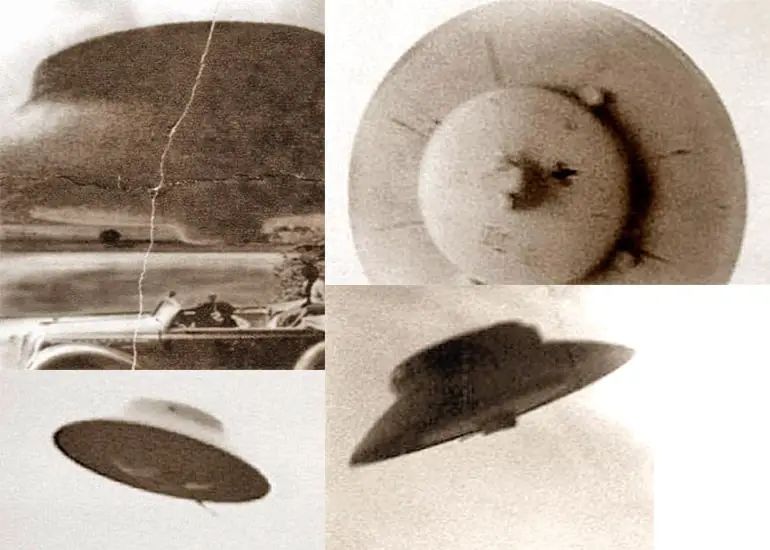
A German documentary broadcast by ZDF has raised claims that Nazi Germany was developing a nuclear bomb alongside an associated flying saucer intended for its transport. Allegedly, these projects were tested on Russian prisoners of war held in Thuringia, eastern Germany, during the latter stages of the Second World War. The documentary centres on SS General Hans Kammler, who was reportedly tasked with overseeing nuclear fission programmes and weapon manufacturing involving thousands of concentration camp prisoners. It alleges that Nazi scientists conducted nuclear tests in the Thuringia valley and that a hemispherical craft – described as a flying saucer – was part of their advanced weapons development. The film draws on intelligence reports, witness interrogations, captured Nazi documents, and claims from Russian military agents.
Key details include assertions from Russian intelligence that two potent nuclear devices were tested in Thuringia, measuring roughly 1.5 metres. However, declassified US records indicate reconnaissance efforts led by General Dwight Eisenhower yielded inconclusive results, with no uranium deposits found in the purported test areas. This discrepancy raises questions about the veracity and extent of Nazi nuclear capabilities. The documentary further speculates on the technological origin of the flying saucer, suggesting connections to “reversed” or otherworldly technology, a notion popular in UFO and conspiracy theory circles. There is no physical evidence publicly available to substantiate these claims, and most historians consider them dubious or allegorical. Nonetheless, the film invites reflection on the possibility of advanced, secretive Nazi projects which might have influenced post-war technological development during the Cold War.
Contextually, the Nazi nuclear weapons programme, known historically as the Uranverein, never achieved a functional atomic bomb, hindered by resource constraints and strategic focus on conventional weaponry. Claims of flying saucers attributed to the Nazis often cite the “Die Glocke” (The Bell) myth—a purported secret craft or device with unexplained capabilities—but this remains unverified speculation. During and after the war, Allied powers, particularly the United States and Soviet Union, aggressively sought to acquire Nazi scientific expertise through Operation Paperclip and similar efforts, suggesting a recognition of the advanced, if not fully realised, technologies developed by Germany. The Thuringia region was indeed a centre for underground research and armaments production, though documented evidence of nuclear explosions or saucer-type crafts is absent from formal historical archives. The enduring mystery surrounding these alleged projects feeds into broader themes of lost or hidden technologies, providing fertile ground for UFO researchers and historians alike to examine the complexities of wartime innovation and post-war secrecy.
Source: Ancient Code