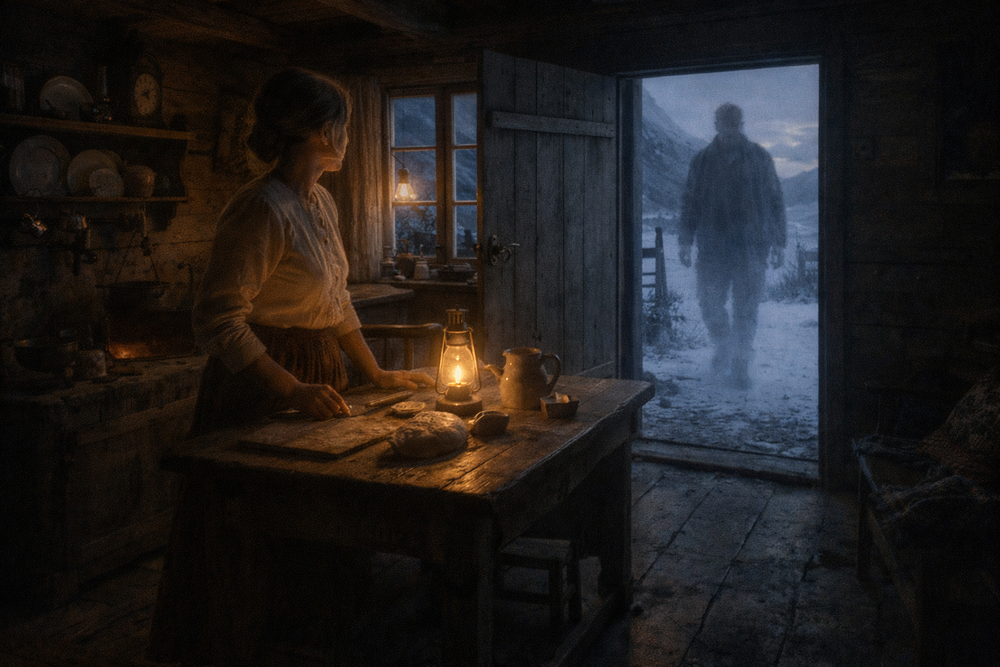
You are in the kitchen when you hear the gate. Then footsteps on the path — the specific rhythm of your husband's walk, slightly heavier on the left. The door opens. You call out. No answer. You go to the hall. Empty. You stand there confused for a moment, then return to what you were doing. Two minutes later, the gate again. The footsteps. The door. This time he walks in, takes off his coat, sits down — and says exactly the words you somehow already knew he was going to say.
In Norway, this is not considered particularly strange. It has a name: the vardoger. The phantom predecessor — the part of you that arrives before the body does. In rural Norway, accounts of the vardoger appear in 19th-century folklore collections so casually that they read not as reports of supernatural encounters but as accounts of ordinary domestic life. The extraordinary was so routinely experienced that it ceased to feel extraordinary.
What makes the vardoger genuinely interesting to anyone investigating the boundaries of the self is that it inverts the usual structure of these phenomena. The doppelganger is seen. The Hat Man watches. The vardoger arrives before you and does what you are about to do. It is not a copy. It is a preview. That distinction carries implications for how we think about time, consciousness, and the relationship between intention and action that are not yet resolved.
"Vardøgr: premonitory sound or sight of a person before he arrives."
— Old Norse definition, from varðhygi — vǫrð (guard, watchman) + hugr (mind, soul)
The Territory
The Norse Soul That Walks Ahead
The word vardoger is almost certainly derived from the Old Norse varðhygi — the combination of vǫrð (guard, watchman, warden) and hugr (mind or soul). The vardoger was originally understood within the Norse framework of the fylgja — a kind of companion spirit that expressed the inner essence of a person, sometimes manifesting as an animal that embodied their character, sometimes as a projected human form. The vardoger was not a threat. It was a herald. Where the doppelganger was an omen, usually dark, the vardoger was simply a fact of life in the Scandinavian north — the soul going ahead to prepare the ground.
The phenomenon is not uniquely Norwegian, but it is most specifically and persistently documented there. Scotland has the analogous co-walker or fetch — though the fetch carries darker connotations, appearing as a death omen rather than a neutral herald. Finland calls the equivalent the etiäinen. Iceland integrates it into the fylgja tradition more broadly. What is distinctive about the Norwegian vardoger is how embedded it became in the culture of daily life — not a dramatic supernatural visitation but a quiet, unremarkable occurrence that happened regularly enough to need a precise vocabulary.
Frederic W. H. Myers, the Victorian psychical researcher whose work on the survival of consciousness remains a landmark of that field, coined the term psychorrhagic diathesis to describe a hypothetical mechanism by which the projected aspects of a personality might leave physical traces or produce sensory impressions at a distance. His framework, whatever its ultimate validity, was an attempt to account for phenomena like the vardoger through a naturalistic lens rather than a supernatural one. The question he was asking — how does a non-physical aspect of a person leave physical evidence — has not been answered in the century since.

The Case Room
The Documented Encounters
The most extensively documented modern vardoger case belongs to Erikson Gorique, an American art dealer, and is recorded by paranormal researcher Rosemary Ellen Guiley in The Encyclopedia of Ghosts and Spirits (2000). In July 1955, Gorique travelled to Oslo for the first time in his life to purchase Norwegian glassware. He arrived at his hotel to find that his room had already been reserved — by a man who had arrived in person approximately one year earlier, given his name, and made the booking. The receptionist described the visitor in detail: same physical description as Gorique, same name, same purpose. When Gorique moved on to meet his business contact — a glass wholesaler named Olsen, whom he had never met — Olsen greeted him as a returning acquaintance and expressed pleasure at seeing him again. Neither man had any explanation. The first meeting, for Gorique, had never occurred. For everyone else, it had.
This case is distinctively challenging because it suggests the vardoger operates not just as a sensory impression — sound, footsteps, a voice — but as a fully present, interactive physical entity capable of conducting business, giving a name, making a booking, and being physically described by multiple independent witnesses a year before the real person arrives. That is a different order of phenomenon from hearing footsteps in a hallway.
The more typical vardoger experience is domestic and auditory. Families in rural Norway reported hearing a relative's distinctive approach — the specific sound of their boots, their way of opening a door, the clink of their keys — minutes or sometimes hours before the person physically arrived. The sounds were not vague impressions. They were specific enough that family members would begin preparing: setting the table, putting the kettle on, calling out a greeting. Then nothing. Then, shortly after, the real arrival — following the same acoustic pattern in exactly the same order.
A family living in a Norwegian community described by researcher Nina of Norway documented their vardoger experiences across multiple generations. The grandmother's vardoger was distinctive enough to be immediately recognisable: the specific sound of her brushing sand off her shoes in the outer hallway, a habit she had developed walking the sandy path to their house. Family members would hear the brushing, enter the hall to find it empty, return to what they were doing, and then moments later hear it again — followed this time by the real grandmother, performing the same action in the same sequence. The detail matters: it was not a generalised presence but a specific, idiosyncratic behaviour that the vardoger replicated precisely.
The connection to bilocation is worth noting directly. The Gorique Oslo case — in which a physical entity conducted real-world transactions a year before its original appeared — is structurally identical to certain bilocation accounts, including the arrival of a recognisable figure who interacts with bystanders and then disappears. Whether these are manifestations of the same phenomenon viewed from different cultural frameworks, or genuinely distinct mechanisms producing similar outcomes, is an open question.
The Explanations
What Folklore, Physics and Perception Research Say
The acoustic explanation covers the simpler cases straightforwardly. In the cold, stable atmosphere of Scandinavian regions, temperature inversions cause sound to refract in ways that extend its range significantly — sounds from some distance can arrive with surprising clarity and apparent proximity. Echoes in fjords and valleys can produce overlapping or delayed signals. A family member approaching along a familiar path might generate sounds audible to the house long before their physical arrival. This is a real phenomenon, it applies to the geographical context where vardoger reports are densest, and it accounts for the auditory cases without any unusual mechanism.
It accounts for them, though, only up to a point. Acoustic refraction cannot explain the Gorique case, where the phantom conducted a business transaction that was independently remembered by two separate professionals a year later. It cannot explain cases where the vardoger is visually observed — seen moving through a hallway, sitting in a chair, carrying out specific actions — rather than merely heard. And it cannot account for the phenomenon's remarkable specificity: the vardoger does not produce generic ambient sounds. It produces the exact sounds of a specific individual's specific habits.
The precognition hypothesis — that the witnesses are not experiencing the actual vardoger but are unconsciously sensing the imminent arrival of the person and generating a sensory impression in advance — has the advantage of keeping everything inside the experiencing mind. It is consistent with modern research into unconscious processing and micro-expressions, which suggests the brain routinely processes information faster and in advance of conscious awareness. Whether that processing can produce detailed, shared, interactive auditory and visual impressions is a claim that precognition research has not yet been able to demonstrate under controlled conditions.
The most honest assessment is that the simple acoustic cases are explicable, and the complex physical-interaction cases are not. The vardoger sits in an interesting position among the phenomena in this series: it is the most domestically embedded, the most culturally normalised, and — in its complex forms — the most difficult to account for. A phenomenon so routine that it needed a word, so persistent that it survived into the 21st century in communities that have otherwise fully absorbed scientific frameworks, and so specific in its detail that acoustic coincidence cannot bear the explanatory weight placed on it.
Case Summary · Key Facts
- Documented primarily in Norway with parallel traditions in Scotland (co-walker/fetch), Finland (etiäinen) and Iceland (fylgja)
- Unlike the doppelganger, the vardoger is benign — a predecessor, not a double or death omen
- Gorique Oslo case (1955): the vardoger conducted physical business transactions a year before the original arrived — confirmed by two independent witnesses
- Rural Norwegian accounts document idiosyncratic personal habits precisely replicated by the vardoger — suggesting an identity-specific mechanism, not generic sensory noise
- Acoustic refraction accounts for simple auditory cases in appropriate geography; cannot account for physical-interaction or visual-observation cases
- Frederic W. H. Myers coined the term "psychorrhagic diathesis" in 1903 as a naturalistic framework for the mechanism — not confirmed, not refuted
- Status: Simple cases partially explained. Complex cases unresolved.
The Open Door
What Goes Ahead
The vardoger raises a question that none of the other phenomena in this series quite pose in the same way: if the phantom arrives before you and performs your actions in advance, what does that say about the relationship between intention and time? The doppelganger suggests the self can be in two places. The vardoger suggests the self can be in two times — or that some aspect of it moves in a direction that linear time does not ordinarily permit.
That is a statement that physics has not made room for. It is also a statement that physics has not entirely foreclosed. The relationship between consciousness and time is not settled science. Experiments in unconscious processing suggest the brain prepares responses before the conscious decision to act is registered. Whether that micro-temporal displacement scales up to minutes and hours is not known.
What is known is that the vardoger has been reported by ordinary people in ordinary domestic settings for as long as Scandinavian communities have had the vocabulary to describe it. It is not a dramatic encounter with something alien. It is the sound of someone you love arriving home before they arrive. The strangeness of it — the genuine, unresolved strangeness — is that the sound is right. Every time.