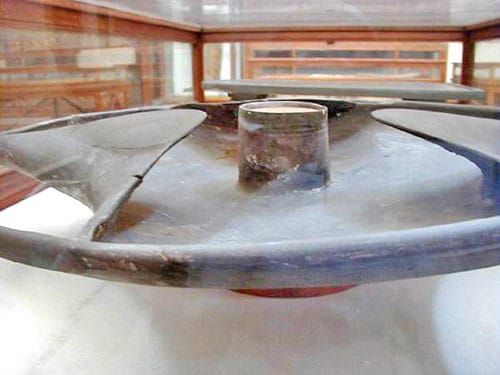
In 1936, archaeologist Walter Brian Emery uncovered a peculiar shale object in the tomb of Prince Sabu, son of Pharaoh Adjuib of Egypt’s First Dynasty, dating back to around 3000 BC. The artefact is circular, measuring 61 centimetres in diameter and 10.6 centimetres in height at its centre, with a concave wheel-like shape and three curved blades inside. Notably, it also has a central hole reminiscent of a pulley or wheel axis. The object was found at Saqqara, a major necropolis near ancient Memphis, and has puzzled scholars ever since, as its design does not correspond with any known Egyptian tools or artefacts from the period.
Archaeologists have struggled to determine the function of the object, primarily because the wheel, as a technology, was not introduced to Egypt until the Hyksos invasion around 1640 BC, long after Prince Sabu’s time. The shale artefact, though visually similar to a wheel or propeller, would have been too fragile to serve as a functional wheel. Its precise craftsmanship has led to debate, as while it could be carved by the skillful artisans of the era, the object’s form bears an uncanny resemblance to modern propellers and rotary devices, raising questions as to whether it was a symbolic or ritual object rather than a utilitarian tool. Some engineers have even observed parallels between the design of the artefact and 20th-century energy-saving rotary devices, though this remains speculative. Egyptologist Cyril Aldred suggested the piece may be a deliberate reproduction of an older, possibly metallic object.
This object sits within wider discussions of artefacts that challenge traditional understandings of ancient Egyptian technology. Saqqara, where this item was discovered, is well known for monumental architecture and artefacts reflecting sophisticated craftsmanship and symbolic complexity, yet this artefact’s form hints at technology apparently out of place for its time. Proposals of ancient astronaut theories, which argue that extraordinary technology influenced Egypt’s early civilisation, cite such objects as evidence without robust archaeological consensus. The absence of similar artefacts in contemporary or subsequent Egyptian contexts complicates drawing firm conclusions. The artefact’s enigmatic nature highlights the limits of current Egyptological knowledge and encourages renewed investigation into the symbolic and technological capabilities of early dynastic Egypt.
Source: Ancient Code