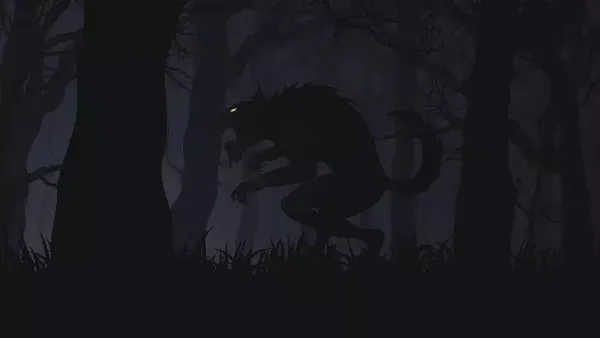
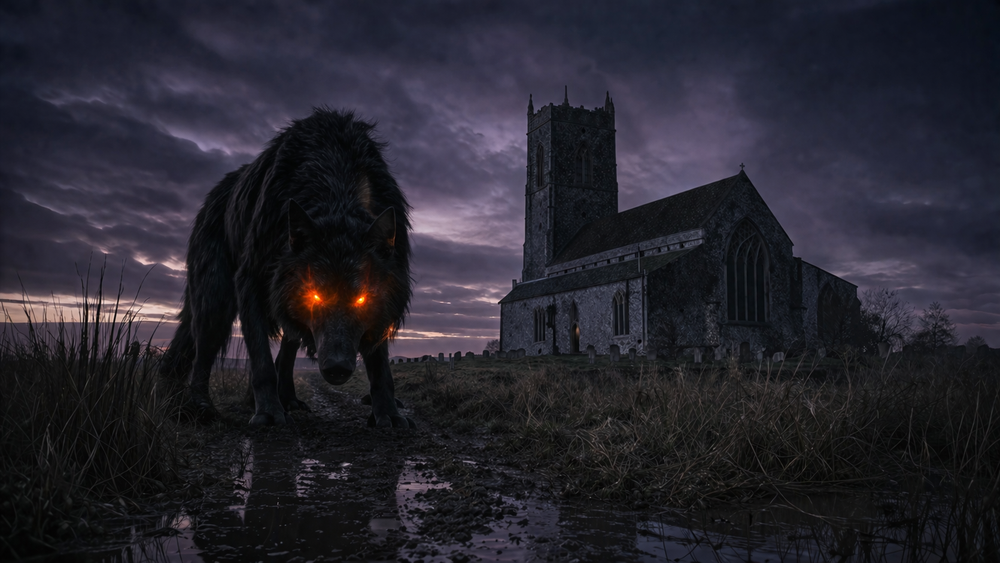
| First Written Record | 1127, Peterborough Abbey. Anglo-Saxon Chronicle records a pack of black hounds with eyes like saucers in the deer park and surrounding woods. |
| Most Famous Incident | August 4, 1577. Holy Trinity Church, Blythburgh and St Mary's Church, Bungay, Suffolk. Two people killed. Scorch marks remain on the Blythburgh north door. |
| Primary Territory | East Anglia: Norfolk, Suffolk, Cambridgeshire, Essex. Coastline, graveyards, crossroads, dark lanes, church environs. |
| Name Origin | Old English scucca: devil, fiend. First printed use of "Black Shuck" by Reverend E.S. Taylor, Notes and Queries, 1850. |
| British Equivalents | Barguest (Yorkshire), Gwyllgi (Wales), Cù Sìth (Scotland), Moddey Dhoo (Isle of Man), Church Grim (nationwide), Padfoot (Lancashire/Yorkshire), Yeth Hound (Devon). |
| Modern Investigation | Paul Sinclair, Truth Proof series and Wolflands documentary (2023). Ongoing first-person witness testimony from East and North Yorkshire. |
| Leiston Abbey Skeleton | 2013 excavation. Large dog skeleton, carbon dated post-1650. DigVentures: unequivocally not Black Shuck. A case study in how legend amplifies through media. |
| Status | Unresolved. Sightings ongoing. Worldwide canine entity tradition documented across every inhabited continent. |
Three ragged scorch marks, like claw scratches remain visible on the north door of Holy Trinity Church, fixed in place since the morning of August 4, 1577. On that day, during a thunderstorm of unusual violence, something is said to have entered the church, where the congregation had already gathered in fear and according to contemporary accounts, it moved through the nave with such violence and fury, that by the time it departed, two members of the congregation lay dead and the church steeple had collapsed through the roof and into the church. As the beast departed, it grabbed onto the church door, leaving the marks that we see today.
If this event was not dramatic enough, what took place at Blythburgh was just a follow up to a similar incident which is reported to have taken place shortly before, at the village of Bungay some twelve miles distance. Again, members of the congregation were taking refuge from the same storm, when their sanctuary was shattered by a furious assault from the same monstrous beast, during which time a number of people were reportedly killed before the beast departed, making its way towards the direction of Blythburgh. Or so the legend goes.
The spine-chilling event is remembered in this verse:
"All down the church in midst of fire, the hellish monster flew, and, passing onward to the quire, he many people slew".
Black Shuck is the earliest recorded canine entity in the British tradition, appearing in written sources as far back as 1127 and supported by nearly nine centuries of eyewitness testimony. The tradition endures across the landscape of East Anglia, where it exists not only as a deep-rooted element of local folklore but, if ongoing reports are to be taken at face value, is an entity which continues to be encountered to this day. Black Shuck is part of a wider tradition of canine cryptids, which have been part of the human experience for a very long time, occurring throughout the world in terms consistent enough to suggest that whatever is being encountered is not a product of any single culture's imagination.
At Blythburgh, often called the Cathedral of the Marshes, the events of August 1577 remain the most famous expression of that tradition. The church stands much as it did then, and the marks on its door remain, a detail that continues to anchor the story in reality, despite the extensive passage of time.
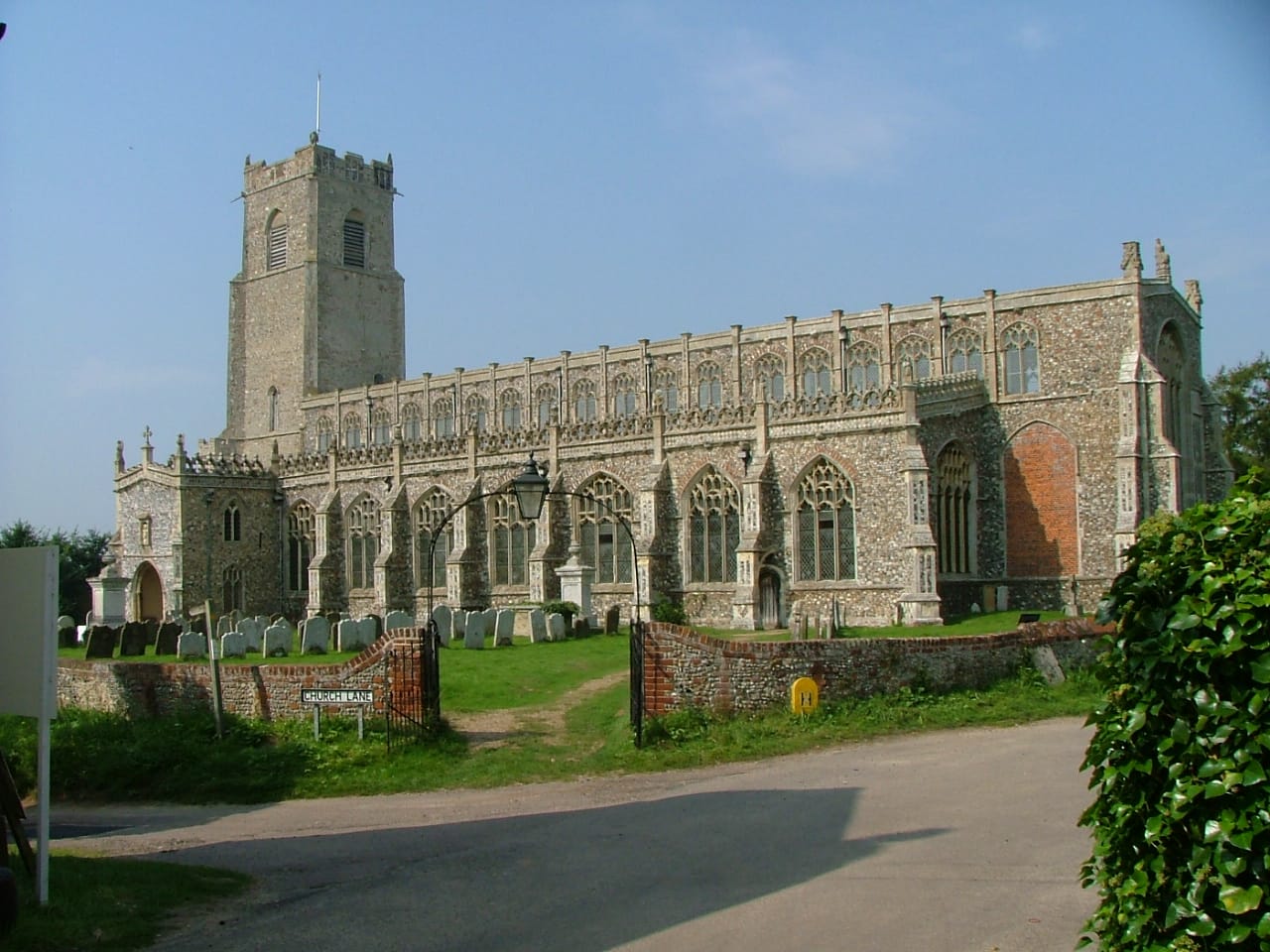
The Devil's Fingerprints
The scorch marks on the north door of Holy Trinity Church are known locally as the Devil's fingerprints, and they represent something genuinely rare in the investigation of anomalous phenomena: physical evidence from the sixteenth century that anyone can go and examine today. Most paranormal incidents leave us with testimony alone, but the Blythburgh case leaves us with with something tangible, which four and a half centuries of scrutiny have failed to come up with a satisfactory explanation for what caused them.
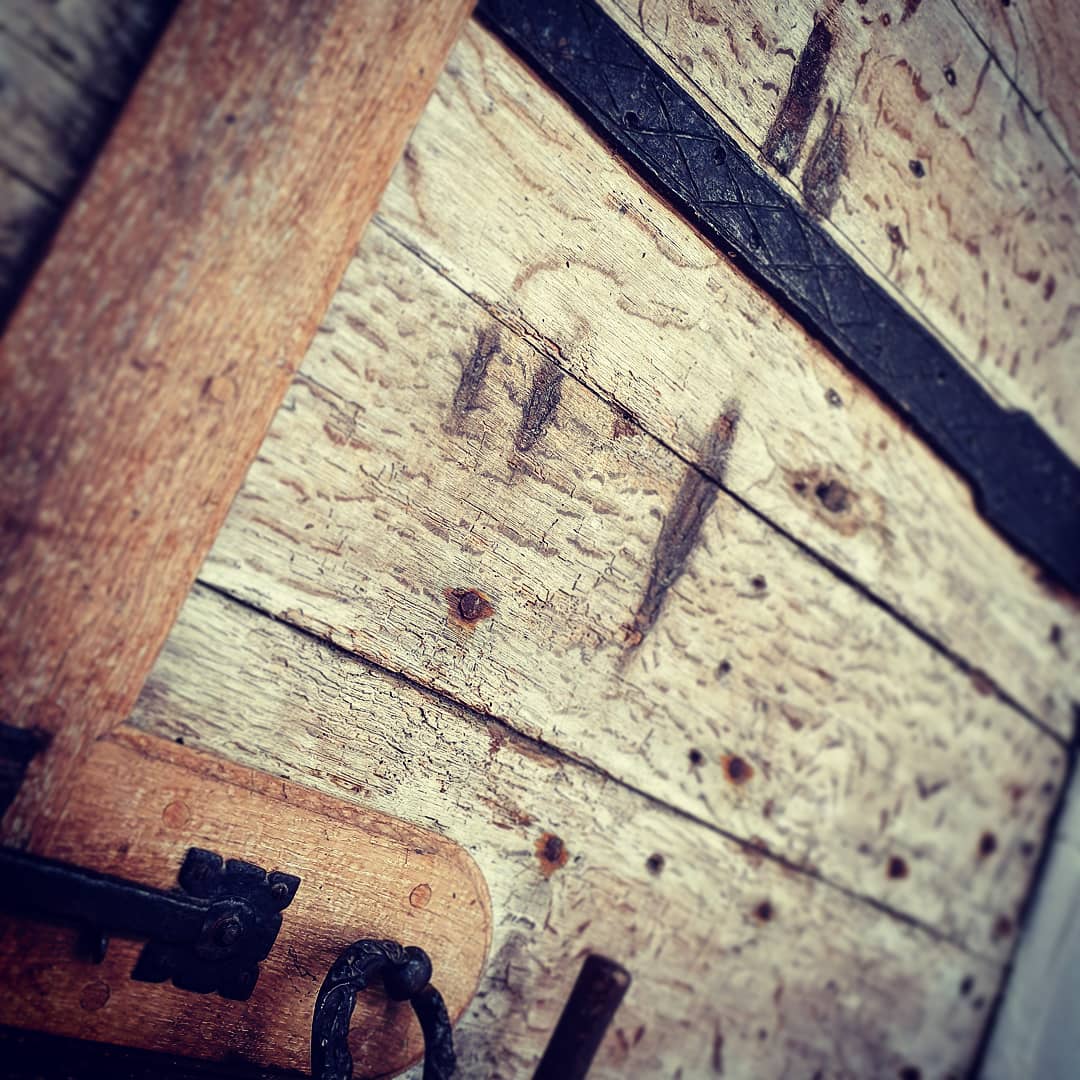
August 4th, 1577: Abraham Fleming and the Morning of the Storm
The Reverend Abraham Fleming was a translator and clergyman who published his account of the events at Bungay and Blythburgh in 1577 under the title A Straunge and Terrible Wunder. Fleming drew on testimony from people present at both churches, writing in the same year the events occurred, and his account is a piece of contemporary reporting rather than folklore assembled after the fact. The framing is theological; Fleming interprets the creature as the Devil in the likeness of a dog, but the underlying facts he records are specific, named, and in several cases corroborated by independent sources.
At St Mary's Church in Bungay, an unusually violent storm had already driven a fearful congregation to seek sanctuary within the church's stone walls, when the creature appeared; running the length of the nave with what Fleming describes as great swiftness and incredible haste. Two people kneeling in prayer died as it passed between them. The same morning, approximately twelve miles away at Blythburgh, a second incident at Holy Trinity Church produced two more deaths and the collapse of the church steeple through the roof. Fleming's account of the creature leaving marks on the Blythburgh door as it exited is the origin of the Devil's fingerprints. The church's own records confirm structural damage and deaths from the same date. There is no serious dispute that an event of some kind took place at both locations on August 4th, 1577. What the cause was and whether the events were linked is still debated.
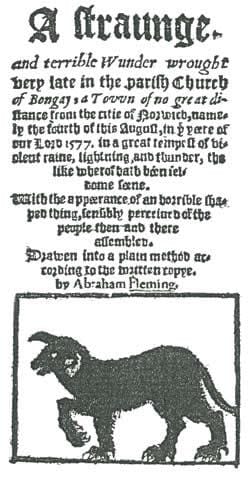
Whether the marks were made by claws, lightning, or by deliberately applied candle flame, (as some experimental archaeologists have proposed), remains an open question. Fleming's account attributes them to the creature. The church's own historical record describes lightning striking the building severely enough to collapse the steeple, which is not incompatible with Fleming's account but does not require it. What is not disputed is that something happened at Blythburgh on August 4th, 1577, which left marks on the church door, killed people inside the building, brought the steeple down through the roof, and was considered significant enough by a named Cambridge clergyman to document in a published pamphlet within the same year.
Nine Centuries in the Making
The 1577 Blythburgh incident is the most thoroughly documented account in the Black Shuck tradition, but it is not the starting point. The earliest written record that most scholars associate with this phenomenon comes from an 1127 entry in the Peterborough Chronicle, which is a part of the wider Anglo-Saxon Chronicles. The account describes the arrival of Abbot Henry of Poitou at Peterborough Abbey and the appearance, shortly thereafter, of a great company of black huntsmen in the deer park and surrounding woods, riding on black horses and black he-goats, accompanied by jet black hounds with eyes like saucers. The monks described how they heard the sound of the hunt and the blowing of horns continue throughout the night. Although this account sits firmly within the Wild Hunt tradition(which is common throughout Germanic and Norse mythology), the specific detail of black hounds with saucer-like eyes is noteworthy and places it squarely within what would become, the East Anglian Black Shuck tradition.
Between 1127 and 1577, the oral tradition of a large black dog haunting the roads, churchyards, coastlines and crossroads of East Anglia became firmly established, carrying a name derived from the Old English scucca, meaning devil or fiend. By the time the first surviving printed reference appears, in an 1850 article by E. S. Taylor in Notes and Queries,across East Norfolk and Cambridgeshire the creature was being widely reported and described as: a vast, shaggy black dog, which was said to visit churchyards at midnight.
By 1901, W. A. Dutt, writing in Highways and Byways in East Anglia, was describing the same entity in terms that would not feel out of place in a modern Dogman report. It appears as a huge black dog moving along dark lanes and isolated footpaths, moving silently with its approach signalled only by the burning light of a single eye. Those who claimed to hear it, spoke of a howl capable of chilling the blood, a detail that has echoed consistently through centuries of testimony.
A Landscape steeped in tradition
East Anglia is among the flattest and most exposed regions in England, its long coastline facing a North Sea that has steadily taken villages and farmland over the centuries. Inland, the terrain shifts between remnants of ancient forest, reclaimed fenland and wide agricultural plains, all threaded together by roads and trackways that long predate the Roman occupation. It is, above all, a landscape defined by thresholds: land meeting sea, fen giving way to field, and the living world meeting the churchyard at the edge of almost every settlement. For much of English history, these routes were genuinely isolated after dark, stretching between villages across open country, where a traveller could expect neither shelter nor assistance.
Black Shuck, as the tradition presents it, inhabits precisely these margins. It is encountered along coastlines, at crossroads, in churchyards, and on the unlit lanes that connect one village to the next, showing a territorial pattern that aligns closely with what researchers in the wider Dogman literature have come to recognise as a consistent feature of credible accounts. In English folklore, crossroads carry a long association with spiritual ambiguity, places where suicides and criminals were buried, outside the limits of consecrated ground, and where the boundaries of the material world were thought to become shifting and uncertain.
The geographical pattern extends even further. The burial mound correlation noted in American cases by researchers like Linda Godfrey, such as those recorded in the Bray Road and Michigan material finds a clear parallel in East Anglia. The region contains numerous pre-Christian sacred sites, and reports of Black Shuck appear with striking regularity in proximity to ancient trackways, and sites linked to ritual activity or the boundaries of older ceremonial landscapes. Across centuries of testimony, the distribution is not random but anchored to the same place types, suggesting a continuity that is as much geographical as it is cultural.
A Creature with Many Guises
The Black Shuck tradition does not present itself with complete consistency, and accounts of its appearance and behaviour vary greatly in the record. Yet these variations do not seem entirely random. Across nine centuries of testimony in East Anglia, the descriptions of Black Shuck follow discernible geographic patterns, suggesting a structure that merits attention rather than being dismissed as the natural drift of oral tradition.
In Norfolk, for example the most frequently reported form is that of a large black dog moving on four legs, often accompanying solitary travellers along dark roads. It does not threaten, indeed some accounts cast it in a protective role. Instead, it keeps pace for a time, before disappearing at some specified point, leaving the witness unsettled but unharmed. This echoes the Gurt Dog tradition of Somerset, where a similar animal was regarded as a benign presence; a tradition from the Quantock Hills even goes so far as to entrust the Gurt it watch over children while their parents worked in the fields.
In Suffolk, the tone shifts markedly. Here, the tradition is dominated by the more dangerous aspect of the phenomenon, exemplified by the 1577 Blythburgh account in which the creature is associated with death, physical damage, and a level of force that leaves lasting marks. It is not a silent companion but something far more disruptive and, at times, violent.
Across Cambridgeshire and Essex, the accounts become more ambiguous. Some witnesses describe a creature capable of passing through solid objects without resistance, while others report something with the physical presence and behavioural responses of a large, startled animal.
W.A. Dutt's 1901 description of a creature with a single cyclopean eye burning in the middle of its head is a more startling regional variant of the more commonly described two eyed form, and the divergence between the two descriptions across otherwise consistent accounts is not something that purely natural explanations handle comfortably. It is in this aspect of the phenomena where we must entertain the possibility that the creature being described inhabits a liminal space, not purely physical but neither fully spectral; It is otherworldly, almost hybrid in manner, hinting at a more complex explanation. One which is best summarised through the ultraterrestrial hypothesis, put forward by paranormal researcher John Keel, as part of his own efforts trying to trying to make sense of apparent contradictions he encountered while researching the Mothman and related UFO phenomenon.
Case Summary · Key Facts
- First written record: 1127, Peterborough Chronicle. Black hounds with eyes like saucers at Peterborough Abbey, establishing the East Anglian black dog tradition at least 450 years before the 1577 incident
- August 4, 1577: Black Shuck enters St Mary's Church, Bungay, killing two people, then travels twelve miles to Blythburgh's Holy Trinity Church, killing two more. Steeple collapses. Marks left on the north door. Church records confirm deaths and structural damage.
- The marks on the Blythburgh north door are physically present and publicly visible today, in the same location described by Fleming's 1577 account
- Name derives from Old English scucca meaning devil or fiend. Oral tradition considerably older than the first 1850 printed use
- Territory: East Anglian coastline, crossroads, churchyards, dark lanes. Liminal geography consistent with the burial mound and edge-zone pattern across the broader Dogman literature
- Character varies by region: benign companion in Norfolk and Somerset, death omen and killer in Suffolk, ambiguous presence elsewhere
- British equivalents documented in every region: Barghest (Yorkshire), Gwyllgi (Wales), Cù Sìth (Scotland), Moddey Dhoo (Isle of Man), Church Grim (nationwide), Padfoot (Lancashire), Yeth Hound (Devon)
- Paul Sinclair's Truth Proof series and Wolflands documentary compile ongoing first-person testimony of bipedal canine encounters from East and North Yorkshire, consistently correlated with ancient earthwork sites
- 2013 Leiston Abbey skeleton: confirmed by DigVentures as not Black Shuck. Carbon dated post-1650. Size of a mastiff.
- International equivalents documented across Europe, the Americas, Africa and Asia
From Suffolk to the Scottish Highlands
Black Shuck is the most famous of the British black dogs but far from the only one. Accounts of large supernatural black dogs have been recorded in virtually every English county, the apparent exceptions being only Middlesex and Rutland, with each region carrying its own name, its own distinct character, and its own accumulated testimony standing independently of the East Anglian tradition, while sharing its fundamental nature.
In Yorkshire, the creature is the Barghest, a goblin dog of enormous size which appears to hapless travellers on the snickelways and side roads of York, said to haunt crossroads and cliff edges, with sight of it held to mean death within a matter of months.
In Wales, the Gwyllgi, the Dog of Darkness or Black Hound of Destiny, is a mastiff or large wolf with noxious breath and burning eyes, appearing on isolated roads after dark, a glimpse of it understood to predict a horrific death.
The Scottish Highlands have the Cù Sìth, an otherworldly hound roughly the size of a calf and, unusually, green-furred rather than black, a harbinger of death that in some traditions carries souls away to the afterlife.
The Isle of Man has the Moddey Dhoo, the black dog of Peel Castle, whose nightly presence in the guardroom was tolerated by the soldiers stationed there until one man, emboldened by drink, attempted to follow it alone into the castle's inner rooms and returned speechless, dying within three days.
In Lancashire and the Midlands, the Padfoot follows solitary walkers with a soft padding sound, and in Devon the headless Yeth Hound is the spirit of an unbaptised child rambling through the moors at night, its wailing audible across open country.
The consistency across this geographic distribution is not trivial. From Suffolk to the Scottish Highlands, from Devon to the Isle of Man, the fundamental description holds: a large dark canine, eyes of unnatural colour and brightness, associated with death, liminality, crossroads and the transition between the living world and whatever lies adjacent to it. No regional explanation of independently evolved local legends accounts comfortably for that structural consistency across the whole of the British Isles.
Wolflands: The Modern British Witness Record
Paul Sinclair is a researcher and author based in Bridlington on the East Yorkshire coast who has spent more than two decades gathering first-hand testimony from witnesses to unexplained phenomena across Yorkshire’s northern and eastern reaches. Sinclair's approach, brooks no truck with sensationalism. Across his Truth Proof series, published from 2016 onwards, and in the 2023 documentary Wolflands, Sinclair's method remains consistent: careful, methodical documentation of named witnesses, a reluctance to include accounts he cannot independently support, and a clear distinction between what can be evidenced and what cannot. Over time, this disciplined approach has built a substantial body of testimony when it comes to describing large canine entities, accounts that sit firmly within Britain’s long-standing black dog tradition while also echoing the physical characteristics reported in American Dogman cases.
The title Wolflands itself is drawn from a striking historical reference. The village of Flixton in North Yorkshire’s Vale of Pickering lies at the centre of an area which Sinclair has been studying, and medieval records suggest that a king once designated part of this landscape as “Wolfland,” seemingly marking it as a protected route for travellers. The implication is that the danger associated with the area extended beyond ordinary wolves. Nearby place names deepen the sense of continuity, including the village of 'Hunmanby' whose Old English roots Hundemanebi translate to “farmstead of the houndman,” as though the landscape has preserved a memory of whatever once inhabited it. Archaeological investigations in Flixton add another layer to the mystery, revealing evidence of pre-Christian ritual activity involving horses and animal sacrifice, pointing to a site where the boundary between human and animal was not only imagined, but actively explored in ceremony.
The encounters Sinclair documents resist simple explanation: Two women driving between Flixton and a neighbouring village described a large figure descending a field in a single leap before landing in the road directly in front of their car, then moving away with a speed and motion unlike any known animal. Independently, both reached for the same comparison, saying it resembled the werewolf depicted in the Harry Potter films, not as a dramatic flourish but as the closest visual reference available to them. Along the coast, experienced anglers who had spent decades fishing by the cliffs spoke of something moving through the darkness with an ease and familiarity that suggested it knew the terrain intimately. A timber lorry driver reported seeing a similarly large figure cross the road ahead of him in a place where no such animal should reasonably have been able to pass. In each case, the witnesses came forward themselves, and each described an encounter that fell outside the limits of their understanding of the natural world.
One pattern recurs throughout Sinclair’s work with notable consistency. Sightings tend to cluster around ancient earthworks, burial mounds, and old trackways, sites associated with pre-Christian ritual landscapes. Sinclair has observed that this correlation is not confined to Yorkshire, but appears in reports from elsewhere, including Native American territories in the United States and pre-Columbian regions of Mesoamerica. Across these cultures, often with no direct historical connection, similar canine figures appear linked to places associated with death, transition, and the passage between worlds. Whether interpreted as folklore, archetype, or something less easily defined, the pattern itself is difficult to ignore.
Sinclair continues to document these accounts through his books, his documentary work, and ongoing field investigations shared via his truthproof.uk, platform.
The Same Dog, the World Over
The British black dog tradition represents one strand of a worldwide pattern in which large anomalous canine entities associated with death, liminal space and the passage between worlds appear in the cultural record of virtually every human civilisation. It is the point at which the Dogman file intersects with something larger than any regional tradition, and the one that serious researchers consistently identify as the most significant and least adequately examined feature of the evidence.
In ancient Egypt, Anubis carried a jackal head on a human body, guardianship of the dead and the weighing of souls at the boundary between life and the underworld being his specific function. In Aztec Mexico, Xolotl carried a canine head on a human body, guiding souls through the nine levels of Mictlan, the same role performed physically by the Xoloitzcuintli dog sacrificed and buried with the dead to ensure safe passage. In Norse tradition, Odin's hounds led the Wild Hunt across the night sky of northern Europe, the spectral chase appearing in every Germanic culture from Scandinavia to England, the black dogs with saucer-like eyes precisely what the Peterborough Chronicle describes in 1127. In Belgium and the Netherlands, the Kludde is a large dog walking upright on its hind legs, moving at impossible speeds, associated with nocturnal roads and water margins. France's earliest written record of a black dog manifesting inside a church with the doors shut, dates to 856 AD, more than seven centuries before the Bungay incident, in terms almost identical to Fleming's account. In Japan, the Inugami are dog spirits capable of possessing human bodies. Across numerous indigenous traditions of North America, wolf spirits and canine guardian figures associated with death and sacred territory appear with the structural regularity that characterises every tradition examined here.
The question this global tradition raises does not sit comfortably within neat, reassuring explanations. The emergence of thematically consistent folklore across cultures with no clear contact between them is not easily dismissed or explained away. The alternative, that these traditions record encounters with something real, something deeply connected to human experience yet fundamentally alien to it is equally unsettling. Across every account, the same associations persist: death, thresholds, and the boundary between worlds. It is not a comfortable conclusion, but it is the one the weight of the evidence most consistently points toward.
The Leiston Skeleton: A Lesson in Legend
In 2013, a community archaeology project run by DigVentures at the ruins of Leiston Abbey in Suffolk unearthed the skeleton of an unusually large dog in the demolition rubble of a former monastic kitchen building, in a shallow unmarked grave with pottery fragments suggesting a sixteenth-century context. The local Leiston newspaper ran a carefully worded piece asking whether the bones might be connected to the Black Shuck legend. The Daily Mail picked it up and transformed it into a declaration that the seven-foot hellhound had been found. International platforms carried the Daily Mail version, each retelling adding certainty the original archaeology never claimed, until the story circulating globally presented the physical discovery of the creature itself as established fact.
DigVentures responded clearly and without ambiguity: the skeleton was not Black Shuck. It stood approximately seventy-two centimetres at the shoulder, the size of a mastiff, and subsequent carbon dating placed it as post-1650, not sixteenth-century. The dog was most probably a large animal belonging to whoever occupied the abbey site after its dissolution. The episode is instructive not for what it reveals about Black Shuck but for what it reveals about the mechanisms by which legends are maintained and amplified. A careful, tentative local report became, through several stages of journalism, a global story that confirmed rather than questioned the legend, the amplification process becoming, in turn, part of the tradition itself. Mark Norman, whose work on black dog folklore constitutes the most thorough modern study of the tradition, has used the Leiston episode as a case study in exactly this process.
The Sceptical Case and Its Limits
The standard rationalist account holds that the Black Shuck tradition began with misidentified large dogs, Great Danes, Irish wolfhounds, Newfoundlands, and was elaborated across centuries by storytelling, religious anxiety and the human tendency to explain the frightening in terms of whatever framework is most available. The Viking settlement of East Anglia brought Odin's black hounds and the Wild Hunt, providing a narrative template into which encounters with large dogs on lonely roads could be fitted, and the template became self-reinforcing as it accumulated testimony across generations. This explanation has genuine force for many individual accounts. The psychology of encountering an unfamiliar large dog at night on an isolated road needs no supernatural supplement to produce genuine fear, and the tradition consistently locates Shuck at precisely the places, crossroads, churchyards, coastal paths, where isolated night-time travel was most anxiety-producing for the people who used them.
The explanation encounters its difficulties at the edges of the evidence. The 1577 incident produced physical consequences documented in church records that predate any motive to elaborate them. The marks on the Blythburgh door have not been satisfactorily accounted for by lightning alone or by deliberate candle burning, both of which have been proposed, neither of which fully matches the pattern of the marks as they stand. The structural consistency of the British black dog family from East Anglia to the Scottish Highlands to Wales to the Isle of Man, across regions with quite different cultural histories and linguistic frameworks, strains the independent parallel evolution hypothesis. The global distribution strains it considerably further.
What Paul Sinclair's contemporary Yorkshire material adds to this picture is not dramatic revelation but an additional layer of the same structural evidence: first-person testimony from people with no prior investment in the Black Shuck tradition, in a landscape whose ancient earthwork geography maps onto the sighting distribution in exactly the way the historical record predicts. The entity his witnesses describe is not the ghost dog of East Anglian legend but it shares its fundamental characteristics, its territorial quality, its association with liminal geography, its apparent indifference to whether the person encountering it understands what it is.
Verdict
Black Shuck is the most historically documented canine entity in the world, carrying a written record across nine centuries in a single geographic region and physical evidence from 1577 that anyone can examine today. The marks on the Blythburgh door are real. The deaths described by Fleming are corroborated by church records. The tradition stretching back to the 1127 Peterborough Chronicle establishes a presence in the East Anglian landscape predating any surviving written explanation for it. The British black dog family, from the Barghest to the Gwyllgi to the Cù Sìth, describes structurally identical entities across every region of the British Isles, and the global tradition extends the same description to ancient Egypt, pre-Columbian Mexico, Norse Scandinavia, and every cultural tradition between them. Paul Sinclair's Yorkshire fieldwork adds a contemporary body of testimony demonstrating that whatever this tradition describes is still generating encounters, still correlating with ancient sacred geography, and still outside the explanatory reach of any framework that the investigating community has so far brought to it.
What the entity is, the file cannot determine with confidence. What the file can say is that it has been encountered for a very long time, across a very wide range of cultural contexts, and that every tradition in the world that has described it has agreed on the same fundamental characteristics: large, dark, associated with death, with the threshold between worlds, with the specific geography where the ordinary and the non-ordinary meet, in terms consistent enough across unconnected cultures to deserve something more rigorous than the dismissal they routinely receive.
The door at Blythburgh was marked in 1577. It carries those marks still. Whatever made them has not finished its business with the East Anglian coast.
Primary Sources
- Fleming, Abraham. A Straunge and Terrible Wunder Wrought Very Late in the Parish Church of Bongay. London, 1577. Primary contemporary account of Bungay and Blythburgh. Digitised via British Library and Wikimedia Commons.
- Taylor, Reverend E.S. "Shuck the Dog-Fiend." Notes and Queries, 1850. First printed use of the name Black Shuck.
- Dutt, W.A. Highways and Byways in East Anglia. Macmillan, 1901. Classic nineteenth-century description of the creature across the East Anglian territory.
- Norman, Mark. Black Dog Folklore. Troy Books, 2016. The most comprehensive modern study of the British black dog tradition, drawing on the largest known private archive of accounts and eyewitness testimonies.
- Norman, Mark. The Folklore Podcast. Available at thefolklorepodcast.com
- Sinclair, Paul. Truth Proof. Vols. 1 to 5. Psychic Book Club Publishing, 2016 to present. The most systematically compiled body of contemporary canine entity testimony from the British Isles, gathered across more than twenty years of first-hand witness interviews in East and North Yorkshire.
- Sinclair, Paul. Wolflands. Documentary, Truth Proof Productions, 2023. Eighty-eight minutes of first-person witness testimony from East and North Yorkshire focused on the bipedal canine entity tradition of the Flixton corridor. Available at truthproof.uk
- DigVentures. Post-excavation report on the Leiston Abbey canine skeleton, 2014. Available at digventures.com
- Peterborough Chronicle (Anglo-Saxon Chronicle). Entry for 1127, describing the black huntsmen and their hounds at Peterborough Abbey. Available via the Avalon Project, Yale Law School.
- North American Dogman Project: northamericandogmanproject.com
The Dogman Files — Case File Series
- Not a Werewolf: The Dogman Rabbit Hole — the full overview investigation
- Case File 01: The Beast of Bray Road
- Case File 02: The Land Between the Lakes
- Case File 03: April Fool — The Michigan Dogman
- Case File 04: Black Shuck and the British Canine Tradition — you are here
- Case File 05: The Skinwalker Connection — coming soon
Frequently Asked Questions
What is Black Shuck?
Black Shuck is a large supernatural black dog documented in the folklore and witness accounts of East Anglia, Norfolk, Suffolk, Cambridgeshire and Essex, for at least nine centuries. The name derives from the Old English scucca, meaning devil or fiend. It is one of the most historically documented canine entities in the world, with physical evidence from a 1577 incident still present and publicly visible at Holy Trinity Church, Blythburgh.
Are the scorch marks at Blythburgh Church real?
Yes. The marks on the north door of Holy Trinity Church, Blythburgh, are physically present and publicly visible. They are described in Abraham Fleming's 1577 account as the marks left by the creature on its departure. Whether they were made by claws, lightning strike, or deliberately applied candle flame, an alternative proposed by some experimental archaeologists, remains contested. They have been in their current location for four and a half centuries.
What happened at Bungay and Blythburgh in 1577?
On August 4th, 1577, during a violent thunderstorm, a large black creature entered St Mary's Church in Bungay, killing two people, then travelled approximately twelve miles to Holy Trinity Church in Blythburgh, killing two more and causing the church steeple to collapse through the roof. Abraham Fleming documented the events in a pamphlet published the same year, drawing on eyewitness testimony. Church records at both locations confirm deaths and structural damage from the same date.
Are there modern sightings of wolf-like creatures in Britain?
Yes, and documented in some detail. Paul Sinclair's Truth Proof series and Wolflands documentary compile first-person testimony from East and North Yorkshire describing encounters with a large bipedal canine figure in the forests, moorlands and cliff-top paths of the region. Witnesses include farmers, gamekeepers, lorry drivers and cliff-top anglers whose familiarity with the countryside in question makes simple misidentification difficult to sustain. The accounts correlate consistently with ancient earthwork sites in the same way as the American Dogman material. Sinclair's research is available at truthproof.uk
Is Black Shuck always dangerous?
No. The tradition varies considerably by region. In Norfolk, Shuck is most commonly described as a benign companion accompanying lone travellers without threatening them. In Suffolk, the tradition is darker, associated with death and physical harm. In Cambridgeshire and elsewhere the accounts are more ambiguous. The internal variability of the Black Shuck character across its own territory is one of the most structurally interesting aspects of the tradition.
Are there equivalents to Black Shuck in other countries?
Yes, extensively. The structural equivalent appears in virtually every human culture with a documented tradition: Anubis in ancient Egypt, Xolotl in Aztec Mexico, Odin's hounds in Norse mythology, the Kludde in Belgium, the Barguest and Gwyllgi in Britain, the Cù Sìth in Scotland, the Inugami in Japan, and canine guardian and death-omen traditions across indigenous cultures in North America, Africa and Asia. The global distribution of a structurally identical entity across cultures with no documented contact is one of the most significant and least adequately explained features of the canine entity phenomenon.
Was the skeleton found at Leiston Abbey in 2013 really Black Shuck?
No. DigVentures stated unequivocally that it was not. Carbon dating placed it as post-1650, not sixteenth-century, and the animal stood approximately seventy-two centimetres at the shoulder, the size of a mastiff. The media amplification of the story from a carefully worded local report to a global declaration of discovery is itself a useful case study in how legends are maintained and propagated in the modern era.
What is the oldest written record of Black Shuck?
The oldest record most scholars associate with the tradition is the 1127 Peterborough Chronicle entry describing black hounds with eyes like saucers in the deer park at Peterborough Abbey. The first printed use of the specific name Black Shuck dates to 1850. Abraham Fleming's 1577 pamphlet A Straunge and Terrible Wunder remains the most detailed and historically significant eyewitness account in the record.
Related files: Not a Werewolf: The Dogman Rabbit Hole | Case File 01: The Beast of Bray Road | Case File 02: The Land Between the Lakes | Case File 03: The Michigan Dogman | Case File 05: The Skinwalker Connection
Embedded JavaScript