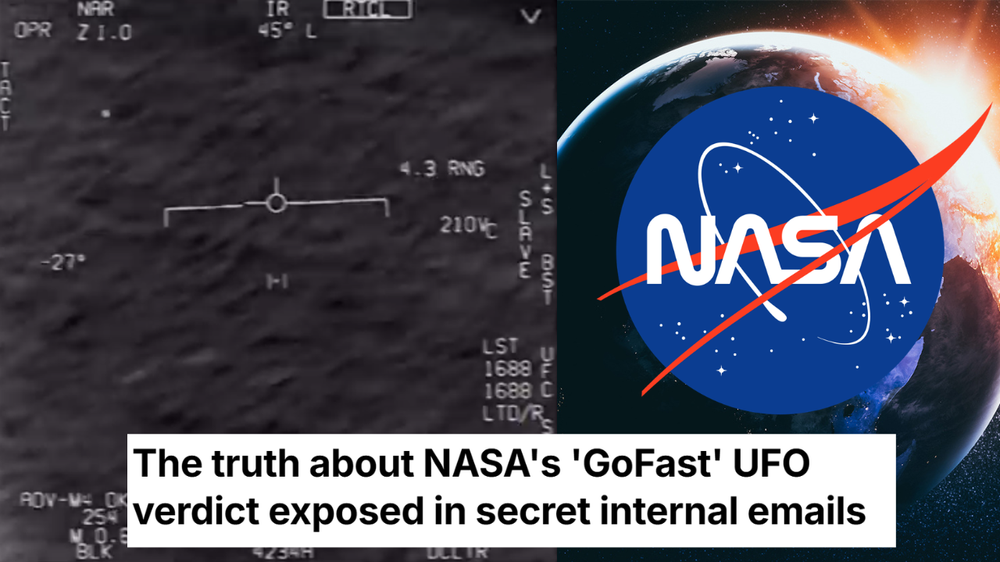
Newly disclosed internal NASA communications have raised concerns regarding the agency’s approach to analysing the renowned Navy “GoFast” UFO video from 2015. Documents obtained via a Freedom of Information Act request show that the 2023 NASA Unidentified Anomalous Phenomena (UAP) study panel neither interviewed the Navy pilots who recorded the footage nor had access to the original sensor data. Instead, the panel’s evaluation rested primarily on the publicly available version of the video. Panel member Josh Semeter, director of Boston University’s Centre for Space Physics, confirmed in an internal email that these limitations prevented the panel from determining crucial characteristics such as the object’s size, shape, or flight mechanisms. Moreover, despite calculations suggesting the object’s speed was not extraordinary, Semeter stressed the incident remained unexplained. Another member, David Spergel of the Simons Foundation, argued the panel had examined too few cases to draw broad conclusions about high-velocity UAP phenomena and urged modifications to the report’s language.
The leaked emails further disclose internal disagreements over record keeping and data access at NASA, highlighting a fragmented approach to UAP research. One email from February 2024 reveals conflicting statements about whether the agency possesses any UAP records, indicating possible organisational gaps. The study team consisted mainly of external experts rather than NASA personnel, potentially contributing to these issues. The controversy unfolds amid growing political pressure for transparency, with former President Trump urging federal agencies to release classified UAP files and legislators such as Rep. Eric Burlison and Rep. Anna Paulina Luna advocating for the disclosure of 46 classified videos. These developments underscore ongoing tensions between institutional caution and public demand for greater insight into aerial phenomena encountered by military personnel.
This episode fits within a broader context of official efforts to address unidentified aerial phenomena while grappling with limited data and institutional hesitancy. The US Navy’s GoFast video, captured in 2015, gained prominence as a rare high-speed UAP encounter recorded by military sensors, prompting significant public and governmental interest. However, the NASA panel’s constrained review process, relying solely on sanitized, publicly released information, contrasts with best practices in rigorous scientific investigation, which demands original data analysis and direct witness interviews. The internal dissent highlighted by Spergel’s comments reflects the continuing debate within the scientific and governmental communities over how to balance transparency, security, and credible evaluation of UAP evidence. As agencies cautiously navigate these challenges, the GoFast case exemplifies the difficulties in conclusively explaining such phenomena and the importance of thorough data access for future inquiries.
Source: UFO News