
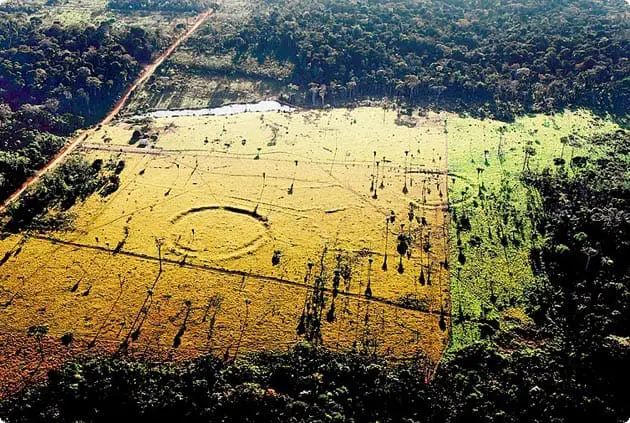
A previously unknown civilisation has been identified in the Amazon rainforest, spanning an area across the border between Brazil and Bolivia. Archaeologists and researchers, utilising Google Earth and satellite technology combined with rapid deforestation, have detected over 210 geoglyphs spread across some 200 sites within a 250-kilometre by 10-kilometre corridor. These striking geometric, zoomorphic and anthropomorphic designs, reminiscent of the Nazca lines in Peru, are predominantly visible from aerial views. Excavations have unearthed pottery, carved stones, and structural remnants such as avenues, irrigation canals, and livestock fences, suggesting a sophisticated society existed in the region roughly two millennia ago. This discovery challenges longstanding historical assumptions that the Amazon was sparsely populated by nomadic groups prior to European colonisation.
The geoglyphs exhibit a range of intricate designs including circles, squares, rectangles, and more complex shapes like hexagons and octagons, often interlinked by broad avenues or seemingly engineered roads. Trenches and pits excavated at these sites measure between one and four metres deep and up to 11-12 metres wide, which indicates considerable labour and planning. The variation in site design suggests diverse functions, with some locations possibly serving ceremonial purposes, others defensive, and yet others connected to agricultural or communal life. Radiocarbon dating of artefacts associates the constructions with a period between 1,000 and 2,000 years ago, with evidence of multiple reconstruction phases. Despite these findings, there is no indication that the inhabitants developed monumental architecture such as pyramids, nor a written language akin to contemporaneous Old World civilizations. Importantly, the scale of these settlements supports estimates that some sites might have housed populations of up to 70,000 people.
This emergent evidence of a complex pre-Columbian civilisation offers significant insight into the historical human impact on the Amazon, an ecosystem long considered largely untouched until recent centuries. The scale and organisation of the geoglyphs imply a managed landscape with advanced knowledge of environmental manipulation, contradicting outdated views that Amazonian inhabitants were solely nomadic hunter-gatherers. Such findings align with growing research demonstrating indigenous peoples’ sophisticated land management practices, including terra preta soil enrichment and sustainable agriculture. The discovery also emphasises the role of modern deforestation and satellite technologies in archaeological research, revealing sites previously hidden beneath dense forest canopy. It raises important questions about future conservation and archaeological investigation in a region currently threatened by environmental degradation.
Source: Ancient Code