| First Documented Encounter | 1887, Wexford County, Michigan. Two lumberjacks near the Garland Swamp, Manistee River corridor. |
| Primary Location | Northwestern Lower Peninsula, Michigan. Manistee National Forest and Traverse City corridor. |
| Indigenous Tradition | Odawa and Ojibwe. The Ojibwe Ma'iingan (wolf brother) tradition. Creature associated with the Manistee River territory since before European contact. |
| Key Accounts | 1887 Wexford County lumberjacks, Robert Fortney 1937 Paris Michigan, Allegan County 1950s, Manistee and Cross Village 1967, Grand Haven cluster 1993 to 1994. |
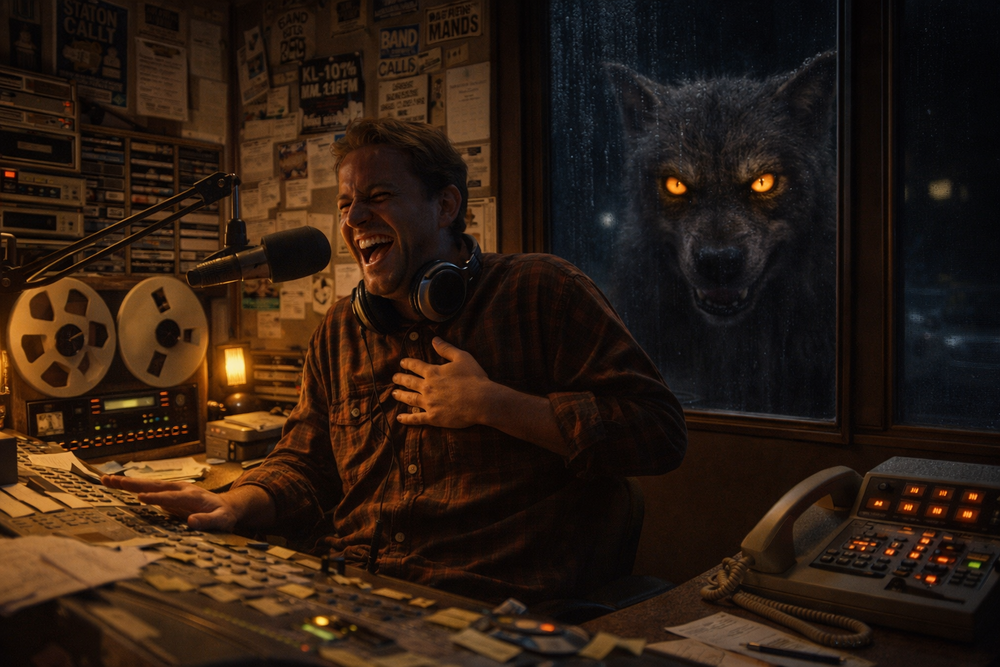
| Cultural Event | April 1, 1987. Steve Cook, WTCM-FM Traverse City, broadcasts The Legend as an April Fool's joke. Listener calls begin within hours. |
| Ten Year Cycle | Sightings cluster on years ending in seven. 1887, 1937, 1967, 1977, 1987, 1997, 2007, 2017. Next cycle year: 2027. |
| Status | Unresolved. Sightings ongoing. Gable Film confirmed hoax 2010. Pre-1987 witness record remains unexplained. |
When a small-town radio disc jockey played a song he had written about a local creature on the morning of April Fool's Day 1987, he had no idea about the Pandora's box he had just opened. Steve Cook was working at WTCM-FM in Traverse City, Michigan, a station serving the scattered communities of the northwestern Lower Peninsula, and the song that he had composed in the preceding days was, by his own account, just a piece of invented radio folklore: a prank built from a mishmash of American traditions, given a keyboard backing and credited to a fictitious name, titled with deliberate modesty "The Legend." Cook expected his song to raise a few laughs before the news came on and be forgotten by lunchtime.
The phones began ringing within the hour, and the callers were not congratulating him on a well-executed joke. They were telling him, often haltingly, that what he had described in the song was real. not only had they seen it, but they had been carrying the memory of it for years, only with no language to place it in, and staying quiet because there was no framework in which the experience could be spoken about without attracting ridicule. Cook's song had given them the one thing they had been missing: a name for it, and the knowledge that other people in the forests of northwestern Michigan had encountered it too.
The phones did not stop ringing for days. Steve Cook had set out to play a prank and found himself instead holding the thread of something considerably older and stranger than anything he had invented.
"I made it up completely from my own imagination as an April Fool's prank for the radio and stumbled my way to a legend that goes back all the way to Native American times." Steve Cook, WTCM-FM, Detroit Free Press interview, 2011
A Joke That Fell Flat
To understand why the Michigan Dogman case is structured so differently from the Beast of Bray Road or the Land Between the Lakes, it is necessary to understand what Cook's song actually did, because the common account of the Michigan Dogman as a creature invented by a radio prank and subsequently elaborated into a legend is almost precisely the wrong way around.
Cook himself has been explicit on this point across the decades since the broadcast, describing in 2011 to the Detroit Free Press how he had made up the song completely from his own imagination as a prank, stumbling his way to a legend that goes back, as he put it, all the way to Native American times. He did not know this when he wrote the song. He found it out from his listeners. The legend was already there, the song simply the first mechanism ever giving people dispersed across the forests of northwestern Michigan a common vocabulary and a public space in which to compare what they had individually experienced in private, and the result of providing that mechanism was the surfacing of accounts predating the broadcast by decades, from witnesses describing something that had apparently been in the territory long before any of them were born.
Cook has maintained his scepticism with admirable honesty, acknowledging that the song gave people a narrative template into which ambiguous experiences could be fitted, noting that he has seen the way folklore is built from such moments. That scepticism is the appropriate starting position for any serious examination of the file. It does not, however, dispose of the pre-1987 accounts gathered from people who had no knowledge of the song and no access to the cultural framework it created, and it is those accounts on which the Michigan Dogman file ultimately rests.
The Odawa, the Ojibwe, and the Brother Wolf
Before Cook, before the lumberjacks of 1887, before the first European trappers entered the territory of the northwestern Lower Peninsula, the land along the Manistee River and the western shore of Lake Michigan was home to the Odawa and the Ojibwe, two nations of the Council of Three Fires, the Anishinaabe alliance inhabiting the Great Lakes region since time beyond the reach of the written record. The Odawa were the Keepers of the Trade, whose commercial networks stretched from Montreal to the Mississippi, while the Ojibwe were the Keepers of the Faith, responsible for the spiritual traditions of the confederacy. Both nations had a relationship with the wolf going considerably deeper than anything in the European tradition, and that relationship is the oldest layer of the Michigan Dogman file.
In Ojibwe creation tradition, the Creator placed Original Man on the earth as the last living being, directing him to walk the land, naming every plant, every animal, every river and feature of the landscape as he went. After a time, Original Man grew lonely, and the Creator sent him a companion: Ma'iingan, the wolf. Together they walked the entire earth, completing the work of naming, growing in the process into something the Ojibwe tradition describes with the specific weight of the word brothers. When the journey was complete, the Creator told them their paths must separate, issuing a warning that Ojibwe communities have carried forward across generations: whatever happens to one of you will also happen to the other. Each of you will be feared, respected, and misunderstood by the people who come after you.
The wolf in this tradition is not a predator to be feared or a symbol to be invoked decoratively. It is a being of specific spiritual intelligence, a guardian figure whose presence in a territory indicates that territory is intact and whose relationship with the human world is active and ongoing. The Ojibwe elder Bob Shimek has written that the spirit of Ma'iingan travels with the wind, that the bond between wolf and Anishinaabe people is not historical but present, alive in ceremony and in the landscape to this day. When Ojibwe elders speak of the wolf as brother, they are describing a cosmological relationship encoded in the most foundational story their tradition possesses, one whose resonances with the creature tradition of the same territory are not something any serious researcher in this field can comfortably set aside.
The Territory: Manistee, Wexford, and the Northwestern Corridor
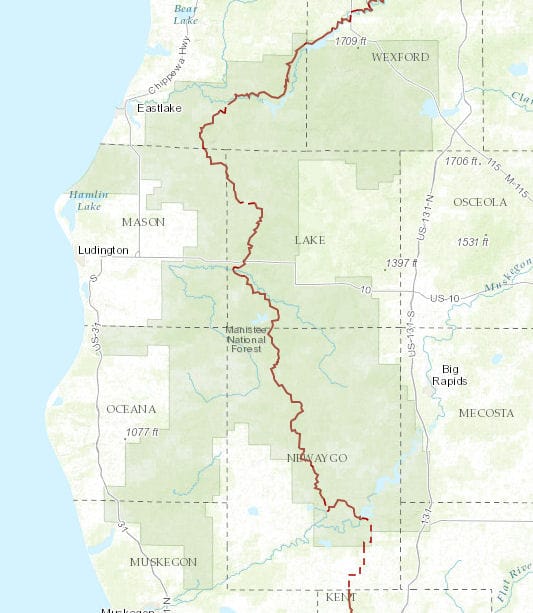
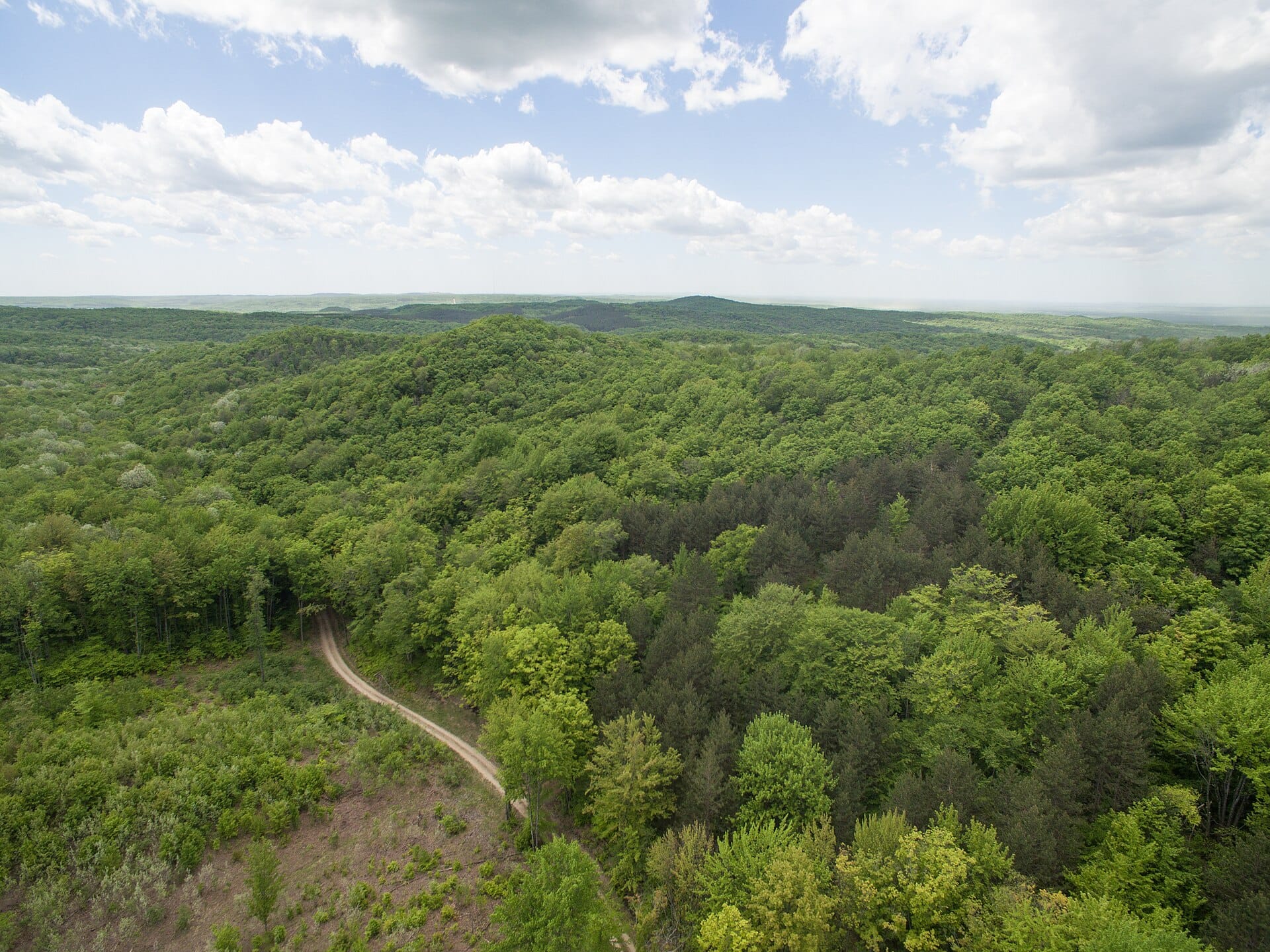
The geographic concentration of Michigan Dogman sightings is one of the most consistent features of the file, deserving more analytical attention than it typically receives. The encounters are not scattered randomly across the state, clustering instead with striking persistence in the northwestern quadrant of the Lower Peninsula, in the territory bounded roughly by Traverse City to the north, Manistee on the western shore, and the Muskegon River valley to the south, with Manistee National Forest at its centre. This is not the most populated part of Michigan, nor the most visited, but it is one of the most extensively forested, geographically isolated despite its proximity to the Great Lakes shore, sitting directly on the traditional territory of the Odawa bands whose headquarters remain in Manistee to this day.
The burial mound correlation running through the wider Dogman literature appears again in the Michigan material, though with less systematic documentation than in Wisconsin. The western shore of Lake Michigan from Sleeping Bear Dunes southward through the Manistee corridor contains a significant concentration of ancient burial and effigy mound sites associated with the Hopewell culture and its successors, the same pre-contact traditions producing the earthworks scattered through the Dogman sighting corridors of Wisconsin and Kentucky. Whether this correlation reflects genuine biological behaviour, spiritual territory, or the simpler fact that the most ancient and undisturbed land in the region tends to carry both mound sites and creature accounts is a question the file does not resolve, but that researchers have consistently found themselves unable to set aside.
The Manistee River itself runs through the heart of this territory, appearing in the accounts with a frequency going beyond coincidence. It was near the Manistee River, in the Garland Swamp at the edge of Wexford County, that the first documented encounter occurred in 1887, and along the Manistee corridor that the highest density of subsequent accounts has been recorded. The red-eyed creature reported near Holly, Michigan in 2008 extended the sighting geography southward while remaining within the broader Lower Peninsula pattern, and the geographic consistency of the reports across more than a century suggests something more structured than the random distribution of misidentifications across a large state.
A Century of Silence: The Pre-1987 Record
The argument for the Michigan Dogman as a genuine and longstanding phenomenon rather than a post-1987 cultural construction rests principally on the pre-contamination accounts, constituting as they do the evidentiary foundation on which everything else in the file is built. These accounts deserve the detail they are rarely given.
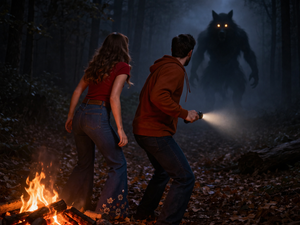
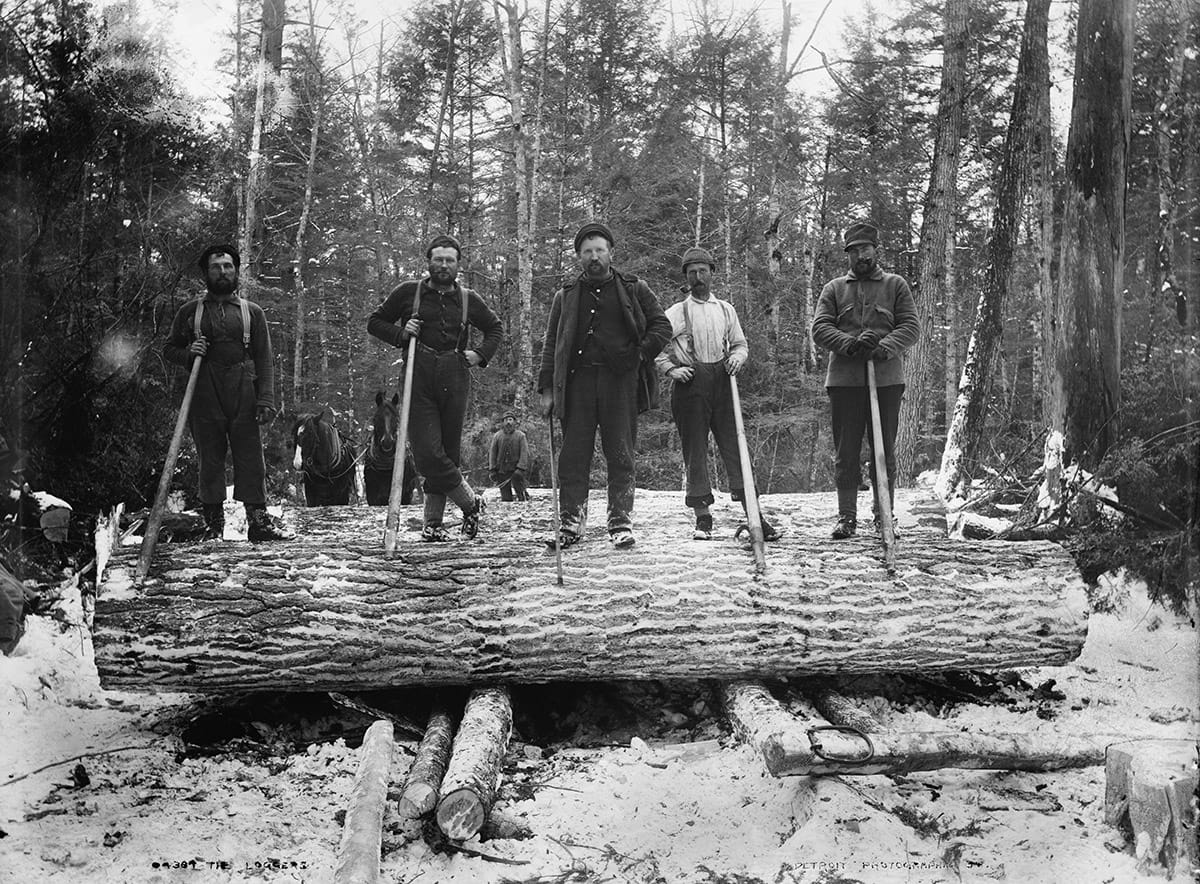
The 1887 Wexford County encounter is the earliest documented account, though it exists in a form shaped by its inclusion in Cook's song. Two lumberjacks working near the Garland Swamp encountered a creature they described as having a man's body and a dog's head, with eyes witnesses across the subsequent decades would consistently describe as either vivid blue or amber, its howl producing a sound they characterised as uncomfortably close to a human scream. By the accounts filtering through to researchers, the two men packed their camp and left the same night, telling almost no one what they had seen and not returning. This reaches us through an uncertain chain of transmission, and it is reasonable to note that Cook's song may have shaped the retrospective telling, though equally reasonable to note that the encounter itself predates the song by exactly a century.
The 1937 Paris, Michigan account sits on considerably more solid ground. Robert Fortney was a named individual who described being attacked by a pack of five wild dogs near Paris in Mecosta County, stating that one of the five walked on its hind legs in a manner inconsistent with any canine behaviour he had previously observed. This account was documented independently of the song, predating it by fifty years. Fortney did not describe what he saw in the context of any legend or cryptid tradition, reporting simply an encounter with a bipedal dog he could not account for within his existing understanding of the natural world.
Reports from Allegan County in the 1950s, together with accounts from Manistee and Cross Village in 1967, add further data points to the pre-song record. The Cross Village account is geographically significant: the village sits on the northern Lake Michigan shore in precisely the Odawa traditional territory at the heart of the wider sighting corridor, placing the creature in 1967, twenty years before the song, exactly where the indigenous tradition would expect it to be found. None of these accounts were connected to each other at the time they were made. There was no shared narrative, no cultural framework, no Dogman legend to explain what people were seeing, only a pattern of encounters in a consistent geographic area, occurring at consistent intervals, described in consistent terms by people with no knowledge of each other's experiences.
April 1st, 1987:How The Song Opened A Door
Cook's song, based on a mishmash of American folklore rather than any specific Michigan tradition, described a creature first seen in 1887 near the Manistee River, tracing its appearances through subsequent decades in years ending in seven. The ten year cycle was his invention, derived from the 1887 starting point and the simple arithmetic of building a legend spanning a century. He did not know, when he invented it, that accounts from the intervening decades actually existed. He found that out from his listeners.
What the song did, in practical terms, was to perform three functions simultaneously: giving a name to something that had been experienced but never publicly articulated, providing a geographic framework allowing people to locate their own experiences within a wider pattern, and creating a radio phenomenon compelling enough that WTCM-FM's switchboard was overwhelmed for days. Every person in northwestern Michigan who had ever seen something they could not explain suddenly had both a shared name for it and public evidence that others had experienced something similar.
The result was not simply a wave of new Dogman sightings in 1987. People began reporting encounters predating the broadcast by years or decades, describing having lived with their experiences privately because there was no mechanism for making them public and no guarantee of being taken seriously. Cook received more than a hundred reports in the years following, a significant proportion describing experiences from before the song aired. He updated "The Legend" in 1997 after a report of an unknown canine breaking into a cabin in Luther, Michigan, re-recording it in 2007 with a mandolin backing, adding verses for each new cycle year as the accounts kept accumulating. He has said he remains unsure what to believe, that the Dogman provides people with an avenue to explain what they could not explain for themselves, a framing that is sceptical without being dismissive, reflecting more careful engagement with the material than most commentators have managed.
- Ojibwe creation tradition describes Ma'iingan (the wolf) as the brother of Original Man, with the Creator's warning that whatever happens to one will happen to the other — a cosmological bond central to Anishinaabe spiritual practice in this territory for thousands of years
- First documented encounter: 1887, Wexford County, near the Garland Swamp. Two lumberjacks describe a seven-foot bipedal figure with a canine head, leaving camp the same night and not returning.
- Pre-1987 record includes Robert Fortney's 1937 Paris, Michigan account (named witness, bipedal dog in a pack), Allegan County accounts from the 1950s, Manistee and Cross Village accounts from 1967 — all predating Cook's song and uncontaminated by it
- April 1, 1987: Steve Cook broadcasts "The Legend" on WTCM-FM Traverse City as an April Fool's joke. Calls begin within the hour. The song becomes the most-requested track on the station for several weeks.
- Cook receives more than 100 reports over the following years, a significant proportion describing experiences predating the song from people who had never previously reported what they saw
- The ten year cycle, originally Cook's invention, was subsequently corroborated by independently documented pre-song accounts from 1937, 1967, and 1977
- The Gable Film, surfaced in 2007 as apparent found footage of a creature attack, was admitted as a deliberate hoax by creator Mike Agrusa, confirmed on MonsterQuest in March 2010
- Sightings cluster in the northwestern Lower Peninsula along the Manistee River corridor, in territory historically occupied by the Odawa and consistent with the burial mound distribution of the broader Dogman geographic pattern
- Next ten year cycle year: 2027
The Case Room: Key Post-1987 Accounts
The post-1987 accounts span more than three decades across the full geographic range of the northwestern Lower Peninsula corridor. The problem of cultural contamination applies to all of them to some degree, given that witnesses may have encountered Cook's song or the wider Michigan Dogman narrative before their own experiences, descriptions potentially shaped by prior knowledge. A subset, however, carries details specific and internally consistent enough to stand alongside the pre-contamination record as evidence worth examining seriously.
The 1993 Barn Encounter
In 1993 a teenage girl in northern Michigan, having slipped out of her house after dark, made her way to a barn on the property and found at the far end of the structure a large creature with a distinctly canine head, standing fully upright, looking directly at her. She described its eyes catching the available light in a way no animal she had previously encountered produced, its size in excess of anything she could have mistaken for a known species at the distance she was observing it. She ran immediately, did not return to the barn that night, and was initially reluctant to associate the encounter with any cryptid tradition, describing it simply as something she had never been able to explain.
Grand Haven, Ottawa County, 1993 to 1994
A cluster of reports from Grand Haven in Ottawa County, centred on a witness identified only as Ben, described three separate encounters with a bipedal canine creature over roughly a year, one occurring in December 1993 in the driveway of Ben's parents' home, the creature standing upright behind a parked car before fleeing when Ben began screaming. A separate account from the same area in 1994 involved a driver striking what he assumed was a deer, finding no body at the scene, only grey fur embedded in the front grille of his vehicle. Ottawa County lies somewhat south of the primary Manistee corridor, and the Grand Haven accounts extend the documented geographic range of the Michigan Dogman while maintaining the physical description characterising the wider record.
The Luther Cabin Incident, 1997
In 1997 a report reached Cook of an unknown canine breaking into a cabin in Luther, Michigan, unusual enough in its specifics — the size of the entry point, the nature of the damage, the tracks left behind — to prompt him to add a new verse to "The Legend" for the first time since its original recording. Luther sits in Lake County at the heart of the Manistee corridor, the incident occurring in the year the ten year cycle predicted a heightening of activity, an alignment Cook himself acknowledged he could not entirely dismiss.
The Ten Year Cycle: Data or Legend?
The ten year cycle is the detail most sceptical commentators dismiss first, understandably so, arriving as it did with the song, its neat arithmetic carrying the structure of folklore rather than field observation. Cook invented it as a narrative device and said so explicitly. The problem is that the independently documented pre-song accounts from 1937, 1967, and the general pattern of 1950s Allegan County reports and 1977 accounts fit the cycle he invented without having been created to fit it. Cook did not know about most of these accounts when he wrote the song, and the witnesses involved had no knowledge of each other or of any ten year pattern when they had their experiences.
The cycle, as it appears in the pre-song record, was not imposed on the data retrospectively. It was present in the data before anyone was looking for it, which is a structurally different situation from a legend generating its own confirming evidence after the fact. The most conservative reading holds that the pre-song accounts are too few and imprecisely dated to constitute genuine evidence of a cycle, the apparent fit with Cook's invented pattern being coincidence amplified by confirmation bias. The less conservative reading is that something in the territory of northwestern Michigan behaves differently in years ending in seven, for reasons no existing framework adequately explains, and that Cook accidentally identified a real pattern while inventing a fictional one.
The 2007 cycle year produced a cluster of reported encounters from across the Manistee corridor, with the 2017 year producing a further cluster documented by the North American Dogman Project and compiled through the testimony archive at Dogman Encounters Radio. The 2027 cycle year is approximately twelve months away from the date of this writing, giving researchers who take the cycle seriously a specific and falsifiable prediction to work with, and giving everyone else a reason to pay attention to what gets reported from the Manistee National Forest in the coming year.
The Gable Film: What Value In A Hoax?
In 2007, the same cycle year producing a cluster of witness accounts from the Manistee corridor, a digital copy of what appeared to be an 8mm home movie surfaced online under the name the Gable Film. Presented as found footage from the 1970s, it opened with ordinary domestic scenes — children on snowmobiles, a man chopping wood, a dog running in a yard — before shifting toward its end to a creature visible at the edge of a treeline: four-legged, dark-furred, moving in a way striking many viewers as inconsistent with any animal they could identify. The creature turns toward the camera. The footage ends abruptly.
The film spread rapidly through the cryptozoological community, taken seriously by a significant number of researchers before a second piece of footage appeared purporting to show the aftermath of the incident, with what appeared to be a police investigation at the scene. The two pieces together formed a compelling narrative appearing to provide the Michigan Dogman file with something it had never previously had: visual evidence of the creature itself, in the territory where it was most consistently reported, in a cycle year when accounts were already accumulating.
The Gable Film was a hoax. Its creator, Mike Agrusa, a fan of Cook's song, came forward before the MonsterQuest investigation that aired in 2010, admitting the entire production, explaining in detail how he had built the footage using vintage cameras and period-appropriate props to achieve the aesthetic of genuine 1970s home movie material, playing both the man with the axe and the creature himself. Linda Godfrey, examining the film carefully, confirmed the hoax. The MonsterQuest episode presented the revelation as a dramatic investigation, though Agrusa has noted that he told the production team the film was fake before filming began, and that the dramatic reveal was itself television stagecraft.
What is worth dwelling on is not the hoax itself, thoroughly documented as it is, but what it demonstrates about the evidential landscape of the Michigan Dogman file as a whole. Agrusa built a piece of footage deceiving a significant proportion of the researchers examining it, using a consumer budget and equipment he already owned, working alone, with no special effects beyond a costume and careful camera work, well enough that it required years of scrutiny and his own confession to establish its fraudulent nature. If an admitted hoax is that difficult to identify as such, the question of how many other pieces of footage in the broader cryptozoological record are similarly unconvincing hoaxes not yet admitted becomes considerably more uncomfortable than the simple story of a debunked film tends to suggest.
The Gable Film does not damage the Michigan Dogman case file, because the file was never built on visual footage. It was built on witness testimony, and the admission of a 2007 hoax does not retroactively explain what Robert Fortney described in 1937 or what the lumberjacks near the Garland Swamp encountered in 1887. What it does is remind everyone examining this material that the evidential standards required by the subject are genuinely demanding, that the testimony record, for all its imperfections, remains more substantial than the visual evidence record and should be treated accordingly.
Explanations & Theories
The standard sceptical account holds that Cook's song created a cultural template into which ambiguous wildlife encounters could be retrospectively fitted, apparent consistency across the witness record reflecting the influence of a shared narrative rather than a shared experience of any actual creature. This argument has genuine force for the post-1987 accounts. The northwestern Lower Peninsula has a recovering wolf population, large populations of coyotes and black bears, the kind of dense forest margin habitat in which large animals are most easily misidentified, together with a cultural framework established by Cook's song and amplified by decades of media coverage, providing ready-made descriptors for anyone having an unusual encounter with a large animal in poor light.
The argument runs into difficulty when applied to the pre-1987 record. Robert Fortney in 1937 had no cultural template. The Allegan County witnesses in the 1950s had no Dogman legend to draw on. The Cross Village accounts from 1967 predate the song by twenty years, describing in the Odawa traditional territory on the northern Lake Michigan shore exactly the kind of encounter that the older indigenous traditions of the same territory had been describing for generations. The consistency of description across accounts that could not have influenced each other is the strongest argument against the pure cultural construction hypothesis, and it is one the sceptical account has not fully answered.
The biological species hypothesis, holding that an unknown large bipedal canine inhabits the forests of northwestern Michigan as an undiscovered animal, faces the familiar problem afflicting every Dogman case file: a biological creature generating this volume of sightings over this time period in this geographic area should have left physical evidence, should have been photographed clearly, should have been struck by vehicles, should have left remains. The absence of such evidence is a genuine problem, though one applying equally to several other large animals whose existence was doubted until physical evidence eventually confirmed it.
The non-biological framework, which the most serious researchers have been increasingly willing to consider, holds that the Michigan Dogman belongs to the same category of entity the Ojibwe Ma'iingan tradition describes — a being whose relationship to physical space is not identical to that of an ordinary biological animal, whose appearances are territorially determined, whose consistent resistance to photographic confirmation and physical evidence recovery reflects something about its nature rather than simply the difficulty of locating a large animal in a large forest. This is not a framework admitting of easy proof or disproof, but it is one that the full breadth of the witness record pushes toward more insistently than any of the purely naturalistic alternatives.
Verdict
The Michigan Dogman is the most epistemologically complex case in the Dogman Files series because it is the only case in which a piece of deliberate cultural creation sits directly in the middle of the evidential record, requiring careful accounting before any assessment of the pre-existing tradition can be made. Once that accounting is done, what remains is a body of pre-contamination testimony describing, with the geographic and physical consistency that researchers in this field have learned to take seriously, a persistent entity in a specific territory, reported by people with no connection to each other and no access to any shared descriptive framework.
Cook stumbled his way to a legend that goes back to Native American times, as he himself described it. That stumbling was not random. He set out to invent a northern Michigan creature and found in the process that the territory he was writing about already had one — that the forests along the Manistee River were carrying the weight of a tradition the Odawa and Ojibwe had maintained for thousands of years, that the lumberjacks of 1887 had encountered without understanding, that Robert Fortney had encountered in 1937 with no framework to place it in, that an unknown number of people across the intervening decades had experienced and kept to themselves because there was no language available for what they had seen.
The song gave them the language. The language unlocked the accounts. The accounts, examined carefully with appropriate scepticism, reveal a pattern of encounter in a specific geographic territory predating the cultural phenomenon by at least a century, a pattern that the Ojibwe creation tradition, with its account of a wolf walking beside Original Man naming the world alongside him, suggests may predate even that.
The next cycle year is 2027. The Manistee National Forest is not getting any smaller, and the tradition it carries is not getting any lighter. Someone should be paying attention.
Primary Sources
- Cook, Steve. "The Legend." WTCM-FM, Traverse City, Michigan, first broadcast April 1, 1987. Original recording available at northamericandogmanproject.com
- Godfrey, Linda S. The Beast of Bray Road: Tailing Wisconsin's Werewolf. Prairie Oak Press, 2003. Contains comparative analysis of Michigan and Wisconsin Dogman accounts.
- Godfrey, Linda S. Real Wolfmen: True Encounters in Modern America. Tarcher/Penguin, 2012. Includes Michigan accounts and post-Gable Film analysis.
- Shimek, Bob. The Wolf Is My Brother: The Cultural, Spiritual, and Historic Relationship Between the Ojibwe Anishinaabe and Ma'iingan of the Great Lakes. White Earth Indian Reservation, 2014.
- MonsterQuest. "America's Wolfman." History Channel, Season 4 Finale, March 24, 2010. The Gable Film investigation and admission of hoax.
- Detroit Free Press. Interview with Steve Cook, 2011.
- North American Dogman Project witness database: northamericandogmanproject.com
- Dogman Encounters Radio archive: dogmanencounters.com
- Little River Band of Ottawa Indians. Cultural resources and territorial history: lrboi-nsn.gov
The Dogman Files — Case File Series
- Not a Werewolf: The Dogman Rabbit Hole — the full overview investigation
- Case File 01: The Beast of Bray Road
- Case File 02: The Land Between the Lakes
- Case File 03: April Fool — The Michigan Dogman — you are here
- Case File 04: Black Shuck and the British Canine Tradition — coming soon
- Case File 05: The Skinwalker Connection — coming soon