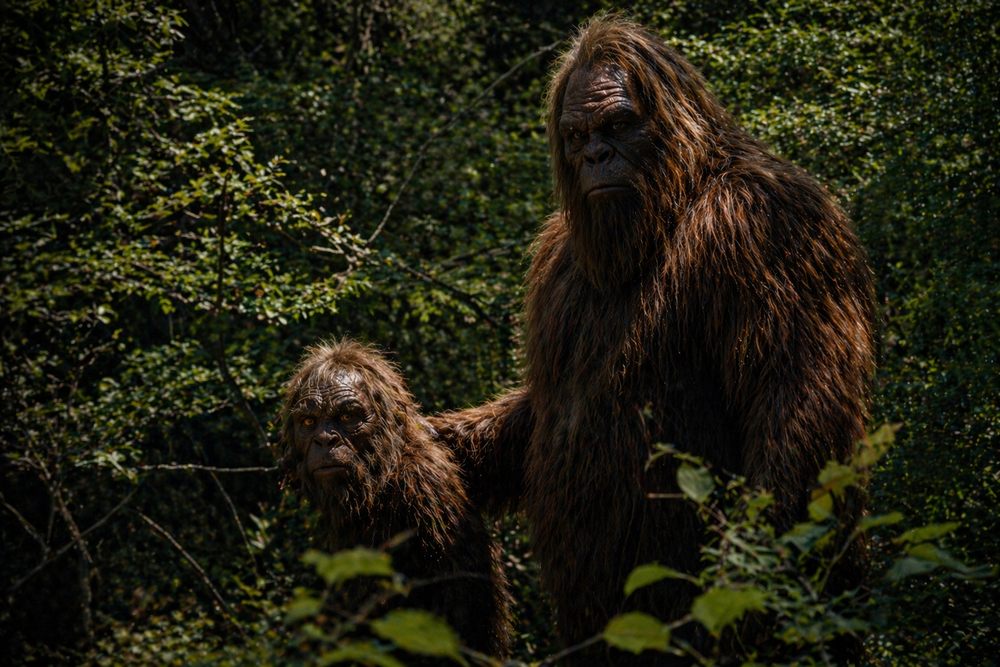
In June 2014, a fifteen-year-old boy camping with his uncle in a wooded region of southeastern Ontario experienced a perplexing incident involving purported Bigfoot beings. The boy fell from a tree, rendering him unconscious for an undetermined period. Upon regaining consciousness, he found himself face-to-face with a juvenile Sasquatch, reportedly appearing injured or cautious. Shortly thereafter, he observed a much larger, imposing creature nearby, which he described as an adult Bigfoot. The teen’s uncle, whom he was camping with, was not reported to have witnessed the event directly. The encounter took place in a remote, heavily forested area conducive to Sasquatch lore in the region. No physical evidence was recovered at the scene, and the boy’s account was submitted several years after the fact.
The witness provided detailed descriptions of both creatures, depicting the juvenile as smaller, somewhat human-like but covered in dark hair, with expressive eyes and a curious demeanour. In contrast, the adult Sasquatch was reported as towering, broad-shouldered, and more formidable, resembling many traditional Bigfoot reports that feature large, upright, apelike hominids. The boy’s initial fall and injury might have rendered him vulnerable, prompting the juvenile to approach cautiously. His uncle’s absence from the experience introduces an element of lone testimony, although the boy’s consistency in recounting the event lends some credibility. Critics point to the lack of corroborative physical proof or photographic evidence, yet the setting aligns well with numerous Canadian Bigfoot encounters in terms of geography and timing.
Southeastern Ontario is not an uncommon location for Sasquatch sightings, contributing to a broader pattern of reports in Ontario and neighbouring regions such as Quebec and the northern United States. The Canadian folklore around Sasquatch has deep roots, featuring in Indigenous oral histories and more recent encounters documented since the 20th century. Juvenile Sasquatch sightings are rarer but have been noted in a few other cases, suggesting a socially structured species if genuine. This encounter adds to the ongoing debate over Bigfoot’s existence, influenced by factors like remote forest habitats, elusive behaviour, and potential interactions with humans. While scientific consensus remains sceptical, the Ontario report fits a recognisable narrative pattern of Sasquatch behaviour involving curiosity towards injured or incapacitated humans, occasionally followed by observation of larger, protective adults.
Source: Phantoms and Monsters